
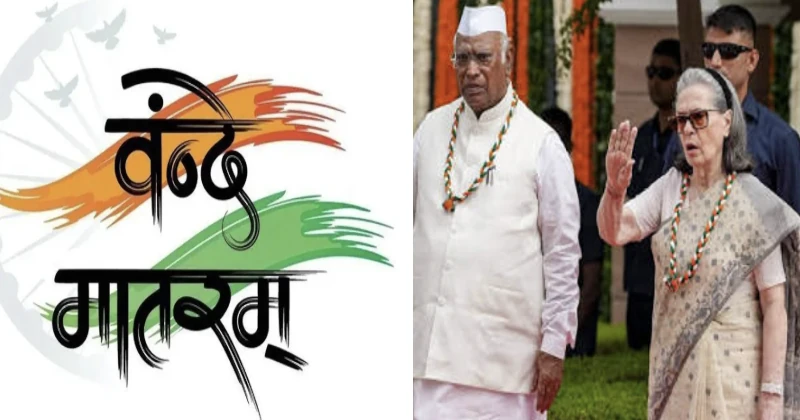
The British once feared the call of “Vande Mataram”, but on Independence Day 2026, the Congress leadership looked visibly uncomfortable at the very same eternal slogan. In New Delhi at Congress party headquarters, the viral videos showed Sonia Gandhi, Mallikarjun Kharge and Rahul Gandhi chatting and gesticulating even as the full version rendition of Vande Mataram was still on, and what should have been a moment of solemn remembrance ended up as one more example of the Congress’s uneasy relationship with India’s national and civilisational symbols.
The Delhi episode is not a solitary controversy, because in Kerala the Congress government deliberately excluded “Vande Mataram” from its official Independence Day programme, despite the Union government’s direction to render the entire song. Earlier, the song sparked controversy at the inaugural session of the Kerala Assembly. A state minister had publicly announced that he would not sing the full composition. At the same time, Congress MP Imran Masood later said that he would stand up in respect but would not sing the song. An Indore Congress corporator had earlier made a similar statement, thereby strengthening the perception that Congress party’s discomfort with “Vande Mataram” is not a one‑off incident but a political reflex.
Every citizen is entitled to their personal beliefs and constitutional freedoms. No faith should be ridiculed, but a national party like Congress cannot wash its hands of the political culture it endorses because when protests against a national symbol consistently attract more anxiety than the sentiment of the millions who revere it, the pattern can no longer be attributed to mere coincidence, and Delhi, Kerala and Indore together reveal a Congress reflex: encourage every dissent against cultural nationalism and then claim that those who want to protect national memory are polarising.
This is the distortion that Congress has inflicted on secularism because real Indian secularism respects every path but doesn’t impose civilisational amnesia. Vande Mataram doesn’t ask any Indian to desert their faith but asks the citizen to salute the motherland that belongs to all. While Congress has repeatedly transformed cultural self‑confidence into a communal question, and its selective secularism expects India’s majority civilisation to apologise for its own vocabulary and sees politically useful defiance of national symbols as sensitivity.
The contradiction is historical, as the song, composed by Bankim Chandra Chatterjee and later embedded in Anandamath, was sung by Rabindranath Tagore at the 1896 Congress session, soon became the battle cry of the Swadeshi movement, and revolutionaries faced colonial oppression with Vande Mataram on their lips. Yet in 1937, the Congress Working Committee restricted official rendition to the opening stanzas after objections to religious imagery in the later verses. But Congress did not ban the song; instead, it began a political tradition of surrendering to organised pressure on how much of India’s civilisational expression could be regarded as legitimate.
This tradition of embarrassment has continued: first dilution, then embarrassment over the full version and now denial every time the public conduct outrages. Congress uses the names of Gandhi, Nehru and Patel to claim its ownership of the national movement. Still, history cannot be selectively inherited, and a political party cannot claim the sacrifices made under the banner of “Vande Mataram” while still appearing apologetic about the song; therefore, the Congress of today, born out of dynastic entitlement and selective memory, has travelled far away from the patriotic energies it claims to represent.
The deeper reason for Congress’s abiding discomfort with Vande Mataram lies in the Congress party’s post-Independence ideological and political trajectory. The early national movement had the strength to encompass cultural patriotism, spiritual vocabulary and political modernity within a common struggle. As Congress grew increasingly embedded in a derivative secularism, it came to regard explicit civilisational references as intrinsically questionable. Vande Mataram defies that framework because it imagines India not as an administrative entity inherited in 1947, but as a living motherland shaped by landscape, memory, sacrifice and sacred belonging, and its later stanzas invoke Durga and Lakshmi, an imagery that Congress fears may disquiet the electoral coalitions so laboriously built up through minority appeasement, which makes the song so dangerous because it reveals the central flaw of Congress ideology – its inability to separate reverence for civilisation from hatred of another faith, and it also unsettles the party’s carefully built proprietorship of the freedom struggle.
“Vande Mataram” is a tribute to the Swadeshi activists, revolutionaries and cultural nationalists whose role in history cannot be conveniently buried under a Nehru‑Gandhi family narrative; therefore, Congress’s discomfort is both ideological and political.
Prime Minister Narendra Modi’s government has been emphasising cultural confidence within the constitutional framework. While the commemoration of 150 years of Vande Mataram restored the composition to its rightful place in public memory, but more decisively, the Prevention of Insults to National Honour (Amendment) Act, 2026, which was passed by both houses of Parliament in monsoon session and received presidential assent on 11 August 2026, extended Section 3 of the 1971 Act to the National Song, thereby placing its statutory protection at par with the protection already extended to the National Anthem.
The law is very specific: it does not mandate anyone to sing Vande Mataram; it merely punishes anyone who deliberately prevents the singing of Vande Mataram or disturbs an assembly engaged in its singing, with punishment being imprisonment of up to three years, a fine, or both. Thus, the Modi government has corrected a long‑standing statutory anomaly, but Congress leaders continue to articulate diffidence, qualification and discomfiture around the same national legacy.
Congress, therefore, owes an unconditional apology not to the BJP but to India, to Bankim Chandra Chatterjee, to the revolutionaries who fought against colonial might, and to every citizen who treats Vande Mataram as a phrase of national appreciation; while political parties may come and go, dynasties may conjure up alibis, and ideologies may try to obscure memory, the salutation to the motherland cannot be suspended, negotiated or effaced, and if Congress remains silent now, it will only demonstrate that the issue is not about protocol but a deeper ideological unease with Bharat itself, so Congress must say sorry because India will never be sorry for singing Vande Mataram.