There is something profoundly powerful about an angry young Bharat. It means that the young have expectations, aspirations and a belief that their country can do better. But there is also a danger: when youthful anger loses its original purpose, it can become someone else’s political instrument.
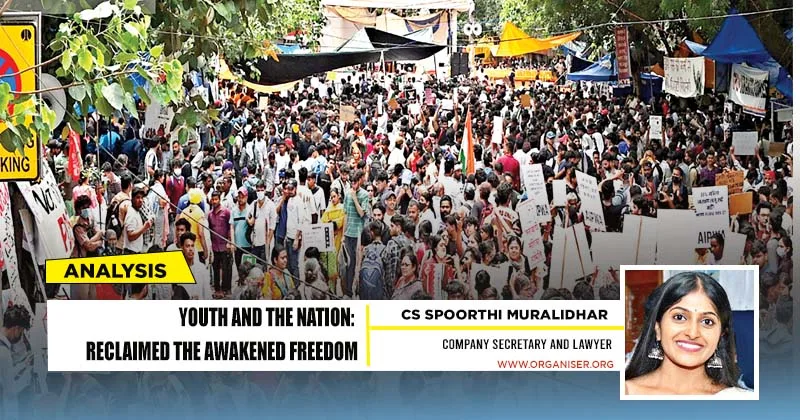
The recent mobilisation around NEET and examination irregularities deserves serious attention. Students have every right to demand accountability. But when a legitimate grievance begins to absorb unrelated political slogans, personalities and ideological causes, young Bharatiyas must pause and understand how quickly a genuine grievance can be amplified, repackaged and expanded in the digital age.
The initial anger over examination irregularities and NEET was neither frivolous nor illegitimate. For millions of young Bharatiyas, competitive examinations represent years of sacrifice and the hope of social mobility. A paper leak or institutional failure is therefore not merely an administrative lapse; it can feel like a betrayal of a generation. Student protests therefore shape how seriously institutions take the education system.
When Grievance Becomes Politics
When does a legitimate student grievance stop being about the student? As the mobilisation expanded from examination-related concerns into a larger political campaign, demonstrations at Jantar Mantar and around Parliament began carrying messages far beyond the original issue. The issue is not whether a citizen is entitled to hold such political views. In a democracy, dissent is legitimate. The question is different: Why should a movement born from an examination grievance suddenly become a vehicle for an entirely different ideological vocabulary?
There is another dimension that Bharat must learn to recognise: the politics of the algorithm. The youth of today do not merely consume politics; they encounter it through reels, memes, short videos, influencers and recommendation engines. A grievance that once took months to become a movement can now become a national narrative in hours. CJP demonstrated precisely how powerful that ecosystem can be. Its rapid digital growth was not an ordinary political phenomenon.
This does not automatically prove that an invisible hand created the movement. Nor should every spontaneous youth movement be reduced to conspiracy. But it should make us ask a more sophisticated question: Who benefits when legitimate dissatisfaction is continuously amplified, simplified and redirected towards political polarisation?
In the digital age, youth mobilisation has become a new form of political power. Bharat must therefore learn not merely how to respond to protests, but how to understand the ecosystem in which they emerge. For that, perhaps we need to return to our own civilisational vocabulary.
Bharat has never understood the individual as an isolated consumer of rights. The individual exists within concentric circles of responsibility — to the self, family, society, nature and the larger Rashtra. This is the meaning of Swa.
Swa is not narrow self-interest. It is self-awareness: knowing who we are, where we come from and what responsibilities arise from that inheritance. And Rashtra is not simply a piece of territory administered by a government. It is a living civilisational community sustained through shared memory, institutions, duties and aspirations. That is why the Bharatiya civilisational idea of inclusiveness is so important.
The Bharatiya youth must learn to distinguish between awakening and agitation. Awakening asks: What is true? Agitation asks: Whom should I oppose? Awakening asks: What can I contribute?
The Maha Upanishad gives us the famous ideal of Vasudhaiva Kutumbakam — the world is one family. It is a profoundly inclusive idea. It does not ask us to erase our identity to embrace others. It asks us to develop an identity expansive enough to accommodate others. The Rigvedic call of Sangachhadhvam, Samvadadhvam — to move together and deliberate together—captures another essential principle: society advances through dialogue, participation and shared purpose. This is precisely where the modern politics of permanent outrage can become dangerous.
A society constantly divided into “us” and “them” becomes incapable of collective action. A generation taught to see every institution only as an enemy may become excellent at protesting but poor at building. And Bharat does not need a generation that merely knows how to protest. Bharat needs a generation that knows how to build.
From Agitation to Awakening
The Bharatiya youth must learn to distinguish between awakening and agitation. Awakening asks: What is true? Agitation asks: Whom should I oppose? Awakening asks: What can I contribute? Agitation asks: Whom can I blame? Awakening builds institutions. Agitation can destroy trust in institutions without necessarily creating anything better.
But constitutional dissent and civilisational responsibility need not be enemies. Indeed, they must reinforce each other. Bharat’s youth should be the most demanding citizens of the Republic — but also its most constructive citizens. This is not an argument against protest. A democracy needs dissent. Governments must be questioned. Institutions must be accountable. Examination systems must be fair. Young people must demand jobs, opportunity, transparency and justice.
When a genuine student grievance over examination irregularities arises, the breakdown of institutional trust creates a vacuum that is rapidly filled by external interests. This dynamic need not be explained through mysterious ‘invisible hands’; it can also be understood through documented mechanisms such as engagement-heavy recommendation algorithms, coordinated astroturfing campaigns and organised political factions that amplify outrage. When a protest at Parliament moves from demanding exam transparency to incorporating unrelated ideological charters, it reflects a tangible transition where original student organisers are sidelined by well-funded digital ecosystems. Recognising this shift does not mean dismissing youth anger as manufactured; rather, it highlights how systemic institutional delays and lack of initial transparency directly enable political opportunism.
At the same time, framing youth action as a rigid choice between destructive agitation and constructive building creates a false dichotomy. Systemic reform rarely occurs through quiet civic duty alone; historical precedent shows that disruptive protest is often the necessary catalyst that forces non-responsive institutions to the negotiating table. The responsibility for maintaining democratic health cannot rest solely on young citizens exercising restraint. True resolution requires university-level algorithmic literacy programmes, clear accountability from examination boards, and an active synthesis of constitutional rights with civic responsibility.
The Power of an Awakened Youth
Ultimately, transforming youth energy into long-term institutional reform requires treating young citizens as critical agents rather than passive targets of influence. “By anchoring democratic dissent within both constitutional rights and responsibilities — including the Fundamental Duties outlined in Article 51A — and a shared commitment to building durable institutions, dissent and nation-building reinforce one another. When students combine rigorous media literacy with structured advocacy, they ensure that their genuine demands for justice drive systemic accountability rather than political polarisation.
The challenge before Bharat is bigger. The deeper challenge is whether a generation possessing unprecedented connectivity will develop an equally unprecedented capacity for discernment. Because the most powerful weapon of the digital age is not propaganda. It is attention. Whoever captures the attention of millions of young Bharatiyas can influence what they fear, whom they distrust, what they believe and ultimately what they choose to build. But there is an even greater answer to such influence — an awakened citizen.

A young Bharatiya who checks before forwarding.Who reads before believing. Who questions both government and opposition.Who refuses to be manipulated by rage. Who can disagree without hating. Who can protest without dehumanising.Who can defend the nation without denying its imperfections. And who understands that democracy is not merely the right to demand — it is also the responsibility to contribute.
This is where Swa becomes Rashtra. When a young Bharatiya discovers his or her own strength, knowledge, character and responsibility, that Swa becomes an instrument of national renewal. The choice before Bharat’s youth is therefore not between silence and protest. It is between being mobilised and becoming awakened. Bharat’s young people must open their eyes — not to stop questioning their country, but to question those who seek to use their questions for purposes larger than the grievance that brought them to the street.
Swami Vivekananda believed that a handful of courageous, dedicated young people could transform Bharat. That faith deserves to be reclaimed. The youth of Bharat must not become foot soldiers of anyone’s manufactured outrage — whether political, ideological or algorithmic. They must become architects of Bharat’s future. Arise. Awake. Think. Question. Build. And let the extraordinary energy of Bharat’s youth belong, first and foremost, to Bharat.