On issues such as human rights, freedom of expression, environmental protection, climate change, sustainable development, and nuclear non-proliferation, the Western world has long presented itself as a global custodian of moral values. Yet, when these very ideals are tested against its own political and social conduct, the double standards underlying this claimed moral superiority have repeatedly come to the fore. Ironically, this contradiction is no longer confined to foreign policy or global geopolitics. The growing ideological convergence between left-liberal thought and radical jihadist politics in Western societies is shaping how values such as freedom, pluralism, secularism, religious liberty, and inclusivity are interpreted. The very America that for decades presented freedom of expression as the soul of its democracy and the right to dissent as a defining feature of its civilisational identity now appears to be witnessing a situation where the acceptability of an idea, organisation, or individual is increasingly determined by whether it conforms to, or challenges, the prevailing ideological narrative.
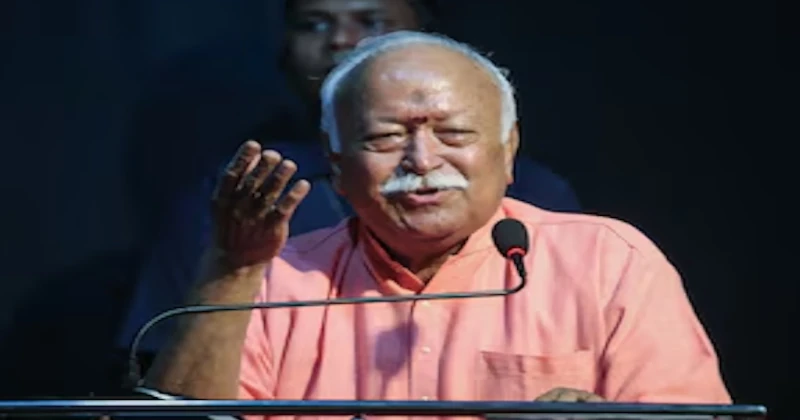
The opposition to the address of RSS Sarsanghchalak Dr Mohan Bhagwat Ji at an event in New York, organised to promote interfaith dialogue, peaceful coexistence and the message of universal oneness, is a telling example of the changing Western discourse. The question is not merely why Dr Bhagwat’s programme was opposed. The larger question is this: in societies that have long projected themselves as the foremost champions of freedom of expression and pluralism, who decides the limits of the right to dissent – and on what basis?
This question found a direct manifestation at the ‘Universal Oneness Celebration’, held at Madison Square Garden, New York, on August 29, 2026. The programme’s stated objective was to promote dialogue and unity among diverse religious and cultural communities and to advance the civilisational ideal of Vasudhaiva Kutumbakam, the world as one family. The American Hindus for Engagement and Dialogue (AHEAD) organised the event, with support from various Hindu-American organisations. According to reports, nearly 6,000 delegates from 29 countries, representing around 29 US states and 850 cities, participated in the gathering. The event also reportedly received the support of more than 250 Hindu-American organisations.
Yet, despite an event centred on dialogue, unity and coexistence, New York Mayor Zohran Mamdani publicly opposed it, while 61 organisations called for its cancellation. The programme ultimately went ahead and successfully fulfilled its stated objective. But it left behind a fundamental democratic question: Can a society that claims to uphold freedom of expression and pluralism declare a speaker and his organisation ‘exclusionary’ without even listening to what he has to say? And can such pre-judgement genuinely be reconciled with the liberal democratic tradition that the West, and the United States in particular, has long projected as a global standard?
The scale of the opposition makes it difficult to dismiss it as merely an individual objection or a spontaneous, knee-jerk reaction. The campaign involving 61 organisations brought together a range of religious and civil rights groups on a common platform. Among them, Hindus for Human Rights (HfHR) was particularly active. Its Executive Director, Sunita Viswanath, said her organisation was among the 61 interfaith and secular organisations that issued an open letter opposing the event. What merits attention is that, while the organisation represented by Sunita Viswanath is ostensibly dedicated to Hindu society and its concerns, both the organisation and Viswanath herself have long been active in vocal international campaigns critical of India, Hindutva, and the Rashtriya Swayamsevak Sangh. It appears that even the organisation’s name projects a particular message to the world: that significant opposition to the Sangh and its ideology exists within the Hindu community itself. Hindus for Human Rights was founded in 2019 and describes itself as an organisation working for human rights, civil rights, and religious pluralism.
Yet its public campaigns reveal a consistent pattern of sharp criticism of India’s policies, Hindutva, and the elected Union Government. Its active involvement in campaigns and discourses around the Citizenship Amendment Act (CAA), the ‘Howdy Modi’ event and ‘Dismantling Global Hindutva’ has made it a prominent voice within international networks critical of India and Hindutva. The role of such organisations in taking critical narratives about India to international platforms matters because the terminology, allegations, and formulations they use often later enter media narratives, political discourse, and policy debates. An important reference point in this context is Viswanath’s political activism during Rahul Gandhi’s visit to the United States.
In 2023, photographs from Rahul Gandhi’s think-tank interaction in Washington, DC, showed her alongside him. The association became a subject of political controversy in India, with questions being raised publicly about her ideological background and her links with Rahul Gandhi. It is important to clarify that a photograph of an activist with a political leader, by itself, does not establish that her views are either right or wrong. However, when an individual has spent years actively shaping and spreading a particular critical narrative about India on international platforms, and then assumes a prominent role in opposing an event in line with that ideological position, an independent examination of her arguments, affiliations, and wider network becomes entirely legitimate. This is precisely where Dr Mohan Ji Bhagwat’s message from New York needs to be placed in perspective. On a platform where he spoke of ‘the oneness of existence’ as a fundamental truth of humanity, emphasised acceptance and respect for diversity, and called for connecting that diversity with a deeper sense of oneness, the tendency to declare a speaker ‘exclusionary’ or unacceptable without first hearing what he actually has to say raises a serious question in itself. If dialogue, coexistence and respect for diversity are indeed the foundations of pluralism, then why should the right to be heard become conditional upon conformity with a particular ideological narrative?
This chain of opposition is not confined to Sunita Viswanath alone. A look at the list of 61 organisations that came out against Dr Mohan Ji Bhagwat’s New York programme includes, alongside Hindus for Human Rights, organisations such as the Indian American Muslim Council (IAMC), Justice for All, and the Interfaith Centre of New York, among several other religious, civil rights and activist organisations. When you view the backgrounds and past campaigns of these organisations together, an important pattern emerges. In the case of IAMC, this pattern is particularly evident. The organisation and its current head, Mohammed Jawad, have for years been engaged in international campaigns concerning Hindutva, the RSS and the Modi Government. At the same time, their position on Gaza and Israel has also been particularly vocal. During the Gaza war in 2023, IAMC called upon American city councils to demand an immediate ceasefire and used strong language in its statements regarding Israel’s occupation and the situation in the Palestinian territories. When viewed in its entirety, this pattern of opposition raises a natural question: does its political activism on India and Israel operate within a similar ideological framework, and to what extent do ideological and political compulsions, along with an Islamic orientation or religious radicalism, shape its critical positions on India and Israel?
The third name in this chain of opposition is Abdul Malik Mujahid, President of Justice for All. Mujahid has also been associated for years with Muslim activism and interfaith activities in the United States. His organisation’s current campaigns have levelled extremely serious allegations against Israel over Palestine. In June 2026, the title of one of its reports itself read: “Palestine: Apartheid Fuels Genocide.” Various materials and campaigns disseminated by the organisation have prominently featured controversial campaigns such as “Save India from Fascism” and “Kashmir Action.” Viewed together, these facts suggest that its activism on issues concerning India and Israel is not limited to one or two isolated reactions, but forms part of a structured ideological position sustained over several years.
Another important layer of this ecosystem appears in American discourse on religious freedom. On August 26, Asif Mahmood, the Pakistani-origin Chair of the US Commission on International Religious Freedom (USCIRF), made serious allegations against India and the Rashtriya Swayamsevak Sangh in the context of Dr Mohan Ji Bhagwat’s visit to the United States and supported calls for restrictive action against individuals associated with the RSS. Earlier statements and hearings of the Commission concerning India have also brought issues such as the CAA, NRC, Jammu and Kashmir, Umar Khalid and Sharjeel Imam into the discourse on religious freedom.
New York Mayor Zohran Mamdani, too, is known for his pro-Palestinian position and for his strongly critical rhetoric concerning Israel, India, Jews and Sanatan traditions. This is not the first occasion on which he has opposed RSS Sarsanghchalak Dr Mohan Bhagwat under the influence of what appears to be a particular religious-ideological worldview.
On several earlier occasions, too, he has expressed positions that have raised serious questions about his ideological outlook. He went so far as to describe the elected and popular Prime Minister of a sovereign nation, Narendra Modi, as a “war criminal.” Moreover, during Prime Minister Modi’s visit to the United States in 2023, Mamdani joined other South Asian elected representatives in issuing a joint statement opposing his visit and strongly criticised the Government of India over the Citizenship Amendment Act (CAA) and the abrogation of Article 370 in Jammu and Kashmir. He has also issued statements in support of Umar Khalid, who is in jail under the UAPA; accused the BJP of provoking riots over the spontaneous demolition of the disputed structure; called for the arrest of Benjamin Netanyahu; refrained from describing organisations such as Hamas as terrorist organisations; and refused to condemn slogans such as “Globalise the Intifada”, which are widely used by pro-Palestinian protesters in the context of the Israeli-Palestinian conflict. Taken together, these positions present Mamdani less as a neutral elected mayor of a sovereign country and more as a politician whose ideological and religious positioning raises serious questions about his impartiality and neutrality.
The issues and contexts may differ, but this selective critical narrative about India does not appear confined to activist groups. Its influence is also visible in American institutional and policy discourse. When New York’s local politics, activist organisations, India-focused Muslim and human rights groups, and religious-freedom institutions are viewed together, an ideological ecosystem emerges in which arguments, allegations, and narratives from different platforms often reinforce one another. An allegation made on one platform becomes a reference point on another; the second platform lends it legitimacy; and eventually, the same allegation begins to be presented in public discourse as a fact. Therefore, while it is essential to examine the narratives being constructed about India and its Sanatan civilisational ethos, it is equally important to understand the ideological forces operating behind these narratives, their global interconnections, and the campaign-based alliances that emerge among them.
But the visit of RSS Sarsanghchalak Dr Mohan Bhagwat Ji during the centenary year of the Rashtriya Swayamsevak Sangh also brings to light other important dimensions and conclusions. The most important is that the final assessment of any individual, organisation, or ideology should not be based on narratives constructed against it. Still, on its own words, ideas and conduct – and it should be judged on that basis. Viewed through this very lens, Dr Bhagwat’s address in New York presents a very different picture. Speaking of the idea that “diversity is natural and unity is truth,” he described diversity not as a cause of conflict but as a natural expression of human life. He placed “the oneness of existence” at the foundation of his worldview. He spoke of human excellence not in terms of establishing dominance over others, but in terms of exercising discernment between right and wrong and recognising one’s responsibility towards the entire world. He also made it clear that unity does not require uniformity and that the true message of India’s civilisational worldview must reach the world not merely through preaching, but through conduct. This spirit is reflected in the Indian civilisational idea of Vasudhaiva Kutumbakam, which has always believed not in erasing differences, but in accepting them while experiencing a larger sense of human oneness.
The ‘One World: One Humanity’ Call to Action by religious leaders in New York on August 29, in the presence of the Sarsanghchalak Ji, similarly called upon communities to begin with themselves, resist hatred and dehumanisation, stand with another community in times of crisis, build relationships of dialogue and cooperation before tragedy strikes, and work together in service of humanity. Viewed together, these two developments raise an important question: if pluralism means accepting the coexistence of diverse faiths and ideas, how can the tendency to declare a speaker ‘exclusionary’ without even hearing his actual words be reconciled with that ideal?
Democracy guarantees the right to dissent, but the real test of pluralism lies not in tolerating agreement, but in accommodating disagreement. In the centenary year of the Sangh, Dr Bhagwat’s message from New York assumes particular significance because it was not merely a response to an immediate political controversy; it was a global articulation of India’s enduring civilisational vision, in which diversity is natural, unity is truth, and humanity carries a shared responsibility towards the world.
If the West continues to project itself as a global standard-bearer of pluralism, freedom and human rights, it must also examine itself against the same standards and ask how effectively it protects not only the freedom of those who agree with the prevailing narrative, but also the freedom of those who challenge it. For ultimately, the openness of a society is not measured by how freely it allows people like itself to speak, but by how willing it is to let those who disagree with it be heard – without fear, prejudice or pre-judgement. That is the real meaning of democracy; that is the true test of pluralism; and perhaps, that is the message India has placed before the world from New York in the centenary year of the Sangh. The liberalism and maturity of American and other Western democracies could perhaps also be judged by their ability to recognise and identify the Left-Jihadi nexus that has emerged in their respective societies in recent years, and to place effective democratic checks on it through a healthy, free and impartial democratic process.