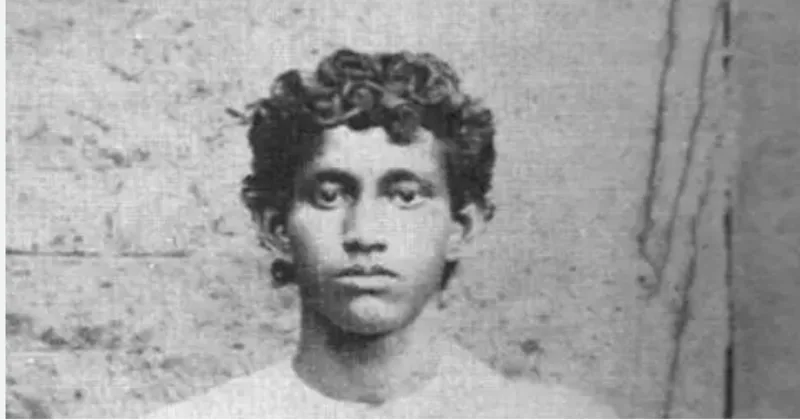
The term Gen Z has become almost unavoidable in contemporary public discourse. From social media to television debates and newspaper columns, we encounter it almost every day. A generation born into the digital age, Gen Z is now increasingly visible not merely as a consumer of technology and popular culture, but also as a political and social force. The recent emergence of what has been described as a “Gen Z protest” has added another dimension to the discussion. It has prompted questions about the political consciousness and social responsibilities of young people. But perhaps the question should not be whether today’s Gen Z is good or bad. That would be an unfair judgment of an entire generation. The more important question is: Where is the immense energy of India’s youth being directed?
This question becomes especially significant on August 11, the martyrdom day of Khudiram Bose. Khudiram was barely eighteen when he walked towards the gallows under British rule. He did not belong to an age of smartphones, instant communication or globalised opportunities. Yet he possessed something that remains timeless; a profound sense of purpose. For him, Bharat was not merely a geographical territory. It was a sacred motherland for which personal comfort and even life itself could be sacrificed. More than a century later, Bharat is free. The responsibilities of its youth have therefore changed. Today’s young Indians are not being asked to fight a colonial government. They are being asked to build a stronger, more prosperous, more just and more confident Bharat.
And in this task, Gen Z has enormous strengths. It is perhaps the most connected generation in human history. Young Indians today have unprecedented access to knowledge. They can learn from universities around the world, access books and lectures within seconds, develop businesses through digital platforms and communicate their ideas to millions without depending upon traditional institutions.
Indian Gen Z is also entrepreneurial. Young people are increasingly willing to experiment, create startups, pursue unconventional careers and challenge established professional structures. They are more comfortable discussing mental well-being, social inequality, gender, environment and other issues that earlier generations sometimes avoided. They are also socially conscious. A young Indian today can witness an injustice in one corner of the country and immediately raise a voice about it. Digital platforms have democratised public expression and allowed ordinary citizens to participate in conversations that were once restricted to political and intellectual elites. There is, therefore, much to admire in Gen Z.
But every strength can become a weakness when it lacks direction. The same digital connectivity that gives young people access to knowledge also exposes them to misinformation. The same social media that allows them to speak against injustice can also turn outrage into entertainment. The same political awareness that encourages questioning can sometimes be exploited by those who deliberately manufacture anger, deepen social divisions and weaken faith in the institutions and ideas that hold a nation together. Youthful rebellion is not a problem. Directionless rebellion is. Bharat should never ask its young people to stop questioning. A healthy democracy needs young citizens who ask difficult questions, challenge governments and demand accountability. But questioning must be accompanied by knowledge, and protest must be accompanied by responsibility.
The youth must learn to distinguish between criticising the country and rejecting the country. There is nothing unpatriotic about saying that India must improve. Indeed, genuine patriotism demands that we confront poverty, corruption, injustice, discrimination and institutional failures. But there is a fundamental difference between wanting to reform one’s country and being persuaded that one’s country itself is the problem. This distinction matters because young minds are naturally idealistic. Their anger against injustice can be powerful and morally valuable. But that very idealism can also make them vulnerable to those who seek to manipulate their emotions for political or ideological purposes.
The antidote is not censorship of youth. It is greater intellectual independence among youth. And this is where our history matters. Khudiram Bose should not be remembered merely as a young revolutionary whose photograph is garlanded every year. His life should make today’s youth ask themselves a more difficult question: What is the larger purpose to which I am willing to dedicate my energy? Khudiram’s generation had a dream of political freedom. Today’s generation has inherited that freedom. Its challenge is to transform freedom into Viksit Bharat 2047.
If Khudiram fought against colonial domination, today’s youth must fight ignorance, poverty, corruption, social prejudice and technological backwardness. If his generation dreamed of an independent Bharat, today’s generation must work towards a Bharat that is educated, innovative, prosperous, secure and culturally confident. This does not require Gen Z to become a replica of the youth of the freedom struggle. Times have changed, and India needs new forms of courage.
A young citizen who refuses to be manipulated by hatred, misinformation or forces seeking to divide society is also serving the nation. Perhaps this is the real lesson of Khudiram Bose for Gen Z. The goal is not merely to be rebellious. The goal is to be useful to the nation.
Swami Vivekananda, after his journey in the West, described India as a Punya Bhoomi, a sacred land. Such an understanding of Bharat creates a different conception of citizenship. The nation is not simply an administrative territory; it is a civilisational inheritance passed from one generation to another. The youth therefore inherit not only rights but responsibilities. They inherit the freedom won by previous generations. They inherit a civilisation that has survived centuries of upheaval. They inherit institutions built after independence. And they inherit the responsibility of passing this inheritance to the next generation in a stronger condition than they received it.
Gen Z has the talent and energy to do exactly that. It does not need to abandon its questioning spirit. It needs to combine that spirit with historical awareness. It does not need to reject modernity. It needs to use modernity creatively. It does not need to become silent. It needs to become more thoughtful in its speech. Most importantly, it needs heroes who inspire construction rather than destruction.
The algorithms of social media will constantly offer new influencers, celebrities and political provocateurs. But a civilisation cannot build its future on influencers alone. Its youth must also look towards those who demonstrated courage, sacrifice, scholarship and service. On August 11, Khudiram Bose reminds us of one such life. He was young. He was fearless. He had dreams. But above all, he possessed a sense of purpose larger than himself. India’s Gen Z also possesses dreams, energy and courage. What it needs is not condemnation, but direction.
Khudiram’s generation sacrificed to win freedom. Gen Z’s responsibility is to make that freedom meaningful. The future of Bharat will not be decided simply by how loudly its youth protest, how many followers they have, or how quickly they can make something viral. It will be decided by what they choose to build. That is why Gen Z is not the problem. The real question is whether its extraordinary energy will be captured by those who seek to divide Bharat or guided by those who inspire it to build a stronger Bharat.