When Indira Gandhi imposed a nationwide Internal Emergency in June 1975 under Article 352 of the Indian Constitution, the republic witnessed an unprecedented erosion of fundamental rights, judicial independence, police excesses, and political incarceration.
Keralam itself holds a distinct chapter in constitutional history. In 1959, Jawaharlal Nehru’s central government invoked Article 356 to dismiss the communist ministry led by E.M.S. Namboodiripad. Yet, throughout the entire history of independent India, Article 360, which empowers the President of India to declare a Financial Emergency if the financial stability or credit of India or any part of its territory is threatened, has remained unused.
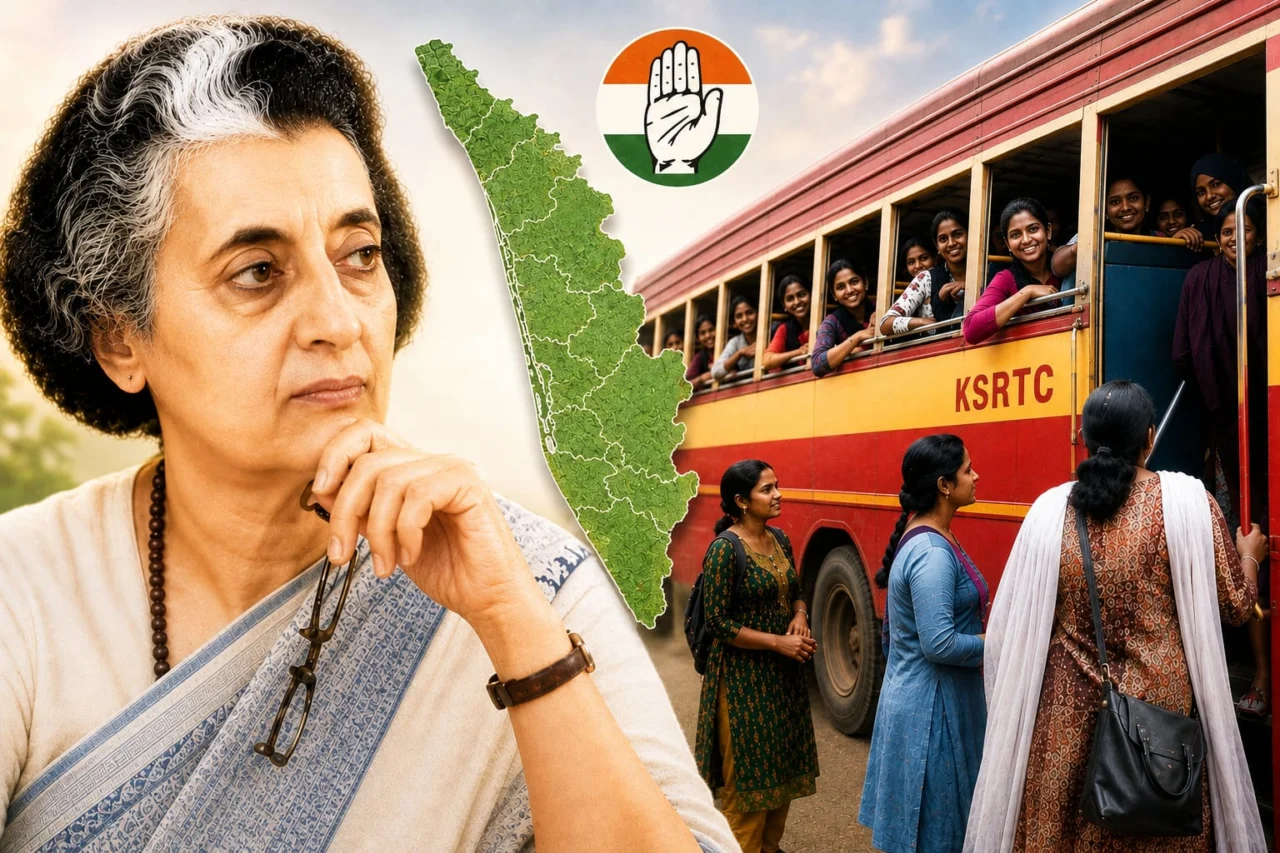
In May 2026, the United Democratic Front (UDF), led by Chief Minister V.D. Satheesan of the Indian National Congress and the Indian Union Muslim League, assumed power in Keralam. Within weeks of taking office, the new administration rolled out one of its flagship electoral promises, the ‘Priyadarshini’ scheme. Named symbolically after Indira Priyadarshini Gandhi, the scheme provides free travel for women and transgender persons across 3,125 ordinary and local Keralam State Road Transport Corporation (KSRTC) bus services.
While framed as a measure for women’s empowerment and social inclusion, the symbolic naming carries a darker economic irony. As the newly installed UDF government navigates its first quarter in office, the mounting costs of popular subsidies, combined with structural economic distress, have raised a grave question of whether the weight of political freebies could push Keralam toward a crisis severe enough to trigger a Financial Emergency.
It is important to clarify that the reference to a “Financial Emergency” in this analysis is strictly symbolic and metaphorical, meant to underscore the precarious financial condition and severe fiscal strain of the state. There is no claim or prediction that a constitutional Financial Emergency under Article 360 will or should be formally imposed on Keralam, rather, the term is used purely as an analytical indicator to reflect the gravity of the state’s economic challenge.
The anatomy of Keralam’s debt trap and KSRTC’s structural deficit
Keralam’s fiscal health has hovered near a crisis point for years, characterised by soaring off-budget liabilities, elevated revenue deficits, and chronic reliance on open-market borrowings to meet daily operational expenditures. Total state debt stands at approximately 4.5 lakh crore, accounting for 36.8 per cent of its Gross State Domestic Product (GSDP), placing Keralam among the most fiscally stressed states in India alongside Punjab and West Bengal, far exceeding the recommended 20% stability threshold according to the Fiscal Responsibility and Budget Management framework (2023).
The injection of the Priyadarshini scheme into KSRTC comes at a time when the state-owned transit corporation is already operating under severe distress. KSRTC collects a monthly revenue of approximately 144 crore, which fails to cover its baseline operational expenditure of 234 crore, resulting in an ongoing monthly operating deficit of 90 crore and cumulative liabilities exceeding 2,000 crore according to Kerala State Audit Department evaluations (2025–26).
Kochi, Keralam: Regarding his statements on the Priyadarsini scheme, State Transport Minister CP John says, "The poverty among women in Kerala is very severe. Many cannot even afford the bus fare. Priyadarshini was introduced as part of Rahul Gandhi's intervention. What I said… pic.twitter.com/ULAyyNAlY8
— ANI (@ANI) August 4, 2026
Absorbing the fare foregone by commuters under the Priyadarshini scheme adds an estimated monthly subsidy expenditure of 60 crore to 70 crore, translating to a yearly financial burden of nearly 800 crore according to state budget expenditure allocations (2026). To bridge the gap between revenue collections and statutory disbursements, the state government has drawn heavily against its quarterly borrowing cap set by the Ministry of Finance, converting user-fee transport revenues into a permanent fiscal drain on the state budget.
Industrial stagnation, trade union militancy, and unemployment
Freebie-driven social policy cannot be evaluated in isolation from a state’s real economic engine, and Keralam’s broader macroeconomic structure presents severe structural bottlenecks that limit its capacity to generate non-tax revenues. Despite boasting a literacy rate of 96.2 per cent, Keralam consistently ranks among the states with the highest youth unemployment rate, frequently exceeding 25 per cent to 28 per cent in the 15 to 29 age demographic as educated citizens continuously migrate out of the state due to a scarcity of high-value corporate and industrial jobs.
Capital-intensive manufacturing remains constrained by high land costs, environmental regulations, and political friction surrounding land acquisition, leaving manufacturing at a low 9.8% fraction of total state GSDP compared to regional peers. Decades of aggressive trade union activism, led by political fronts including the Centre of Indian Trade Unions (CITU) and the Indian National Trade Union Congress (INTUC), have fostered a reputation for operational instability among private investors, where frequent general strikes (hartals) and labor disputes historically discourage foreign direct investment (FDI) and business expansion.
Furthermore, as a consumer-dependent state that imports over 70 per cent of its food grains, vegetables, and daily consumer goods from neighboring states, Keralam suffers from elevated retail inflation fluctuating between 6 per cent and 7.5 per cent according to Ministry of Statistics and Programme Implementation (MOSPI) Consumer Price Index reports (2025–26), which compounds local price index rises and places immense financial pressure on ordinary citizens.
The mechanics of ‘Freebie Politics’ and fiscal imbalance
The launch of the Priyadarshini bus scheme reflects a broader trend of freebie-driven electoral competition across Congress-ruled states like Himachal Pradesh, Karnataka, Telangana, and Keralam, where unrestricted revenue-expenditure subsidies redirect scarce capital away from productive investments despite short-term popularity.
Under the Priyadarshini mandate, women and transgender passengers ride free on ordinary KSRTC buses, recording 3.81 crore free journeys in its first 30 days alone. This surge increased the proportion of female passengers on ordinary services from 50.9% to 66 per cent, creating immediate cash deficits for the transport operator as passenger volume increases while fare collection per kilometer drops on major routes.
Kerala:
“This is 'insult' to women using the free travel scheme on KSRTC buses is part of a planned attempt to end the Priyadarshini scheme.”
– CPI(M)'s P Rajeev after Transport Minister CP John courts controversy suggesting many women use the scheme to avoid paying fares even… pic.twitter.com/8jnFEqEm8H
— News Arena India (@NewsArenaIndia) August 4, 2026
Higher passenger loads on aging public fleets accelerate vehicle depreciation without providing the necessary revenue to purchase replacement buses, leading to higher fleet breakdown rates and impaired service reliability. Furthermore, private bus operators who manage over 70 per cent of public transit routes in Keralam face asymmetric competition on overlapping routes, pushing small operators into losses and shrinking state revenue from private transport permits and road taxes. When public sector undertakings rely continuously on state treasury bailouts to cover basic operating costs, government borrowing is steadily diverted from asset-creating infrastructure projects, such as highways, ports, and industrial parks, into servicing daily consumption expenditure and subsidising routine transport.
How Congress-led freebies are straining state treasuries
This pattern of freebie-driven electoral promises leading to systemic financial strain is actively unfolding across other Congress-ruled states, offering a grim template for Keralam. In Karnataka, the execution of the “Shakti” scheme, granting free bus travel for women, combined with four other major “guarantee” promises, has severely strained state finances, forcing transport corporations like KSRTC into operating deficits and prompting calls for steep fare hikes to keep fleets functional.
In Telangana, the “Mahalakshmi” zero-ticket transit initiative and extensive cash-transfer guarantees have piled massive subsidy clearance backlogs onto state transport entities (TGSRTC), draining capital from crucial infrastructural spending. Meanwhile, in Himachal Pradesh, the weight of unhedged poll promises, including free electricity allowances and the restoration of the Old Pension Scheme (OPS), triggered a fiscal revenue deficit so severe that the state government was forced to introduce austerity cuts and defer salary payments for the Chief Minister, cabinet ministers, and senior officials.
If Keralam continues down this identical path, piling the Priyadarshini scheme onto an economy already shackled by weak tax revenues and industrial stagnation, it risks joining these states in a compounding spiral of structural debt and severe financial distress.
The discussion surrounding a potential financial emergency in Keralam serves not as a formal prediction or constitutional assertion, but rather as an alarming indicator of the state’s escalating economic strain. It highlights how an unbridled expansion of populist welfare schemes, like the Priyadarshini bus service introduced under the Congress-led UDF government, can severely exacerbate an already fragile fiscal framework. Without necessary structural corrections, strict expenditure management, and long-term industrial revival, continuing on a path driven predominantly by freebies risks pushing Keralam toward severe financial distress, where essential public infrastructure spending grinds to a halt, statutory pension disbursements face delays, and overall state solvency is fundamentally jeopardised.