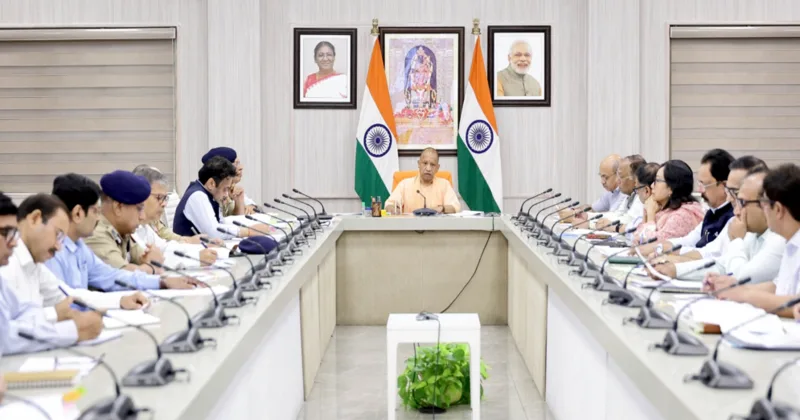
NDA led state administrative machinery tends to return to the idea of antyodaya, the upliftment of the last person in the queue. At the Monsoon Session of the state legislature, Chief Minister Yogi Adityanath reiterated exactly that message, announcing the constitution of an Outsourcing Service Commission, a hike in honorarium for the state’s rural and community workforce and a supplementary budget of ₹59,019.54 crore, which he described as devoted to farmers, youth, women and the poor.
The Chief Minister made it clear that the state government has already constituted the Outsourcing Commission and that it will be operationalised within the next one to one and a half weeks. Its purpose is to ensure that every outsourced worker receives a minimum honorarium along with social security guarantees such as medical facilities, accident insurance, maternity leave and pension. He added that the funds required for this arrangement have already been provisioned in the supplementary budget, so that implementation is not delayed.
The Commission mandate will cover lakhs of contractual and outsourced workers across the state, whose engagement has so far been handled through a fragmented network of placement agencies, often leaving them without timely wages, social security or continuity of service. Under the new framework, salaries will be credited directly into workers’ bank accounts, reducing the role of intermediaries and improving transparency in disbursal.
Honorarium hike for the rural workforce
The second major strand of the announcement concerns the state rural and community-level workforce. The Chief Minister said that Anganwadi workers, ASHA workers, mid-day meal cooks, village chowkidars and kotedars (fair-price shop dealers) will all see an increase in incentives and honorarium, with funds set aside for this in the budget. These categories are widely regarded as the backbone of rural health, nutrition and the public distribution system, and the government says their contribution is now being formally recognised through enhanced financial incentives.
The supplementary budget in numbers
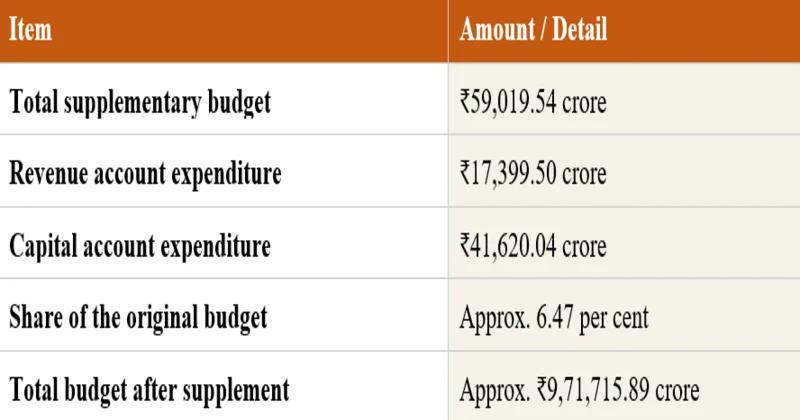
The overall size of the supplementary budget stands at ₹59,019.54 crore, roughly 6.47 per cent of the state original budget. Finance and Parliamentary Affairs Minister Suresh Kumar Khanna, presenting the budget in the Assembly, said it comprises a revenue account expenditure of ₹17,399.50 crore and a capital account expenditure of ₹41,620.04 crore. With this additional provision, the state’s total budget will rise to approximately ₹9,71,715.89 crore. The finance minister also underlined that the fiscal deficit remains within the prescribed limit and that the government is pushing development work forward while maintaining fiscal discipline.
Provisions centred on youth, women and farmers
Energy, industrial development, health, agriculture, rural development and social welfare have been given particular priority in the budget. The Chief Minister said the supplementary allocation was brought specifically to launch new schemes for farmers, women and the poor, announce fresh initiatives for youth employment and skilling, advance welfare programmes for the underprivileged, and step up efforts toward women dignity and self-reliance.
On the youth front, provisions have been made for job fairs, the skill development mission and the startup ecosystem, with additional funds intended to expand training capacity across the state’s technical and vocational institutions. The government maintains that investment in industry and energy will generate fresh employment opportunities, particularly in districts where industrial corridors are being expanded. For women’s self-reliance, the budget makes room for incentives to self-help groups, strengthening of safety and rehabilitation centres and women entrepreneurship schemes, aimed at drawing both rural and urban women into economic activity.
The question of social security for outsourced and contractual employees has remained unresolved for years. Under previous governments, the engagement of this workforce was left largely to placement agencies, leading to frequent complaints of delayed wages, exploitation and an absence of service security. The present government contends that under its double-engine governance model, this workforce is now being brought into a formal structure that safeguards its dignity, an attempt to balance administrative responsibility with public welfare.
Opposition uproar and the treasury benches’ response
The Chief Minister also launched a sharp attack on the opposition. He alleged that the Samajwadi Party did not allow meaningful discussion in the House on issues concerning farmers, youth, women and the poor, and instead disrupted proceedings through uproar. During the budget presentation, opposition members reportedly entered the well of the House shouting slogans, which the treasury benches countered in kind. The Chief Minister said the legislature was the highest platform for voicing public concerns and that House time ought to be used for serious deliberation on matters of public interest rather than disruption.
Analysts view the constitution of the Outsourcing Commission as a significant step toward formalising the state unorganised and contractual workforce, a segment that has long operated outside the reach of standard labour protections. In recent years, the government had also moved toward setting up a dedicated corporation for the appointment of outsourced workers, under which a retirement age of 60 and a minimum wage of ₹20,000 had been proposed. The new Commission is seen as an attempt to give that earlier process an institutional shape.
Employee organisations have welcomed the Commission formation, though they caution that real relief will only materialise once the minimum honorarium and social security benefits are implemented on the ground in a timely manner, given how often past promises to this workforce have slipped in execution. According to administrative officials, a district-level monitoring mechanism will also be developed to track the Commission implementation, allowing grievances to be resolved quickly. The government has indicated that the rules governing the Commission will be notified in the coming months to maintain transparency.
The government describes the supplementary budget as more than an accounting exercise, calling it a reflection of the double-engine administration’s priority of keeping farmers, youth, women and the poor at the centre of policy. In the weeks ahead, all eyes will be on the formal notification of the Outsourcing Commission and the process of its implementation, since the security of lakhs of workers’ futures now rests on it. The initiative also ties into a longer governance tradition in which reaching development to the last person in line is treated as the state’s foremost obligation.