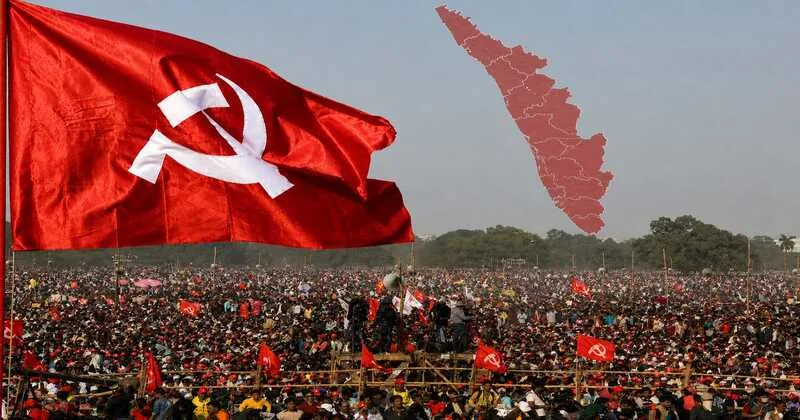
The Left parties, once dominant enough to paint large swathes of India’s political map red, are today confronting an unprecedented existential crisis. The undivided Communist Party had emerged as the principal opposition in the first Parliament of post-independence India, shaping early ideological debates and parliamentary interventions. Even after the historic split in 1964 into Communist Party of India (Marxist) (CPI(M)) and Communist Party of India (CPI), these parties retained considerable strength across regions. However, in contemporary India, they are increasingly seen as grappling with deep ideological poverty, organisational stagnation, and shrinking electoral relevance.
Historical spread and regional strongholds
Beyond their long-term bastions in West Bengal, Keralam, and Tripura, communist parties in India exercised influence across several other states after independence, often participating in governments or acting as significant opposition forces. In Bihar, communist parties, both CPI and CPI(M), along with later formations such as CPI-ML, had a historically strong presence, particularly in agrarian regions. From the 1960s to the 1990s, they consistently held between 25 and 35 seats in the state assembly. Even as their strength declined over time, they remained electorally relevant; in the 2020 Bihar Assembly elections, Left parties, as part of the Mahagathbandhan alliance, secured 16 seats. However, in the 2025 Assembly elections, the Left parties faced a major setback, winning just three out of 33 seats.
In Tamil Nadu, the CPI and CPI(M) carved out influence through trade unions and strategic alliances. They became crucial partners to the Dravidian majors, including Dravida Munnetra Kazhagam (DMK) and All India Anna Dravida Munnetra Kazhagam (AIADMK), and were often part of ruling coalitions.
In Manipur, the CPI rose as a significant political force following the 1946 agrarian struggles led by Irawat Singh. During the late 1940s and early 1950s, it played a key opposition role, shaping the early political landscape of the state.
In Andhra Pradesh, the united CPI had deep roots in the Telangana armed struggle. Before the 1964 split, it was a formidable force in the Andhra region. Even later, Left parties secured significant representation, winning 34 seats in the 1994 assembly elections and 15 seats in 2004.
In Maharashtra, communist parties played a role in the formation of the linguistic state through the Samyukta Maharashtra Samiti. Their presence continues, particularly among farming communities and industrial labour, with constituencies such as Dahanu reflecting this legacy. In Punjab, the CPI maintained a notable presence until the 1980s, holding legislative seats and shaping labour and agrarian politics. However, this influence was significantly diminished later. Communist parties have also intermittently held seats in Rajasthan and Himachal Pradesh, particularly through CPI(ML) formations.
Collapse in traditional bastions
The decline of the Left is most visible in its former strongholds. In West Bengal, the CPI(M)-led Left Front governed for an uninterrupted 34 years from 1977 to 2011. This period represented one of the longest democratically elected communist governments in the world. However, today, the party finds itself unable to win even a single seat in the state assembly. The erosion of Left support in West Bengal has been compounded by the rise of the Bharatiya Janata Party (BJP), which has emerged as the principal opposition force, displacing the Left almost entirely from the political landscape. A similar trajectory is visible in Tripura. After ruling the state for 25 consecutive years, the Left lost power in 2018. Since then, its presence has significantly weakened, with diminished organisational strength and electoral appeal. These collapses are not isolated events but indicators of deeper structural challenges within the Left’s political framework.
Several factors have been identified as contributing to the decline of Left parties in India. A primary reason is the accumulation of anti-incumbency sentiment, particularly in states like West Bengal and Tripura, where prolonged periods of rule led to public fatigue. The sense of stagnation and dissatisfaction among voters contributed to electoral reversals. Economic policies also played a role. In West Bengal, for instance, the end of Left rule was influenced by anti-farmer sentiment triggered by land acquisition policies for industrial projects, notably in Singur and Nandigram. These developments alienated sections of the rural population that had traditionally formed the backbone of Left support.
Another significant factor has been the inability of the Left to adapt to changing socio-political realities. The parties have struggled to connect with younger generations, failing to align their messaging with evolving aspirations. This has resulted in a generational disconnect and declining appeal among youth. The Left has also faced criticism for alienation from Hindu religious identity and perceived appeasement of Muslims. Historically, Left parties have been reluctant to engage with the deeply religious nature of Indian society, often viewing expressions of Hindu belief through the lens of communalism. This stance has alienated sections of the electorate, particularly as political discourse increasingly emphasises identity and cultural belonging.
Additionally, the Left has been unable to present a distinct and compelling development model in its stronghold states. This has limited its ability to counter the “development and welfare” narratives advanced by rival political formations. The absence of a clearly articulated alternative has further weakened its ideological positioning.
Leadership challenges have compounded these issues. The failure to mentor and promote a younger generation of leaders has created a vacuum, leaving the parties with ageing leadership structures and limited renewal. This has hindered their capacity to adapt organisationally and politically.
Left at a Crossroads: From dominance to possible exit from power
In the 21st century, the trajectory of the Left has shifted dramatically. From ruling three states simultaneously, West Bengal, Keralam, and Tripura, the Left has been reduced to a presence confined to a few pockets. Today, both CPI(M) and CPI together rule in Keralam and hold only one seat in the Lok Sabha, with the CPI having none. In the Rajya Sabha, out of nine members from Keralam, CPI(M) holds three seats while the CPI has two.
The decline is not merely numerical but symbolic. Once a central pole in Indian politics, the Left now struggles to remain electorally competitive at the national level. Its shrinking parliamentary presence reflects a broader erosion of political influence, ideological appeal, and grassroots mobilisation.
Exit poll results for the 2026 assembly elections indicate that the Left could face a decisive setback in Keralam, currently the only state governed by CPI(M) -led Left Democratic Front (LDF). Multiple exit polls suggest a likely change of government, with the Congress-Muslim League-led United Democratic Front (UDF) poised to defeat the LDF led by Chief Minister Pinarayi Vijayan. Five major exit polls point towards a UDF victory. If these projections are confirmed when results are announced on May 4, India could witness a historic moment where no state is governed by a Left-led administration, a stark contrast to decades of continuous Left rule in key regions. The implications of such an outcome would be profound, not only electorally but also ideologically, raising fundamental questions about the future trajectory and relevance of Left politics in India.
The Keralam exception and uncertain future
Despite the broader decline, there remain notable differences in the functioning of communist parties in Keralam compared to other states. These differences have allowed the CPI(M) to retain a degree of relevance and organisational strength in the state, even as it weakened elsewhere. Keralam’s political culture, history of social movements, and political awareness have also been shaped significantly by decades of communist influence. This influence fostered a form of pseudo-secularism that distanced sections of society, particularly Hindus, from aspects of their religious and cultural identity. Rather than emerging at a single historical moment, this shift is seen as a gradual and continuous process, reflected across spheres such as arts, cinema, workplaces, student movements, and women’s participation, where the imprint of Left ideology has remained visible.
In West Bengal, the communist politics coexisted with public expressions of Hindu religious practices such as Kali Puja. In Keralam, however, Left-oriented intellectual discourse encouraged Hindus to downplay or move away from traditional practices. This process continues to shape political socialisation in the state.
For example, in Keralam, an ordinary person may regularly travel by private buses even though the state-run KSRTC buses are available under government control. They may use private mobile networks despite the existence of BSNL, which is under the central government. They may shop from private stores and rely on goods and services that are largely outside direct government control. Yet, when the same ordinary Malayali is asked whether KSRTC buses under the government should be privatised, the very person who routinely depends on private services tends to oppose privatisation. Even when asked about privatising BSNL, they resist the idea. There is a tendency to overlook the fact that they themselves consistently use private institutions and services in everyday life. This response is shaped by the deeply ingrained mindset of Left politics, which influences how they think, especially the Communist Hindus. Even when the Congress came to power repeatedly, it largely followed the policies of the Left parties and was unable to move beyond them. This is the key factor that, unlike in other states, has helped Left politics sustain itself in Keralam.
At the same time, the growth of the Bharatiya Janata Party (BJP) is increasingly being seen as a challenge to this long-standing ideological influence, potentially altering the social and political landscape in the years ahead.
Therefore, the outcome of the 2026 assembly elections is being closely watched as a critical indicator of the Left’s future. The results to be announced on May 4 will not merely determine the fate of a state government but could signal a turning point in the history of Left politics in India. If the projections hold true, the country may enter a phase where the Left, once a central force in shaping India’s political discourse, no longer governs any state.
Such a scenario would mark the culmination of a long decline, from dominance and ideological influence to marginalisation and uncertainty, raising fundamental questions about whether the Left can reinvent itself in a rapidly changing political landscape.