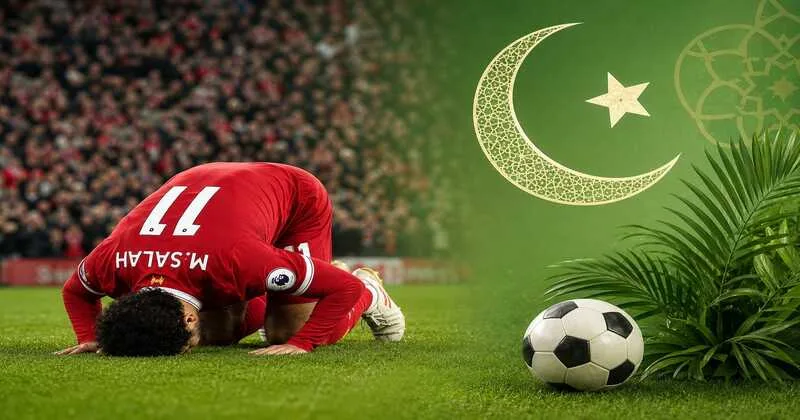
Over the past two decades, association football has increasingly transformed from a traditional Western sporting staple into a premier operational vehicle for Islamic soft power, religious visibility, and cultural shift across European societies and beyond. The rapid ascent of elite Muslim footballers into the highest echelons of international competition has fundamentally altered the socio-religious dynamic inside stadiums, media broadcasts, and fan subcultures.
High-profile athletes, including Liverpool forward Mohamed Salah, former Bayern Munich winger Sadio Mane, and French international midfielder Paul Pogba, routinely display their Islamic faith on pitch sidelines through public acts of devotion such as the Sujud, the prostration of gratitude performed after scoring goals. Broadcast directly to an estimated global television audience exceeding three billion viewers, these ritualistic displays have integrated Islamic religious practices into mainstream Western pop culture.
Sociological research indicates that this athletic idolisation generates measurable shifts in public attitudes toward Islam and its socio-religious tenets. A widely cited 2019 empirical study conducted by political scientists from Stanford University and Yale University, published in the American Political Science Review, analyzed over 8,000 hate crime reports and 15 million social media posts in the United Kingdom. The researchers documented a 16 percent reduction in anti-Muslim hate crimes in the Merseyside area following Mohamed Salah’s signing with Liverpool Football Club, alongside a 50 percent decline in anti-Muslim tweets among Liverpool supporters compared to fans of other top-flight English clubs.
While civil rights advocates frequently cite these metrics as evidence of diminishing Islamophobia, critical sociologists and political analysts argue that this athletic hero-worship functions as an effective mechanism for religious normalisation, dampening public skepticism toward Islamic theology and its broader socio-political implications.
Beyond altering general public perceptions, athletic fandom has directly facilitated documented cases of religious conversion in Western nations. High-profile instances, such as Nottingham Forest season-ticket holder Ben Bird publicly attributing his conversion to Islam to Mohamed Salah’s pitch performance and visible piety, underscore how popular sports culture can serve as an effective pathway for religious proselytization (da’wah). Stadium chants echoing across major European venues, containing phrases such as “if he scores another few, then I’ll be Muslim too”, demonstrate how athletic adulation erodes cultural resistance, making religious transition socially acceptable within working-class Western communities historically rooted in secular or Christian traditions.
Institutional Adaptation: The systemic rewriting of Western sporting traditions
As the demographic footprint of Muslim athletes has expanded across Europe’s top-tier leagues, major sports governing bodies and elite clubs have systematically recalibrated long-standing operational frameworks, match schedules, dietary standards, and infrastructural codes to accommodate Islamic religious requirements.
In April 2021, the English Premier League and the English Football League implemented unprecedented guidelines permitting match officials to pause evening fixtures at sunset, allowing fasting Muslim players to break their fast with fluids and supplements during the holy month of Ramadan.
This procedural innovation, first officially executed during a match between Leicester City and Crystal Palace to accommodate players Wesley Fofana and Cheikhou Kouyate, has since become standard operational policy across primary European domestic competitions, including France’s Ligue 1 and Germany’s Bundesliga.
Qatar opens the FIFA World Cup 2022 with Quran recitation by children.
Maa Shaa Allah.
So beautiful 🥰🥰🥰
Yaa Allah, make the Glorious Qur'an our companion, forgive us & have mercy on us. pic.twitter.com/iUfL8NY2u0— Usman Moh'd Chiroma (@UssyCiroma) November 20, 2022
Beyond match-day scheduling adjustments, physical infrastructure across iconic European sports venues has undergone systemic modification to embed religious facilities into everyday club operations. Premier European venues, including Liverpool’s Anfield, Manchester City’s Etihad Stadium, Newcastle United’s St James’ Park, and London’s Wembley Stadium, have constructed permanent Islamic prayer rooms and multi-faith facilities catering to players, coaching staff, and expanding Muslim fan demographics.
These institutional concessions extend directly into commercial operations, where traditional Western post-match traditions rooted in alcohol consumption have been fundamentally restricted. Leagues have phased out champagne presentations for individual post-match awards after Muslim players raised religious objections, substituting them with non-alcoholic rosewater or customized trophies.
Furthermore, high-profile Muslim players have increasingly exerted pressure on club commercial agreements, refusing to feature in promotional materials for betting companies, online gambling platforms, and alcohol producers. Players like Paul Pogba famously removed corporate beer branding from press conference tables during major European international tournaments, forcing multi-billion-dollar global federations to grant religious exemptions.
Critics of these rapid institutional changes contend that such adaptations represent far more than routine workplace inclusivity; they signify a structural realignment of Western sports governance to mirror Islamic religious guidelines, incrementally displacing established secular and local cultural norms within one of Europe’s most revered institutional sectors.
Sovereign Capital Infiltration: Gulf ownership and corporate leverage
Parallel to individual athlete visibility on the pitch, state-backed sovereign wealth funds and ultra-wealthy financial entities originating from Muslim-majority nations have deployed hundreds of billions of dollars in foreign direct investment to acquire controlling ownership of elite Western football clubs.
This systematic financial expansion serves as the primary engine for state-directed sports diplomacy and geopolitical soft power, granting foreign states unprecedented leverage over Western civic institutions, local municipal economies, and global media narrative frameworks.
In 2011, Qatar Sports Investments (QSI), a subsidiary of Qatar’s state sovereign fund, completed the acquisition of French giant Paris Saint-Germain (PSG). QSI injected over 1.5 billion euros in state capital to dominate European football, ultimately securing global megastars including Lionel Messi, Neymar, and Kylian Mbappe.
Lionel Messi’s tenure at Qatari-owned Paris Saint-Germain specifically served as a crown-jewel asset for the Gulf state’s global branding campaign, effectively aligning the global prestige of the world’s most recognizable athlete with Qatar’s state-backed sports apparatus in the critical lead-up to international geopolitical milestones.
Franck Ribéry and Nicolas Anelka for France 🤲
Ribéry and Anelka, two reverts, pictured making dua to their Lord ahead of their game
فَاذْكُرُوْنِيْۤ اَذْكُرْكُمْ وَاشْكُرُوْا لِيْ وَلَا تَكْفُرُوْنِ
“So remember Me; I will remember you. And be grateful to Me and do not deny… pic.twitter.com/o0oQ3dZlUf
— Faithfull Ballers (@FaithfullBaller) August 8, 2026
Similarly, Abu Dhabi’s City Football Group transformed Manchester City Football Club into an international athletic juggernaut through capital injections exceeding 1.2 billion pounds, altering the urban landscape of East Manchester while constructing a global network of feeder clubs spanning North America, South America, Asia, and Australia.
In 2021, Saudi Arabia’s Public Investment Fund (PIF) acquired an 80 percent controlling stake in English Premier League club Newcastle United for 305 million pounds as a central pillar of its state-directed Vision 2030 strategy.
Following this acquisition, the Saudi state fund initiated a massive disruption of global sports markets in 2023 by deploying over 950 million dollars in transfer fees to recruit international stars, including Cristiano Ronaldo, Karim Benzema, N’Golo Kante, and Neymar, to the domestic Saudi Pro League.
By embedding sovereign state wealth directly into historically working-class European football clubs, these Gulf regimes secure deep-seated public loyalty, insulate themselves from Western political critique regarding domestic human rights records, and project an image of financial dominance and modern Islamic state power across international commercial markets.
Global Projection: Mega-events, strategic Da’wah, and geopolitical hegemony
The geopolitical deployment of football reached its historical peak during the 2022 FIFA World Cup in Qatar, marking the first time the world’s most watched sporting mega-event was hosted in a Muslim-majority West Asian country. Rather than adopting standard Western event operations, Qatari authorities used the global tournament, which reached an estimated total audience of over 5 billion viewers, as an explicit international platform to project Islamic cultural norms, Sharia-aligned behavioral regulations, and religious proselytization on an unprecedented scale.
State agencies implemented coordinated public ‘da’wah’ campaigns throughout host cities, erecting public murals across Doha detailing prophetic traditions, distributing over 250,000 translated copies of the Quran in multiple languages to visiting supporters, and hosting international Islamic scholars to engage Western fans in religious discussions.
Dutch football legend Clarence Seedorf converts to Islam https://t.co/AZRbbieqlU pic.twitter.com/rIlScFkSvb
— Anadolu English (@anadoluagency) March 4, 2022
On an institutional and regulatory level, the host nation enforced strict Sharia-compliant public behavior mandates across all stadium perimeters and fan zones. Qatari authorities implemented absolute bans on alcohol sales inside tournament stadiums, suppressed rainbow-colored LGBTQ+ iconography, including threatening disciplinary action against European team captains attempting to wear OneLove armbands, and strictly regulated public displays of affection.
Symbolic ceremonial programming further reinforced this ideological projection.The World Cup opening ceremony featured recitations from the Quran by disabled youth ambassador Ghanim Al-Muftah alongside actor Morgan Freeman, the first time in FIFA history that Islamic scripture was integrated into an official World Cup opening ceremony broadcast worldwide.
Political scientists and international security experts observe that the 2022 World Cup established a blueprint for how sports mega-events can be used by conservative Islamic states to challenge Non-Islamic cultural hegemony, enforce religious compliance on international visitors, and establish a new global consensus where secular standards are subordinate to host-nation religious mandates.
The Global Footprint: Beyond the West and the reshaping of worldwide fan culture
The socio-cultural transformation driven by football extends far beyond Western Europe, exerting a profound influence across Asia, Sub-Saharan Africa, and the broader Global South. In regions where European football leagues command immense television viewership, the visible piety of elite Muslim players and the financial dominance of Islamic sovereign state owners act as powerful agents of cultural alignment.
Across West Africa, North Africa, and Southeast Asia, particularly in nations such as Indonesia, Malaysia, Nigeria, and Senegal, the stardom of Muslim icons playing for European teams owned by Gulf states is actively leveraged by regional religious organisations to promote Islamic identity among local youth populations.
Muslim footballer @ToniRuediger performs sujood after winning the Champions League final with Chelsea
#Muslim #Football #Islam #Prayer #Allah #God #Thankful pic.twitter.com/DWOcpXrik9— Islam Channel (@Islamchannel) June 3, 2021
Furthermore, Gulf states have systematically integrated sports development aid into their broader foreign policy and religious outreach programs across developing nations. State-funded athletic academies, stadium construction projects, and sports infrastructure grants funded by Qatar, Saudi Arabia, and the United Arab Emirates operate extensively throughout Sub-Saharan Africa and South Asia.
These sports development funds often function alongside state-sponsored educational and religious infrastructure projects, creating an intertwined network of athletic and socio-religious influence. In countries like Indonesia, home to the world’s largest Muslim population, the domestic broadcasting of European matches featuring prayer breaks and visible Islamic iconography reinforces religious solidarity and softens domestic public attitudes toward Gulf-backed religious initiatives.
The convergence of global athlete proselytization, institutional structural adaptation in Western leagues, massive foreign sovereign acquisition, and state-sponsored event hostings confirms that football has evolved into one of the most effective, pervasive, and unobtrusive soft-power instruments in modern international relations.
Through the combined leverage of financial capital, cultural idolization, and institutional compromise, the sport has established a continuous mechanism for the expansion of Islamic visibility, cultural normalization, and socio-political influence across both Western societies and the wider international order.