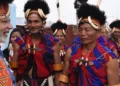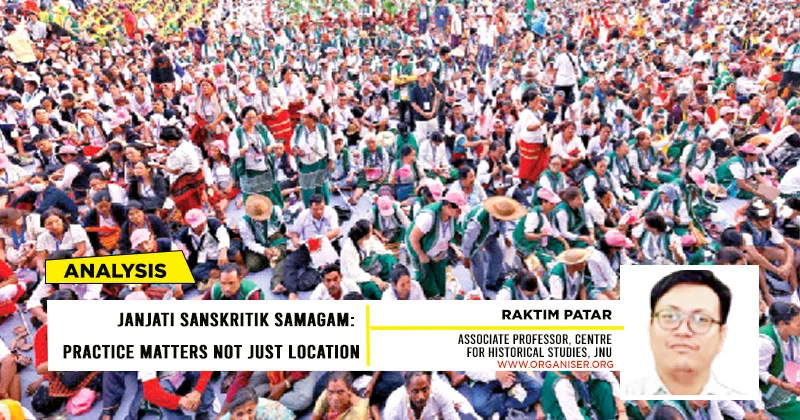
The morning air of May 24, 2026, around the iconic Red Fort in New Delhi carried an unmistakeable energy on a day that will be remembered for generations. More than two lakh tribal men and women, adorned in their traditional attires, carrying the flags of their communities, and chanting the name of their greatest hero, Bhagwan Birsa Munda, converged in one of the most powerful demonstrations of indigenous assertion in independent India’s history. The occasion was the 150th birth anniversary of Birsa Munda, the legendary freedom fighter, spiritual leader, and revolutionary who dared to challenge both colonial subjugation and social exploitation.
Registering their Legitimate Grouse
But the gathering was not merely a commemoration, it was a clarion call for constitutional justice. At the heart of this massive mobilisation under the banner of Janjati Suraksha Manch, was a singular, urgent demand: the amendment of Article 342 of the Constitution of India to exclude individuals who have converted to Christianity or Islam from being listed as Scheduled Tribes (ST). The tribals who gathered that day spoke with one voice, that the constitutional protections meant exclusively for them are being diluted, and that the time for course correction has long come.
Towering Symbol of Resistance
To understand the passion behind this movement, one must first understand the man whose birth anniversary gave it wings. Bhagwan Birsa Munda was born in 1875 in the Jharkhand region and grew up to become a towering symbol of resistance. He led the famous Ulgulan, the Great Tumult, against British colonial rule and the exploitation of tribal lands and forests. He was equally fierce in protecting the tribal way of life, culture, and spiritual identity from external forces, whether colonial or missionary. It is deeply significant that over two lakh tribal people chose Birsa Munda’s 150th birth year anniversary year to make this demand. His life was spent fighting against those who sought to uproot tribal people from their identity, and today, his people continue that very fight, not with bows and arrows, but with their democratic voice.
Amendment to Article 342
Article 342 of the Indian Constitution empowers the President to specify the Scheduled Tribes in relation to any State or Union Territory. The list of Scheduled Tribes, once notified, entitles members to reservations in education, employment, and political representation, benefits that were instituted to uplift some of the most historically marginalised communities in the country.
The demand of the tribal gathering is clear and constitutionally grounded: those who have converted to Christianity or Islam and thus voluntarily abandoned the traditional belief systems, cultural practices, and way of life that define tribal identity should no longer be entitled to the benefits reserved for Scheduled Tribes. The tribals argue, with considerable moral and logical force, that Scheduled Tribe status is not merely a socio-economic category, it is an identity rooted in a specific culture, ancestral connection to the land, a living relationship with nature, and a distinct spiritual worldview. When a person converts to an Abrahamic religion, they sever themselves from this very identity and align with a global religious community that has its own institutions, networks, and sources of support.
Concern over Conversion
The demand is thus not one of exclusion but of protection. Protection of a constitutional framework that was designed for a specific and vulnerable group, and ensuring it serves only those who genuinely belong to and live within that identity. The concern over religious conversion is not abstract or political, it is lived and visceral for tribal communities across India. For centuries, tribal people have maintained a unique and irreplaceable cultural heritage. Their music, dance, art, oral literature, festivals, agricultural rituals, healing practices, and relationship with forests and rivers constitute a civilisational contribution that no other community in India can replicate.
The tribal gathering at Red Fort, by choosing the birth anniversary of Bhagwan Birsa Munda a man who resisted every attempt to uproot his people, sent a message that was unmistakable in its historical resonance and its democratic legitimacy
Conversion to Christianity or Islam, as witnessed across several tribal belts in Jharkhand, Odisha, Chhattisgarh, the North East, and parts of central India, leads to a systematic dismantling of this heritage. Converts are often encouraged, and in many documented cases, pressured, to abandon their traditional festivals, cease worshipping ancestral deities, discontinue customary practices, and even rename themselves. The cultural rupture does not stop there. Over generations, converted families lose fluency in tribal languages, lose interest in tribal art forms, and gradually cease to participate in the communal life that binds tribal societies together. What is worse is that conversion very often turns tribal people into pale imitations of a Western cultural model, adopting foreign religious practices, singing hymns in alien languages, following a worldview that treats their ancient forests and rivers not as sacred but as resources to be managed under the doctrines of a distant faith. A tribal person who no longer identifies with their community’s gods, festivals, and customs is, in the cultural and sociological sense, no longer a tribal person, even if their legal classification says otherwise.
As a tribal person from North East, I have witnessed this tragedy first-hand. I have seen people from my own indigenous community, born into a rich ancestral heritage of songs, rituals, sacred groves, and living traditions passed down through countless generations, transform almost entirely after embracing Christianity. What is most painful is not the change in faith alone, it is the contempt that often follows. These are individuals who once participated in the same harvest festivals, who knew the same folk stories, who understood the language of the forests around them, but who, after conversion, began to look upon their own ancestral customs as primitive, superstitious, or even sinful. They became, in a very real sense, propagators of a Western cultural worldview while actively distancing themselves from, and in some cases openly mocking the very heritage that shaped them.
This is not a spontaneous transformation. It is the product of deliberate and systematic conditioning, a process of psychological and cultural uprooting that missionaries and the institutions behind them have refined over centuries. The converted tribal is taught to see their traditional healer as a witch doctor, their sacred festivals as devil worship, their ancestral deities as false idols. Over time, what was once a source of pride becomes a source of shame. The result is a person who is neither fully rooted in their indigenous identity nor genuinely absorbed into the Western civilisation they now emulate, a cultural orphan, cut off from their own soil. This kind of deep-seated brainwashing is perhaps the most insidious form of cultural violence, for it makes the victim a willing participant in their own uprooting. This is precisely the contradiction that the two lakh voices at Red Fort were protesting. They were saying: do not use our constitutional protections to benefit those who have chosen to leave our world behind.
It is important to emphasise that this demand is not about hatred toward any religion or religious community. It is about the integrity of a constitutional provision. The Supreme Court of India, in multiple judgements, has held that Scheduled Tribe status is intrinsically linked to social, cultural, and community identity, not merely ancestry. Legal scholars and constitutional experts have long noted the anomaly of extending tribal reservations to those who have converted and thus can no longer be said to share the tribal way of life.
The tribal gathering at Red Fort, by choosing the birth anniversary of Bhagwan Birsa Munda a man who resisted every attempt to uproot his people, sent a message that was unmistakable in its historical resonance and its democratic legitimacy. India’s tribal communities are not merely a vote bank or a welfare category, they are the living repositories of some of the oldest civilisational wisdom on this earth. Their relationship with forests, their understanding of biodiversity, their oral histories, their systems of justice and community governance, all of these represent a heritage that modern, industrialised society desperately needs.