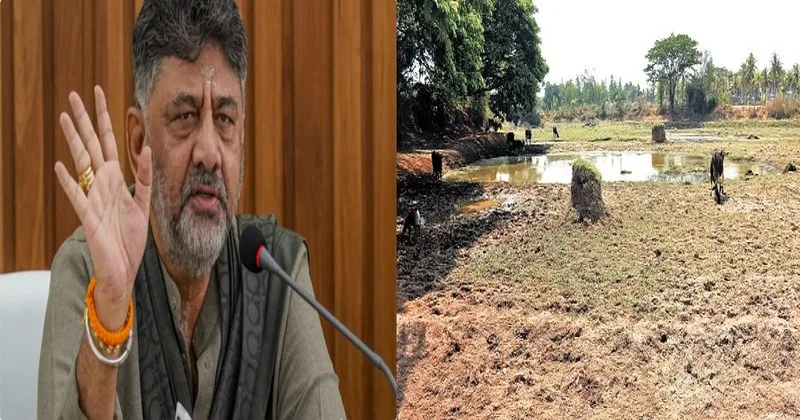
Bengaluru: Karnataka is staring at a widening drought crisis, with the Revenue Department identifying 54 taluks as facing severe drought and another 40 as experiencing moderate drought. Yet, even as rainfall deficiency and crop stress intensify across large parts of the state, the government is yet to constitute the Cabinet sub-committee on natural disasters, raising questions over the administration’s preparedness and response to the emerging crisis.
The Revenue Department has reportedly placed before the Cabinet a proposal to assess the drought situation under the Drought Management Manual, 2020, and to consider early declaration of drought in eligible taluks. The proposal, bearing number K.E. 586 TNR 2026 and case number C/410/2026, is based on rainfall, crop condition and other prescribed indicators.
The delay in constituting the natural disasters Cabinet sub-committee has become particularly significant as opposition parties and administrative teams have already begun visiting drought-hit regions and interacting with farmers. While political leaders are conducting field inspections, the absence of the specialised Cabinet mechanism raises concerns about coordination, timely decisions and delivery of relief measures.
According to the Revenue Department’s assessment, Karnataka received only 346 mm of rainfall between June 1 and August 3, against the normal 498 mm, representing a 30 per cent deficit. The shortage has been reported across all four meteorological regions. Malnad recorded a 33 per cent deficit, coastal Karnataka 25 per cent, north interior Karnataka 25 per cent and south interior Karnataka as much as 40 per cent.
The situation was particularly severe in June. Against the normal rainfall of 199 mm, the state received only 116 mm, resulting in a 42 per cent deficit. The department has described this as the fourth-lowest June rainfall recorded in the state in the past 50 years, dating back to 1976.
July also failed to provide relief. Karnataka received only 192 mm against the normal 271 mm, resulting in a 29 per cent deficit. According to the department’s analysis, this was the 10th-lowest July rainfall recorded during the last five decades.
For the period from June 1 to July 31, the state received only 308 mm against the normal 470 mm, a cumulative deficit of 34 per cent. The Revenue Department has termed this the third-lowest rainfall recorded for the period in the past 50 years.
The rainfall distribution has also been highly uneven. The department has classified one district under severe deficit and 26 districts under deficit conditions, while only four districts have recorded normal rainfall. At the taluk level, 14 taluks are in the severe-deficit category and 166 are in the deficit category.
The situation is even more worrying at the hobli level. Of 850 hoblis assessed, 647 have reportedly recorded rainfall deficiencies of 75 per cent or more. Overall, 180 of the state’s 240 taluks have experienced rainfall conditions falling into the severe-deficit range, according to the Revenue Department’s assessment.
The prolonged dry spells have already begun affecting agriculture. The department has noted that the irregular distribution of the southwest monsoon, combined with long periods of dry weather, has adversely affected sowing and crop growth. In several areas, inadequate soil moisture has affected germination, with some sowing reportedly failing altogether.
Despite these warning signs, the government’s response now hinges on Cabinet-level decisions that could have been initiated earlier. The Revenue Department has proposed that drought declarations be considered based on the prescribed indicators and that an early declaration be permitted where seasonal conditions clearly point towards drought.
The Drought Management Manual, 2020, normally requires the declaration process for monsoon drought to be completed by October 31. However, it also provides scope for an earlier declaration in August when rainfall deficiency and prolonged dry spells clearly indicate an emerging drought.
The department has argued that early declaration is necessary because June and July rainfall deficits and prolonged dry spells can substantially reduce sowing and affect crop establishment. Early action, it has said, would allow drought mitigation and relief measures to be implemented in time.
The government is also looking towards financial assistance under the National Disaster Response Fund. Under the manual, once drought is declared, a memorandum seeking NDRF assistance can be submitted within a week if the disaster is severe. Even in a moderate drought, assistance can be sought if the State Disaster Response Fund is insufficient to meet relief requirements.
Adding to the uncertainty is the forecast for the second half of the southwest monsoon. The India Meteorological Department’s July 31 outlook has indicated the possibility of strengthening El Niño conditions, while several global forecasting models point towards below-normal rainfall over large parts of Karnataka, barring some areas of north Karnataka.
With 54 taluks already classified as facing severe drought and another 40 categorised as moderately affected, the government faces pressure to move beyond assessments and initiate relief measures. The continuing absence of a natural disasters Cabinet sub-committee, at a time when the administration itself is documenting widespread rainfall deficiency and agricultural stress, is likely to intensify questions over whether the government has responded with the urgency the situation demands.