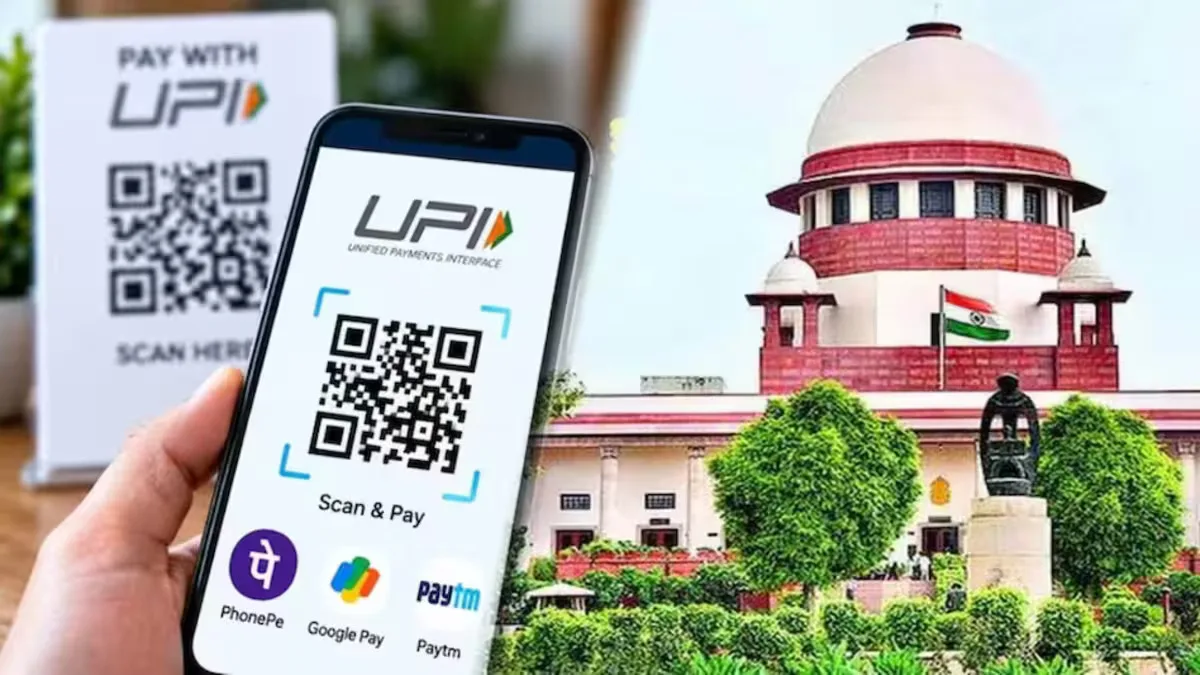
The Supreme Court has declined to stay the Centre’s decision introducing a Merchant Discount Rate (MDR) on specified UPI merchant transactions above Rs 2,000, while asking the Union Government to explain on affidavit the legal and policy basis of the new framework.
A Bench comprising Chief Justice of India Surya Kant and Justices Joymalya Bagchi and V Mohana was hearing a public interest petition filed by advocate Anjan Datta challenging the September notifications governing the new MDR regime. The framework is scheduled to come into effect from October 15.
The hearing, however, was not merely about the quantum of the charge. The Court sought clarity on its legal character.
When the Centre submitted that MDR was neither a tax nor a fee, Justice Bagchi questioned the legal basis on which the amount would be collected. The Centre, represented by Additional Solicitor General N Venkataraman, maintained that the Government would not receive any part of the amount. According to it, MDR operates within the payment ecosystem and is shared among banks, payment service providers and other participants involved in processing a digital transaction. The Court asked the Government to place these details on affidavit.
The distinction is important because the new regime does not impose a charge on every UPI transaction. Person-to-person transfers will continue to remain free irrespective of the amount. Payments to merchants up to Rs 2,000 also remain outside the MDR framework. The Finance Ministry has stated that approximately 96 per cent of merchant transactions will remain unaffected. Small merchants receiving up to Rs 1 lakh a month through UPI QR codes under the P2PM category will continue to receive the benefit of zero MDR.
For specified person-to-merchant transactions above Rs 2,000, the general MDR has been fixed at 0.4 per cent. For transactions of Rs 75,000 and above, the charge is capped at Rs 300. Essential and thin-margin sectors including railways, telecommunications, insurance, fuel and agricultural inputs will attract a flat MDR of Rs 5 for applicable transactions, while specified capital-market transactions will attract a lower rate of 0.02 per cent, subject to the prescribed ceiling.
The Government has also maintained that consumers are not to bear the MDR. Banks have been advised to ensure that merchants do not pass the charge on to customers, while UPI application providers have been prohibited from imposing platform fees or hidden charges on individual users.
The Centre’s stated justification is the long-term sustainability of the UPI ecosystem. It argues that banks and payment intermediaries incur costs in processing and maintaining the infrastructure behind digital transactions and that a limited MDR on higher-value commercial transactions would help support that ecosystem while keeping ordinary payments free.
The Supreme Court has not, at this stage, pronounced upon the legality of that reasoning. Its refusal to grant interim relief means that the October 15 rollout has not been stopped. At the same time, by seeking an affidavit on the source and legal incidence of the charge, the Court has kept the central question alive: what precisely is MDR in law, and on what authority does the new payment arrangement rest?