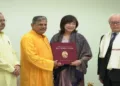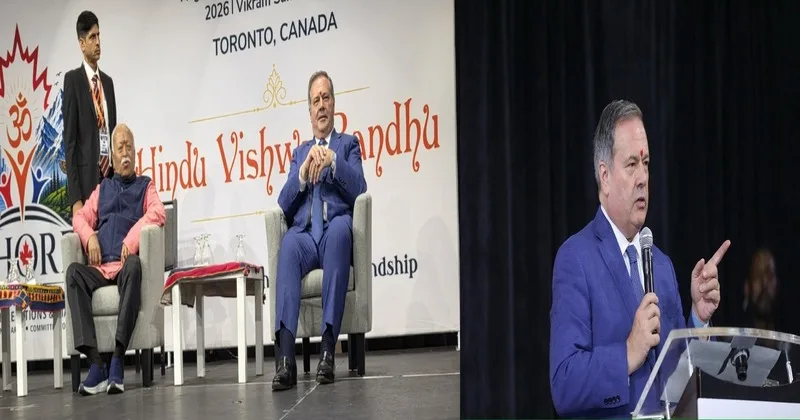
Toronto: Former Canadian Defence Minister and former Premier of Alberta Jason Kenney, while addressing a massive gathering at the ‘Hindu Vishwa Bandhu – Embrace the World in Friendship’ event in Canada, recalled his close association with India and said that RSS Sarsangchalak Dr Mohan Bhagwat had nicknamed him the “Minister for Curry in a Hurry” because, on a typical weekend, he might visit 12 different mandirs, banquet halls and weddings. Kenney said it was wonderful to see many old friends and recalled that he was considered one of the closest friends of India in the Government of Canada at the time.
Recalling a period when various powerful countries did not want to have anything to do with Gujarat, Kenney said, “You’ve heard of Gujarat? Yes. Big mistake.” He recalled telling then Prime Minister Stephen Harper in 2006 that Gujarat was the fastest-growing part of India as well as the fastest-growing part of the Indian diaspora in Canada. He added that he also told Harper about then Chief Minister Narendra Modi, saying, “they have this Chief Minister who I think will be the next Prime Minister of India, a man named Narendra Modi”.
Kenney said he had told the Canadian Prime Minister that the country needed to end the diplomatic and commercial blockade of Gujarat and adopt a whole-of-India strategy. “Prime Minister, we have to end this diplomatic and commercial blockade of Gujarat, and we have to take a whole-of-India strategy as a country. No longer can Canada’s Asia policy simply be a China policy. It must be centred on the world’s largest democracy, an English-speaking parliamentary Commonwealth democracy”, he said.
He said the momentum began with the nuclear cooperation agreement and other initiatives and added that Harper gave him permission to open a trade promotion office in Ahmedabad, Gujarat, making him the first G7 minister since 2002 to do so. Recalling his meeting with then Chief Minister Modi, Kenney said Modi told him, “Thank you very much for coming. We won’t forget that you were the first ones to come.” He further recalled Modi asking, “How quickly can we buy your natural gas?” and saying, “We would rather buy it from the Canadians than the Qataris”.
“I am pleased to tell you that we shipped our first shipment of natural gas to India through Gujarat this year,” Kenney said. Explaining the significance of the development, he recalled his tenure as Chief Minister of Alberta, which he described as “Canada’s Texas”. He said, “We have the third-largest oil and gas reserves in the world. And we, as a democratic, rule-of-law, parliamentary democracy, Commonwealth country with a huge NRI diaspora, want to be one of the principal sources of energy fueling the rise, the great rise, of India today”.
Kenney also conveyed the regards of his friend Prem Watsa, whom he described as perhaps Canada’s greatest Indo-Canadian entrepreneur. Recalling Watsa’s journey, he said he came to Canada with only a few dollars in his pocket and, through innovation and hard work, built one of Canada’s greatest and largest companies. He described this as “a testament to the spirit of the desi community in this country” and added that Watsa was “perhaps one of the greatest advocates for the rise of India here in Canada”.
Speaking about the CHORD event, Kenney said he was touched to see the event hosted by Canadian Hindus for outreach and dialogue. He said, “This is a very diverse country, perhaps not as diverse as India with its hundreds of languages and 1.4 billion people and all of the different regional cultures. But we are deeply diverse”.
However, Kenney cautioned against viewing diversity alone as the greatest strength. “I often hear politicians in this country say, ‘Diversity is our greatest strength.’ I think that’s a mistake. If all we have is diversity, we end up talking to people in our own communities alone, and we end up with a series of cultural silos,” he said. He added, “What we need, and I believe your vision, Dr Bhagwat, is unity in our diversity”.
Kenney further said there was a need to recognise “higher truths about the human person”. “We are not merely consumers. I’m a Christian. It says in my holy book that man liveth not by bread alone,” he said.
Highlighting India’s economic rise, Kenney said one of the most “astonishing, beautiful, inspiring” aspects of India’s emergence as a major economic and global power was that it was the fastest-growing economy in the world. “You can do that through good economic policy. But life is not just about GDP or consumption or trade or investment, as important as those things can be to human fulfilment”, he said.
He added that India at its best remains rooted in its ancient spiritual values even amid its striving, innovation and growth. “India, at its best, stays rooted in its ancient spiritual values that understand that the spiritual comes before all,” Kenney said.
Sharing an example from his visit to the Reliance refinery in Jamnagar, the largest oil refinery in the world, Kenney recalled seeing a highly sophisticated control room with huge screens and hundreds of workers. He said, “And I noticed that the most important thing in that high-tech operation, one of the most impressive in the world, wasn’t the computers. It wasn’t the technology. It was that right in the middle of the room was a pandit saying puja to Ganesha”.
According to Kenney, this was “India’s most important lesson to the world”. He said, “In all of our busy-ness, in all of our striving for prosperity, to stay rooted in spiritual values and the primacy of the spiritual.” He added that this was also the message Dr Bhagwat brings, along with the importance of unity in diversity.
“We Canadians call it pluralism, and we need it. We need to be intentional about it. Let me be blunt,” Kenney said. He pointed to tensions between different faith, ethnic and cultural communities in Canada and said there was a need to be intentional about knowing and respecting one another and overcoming divisions. “There are tensions between different communities in this country, between different faith communities, ethnic and cultural communities, and we need, like CHORD is trying to, to be intentional about getting to know each other and respecting one another and overcoming those divisions”, he said.
Recalling Prime Minister Modi’s first visit to Canada 11 years ago, Kenney said he had welcomed him at the airport in Ottawa and taken him to Parliament, where he introduced him to Prime Minister Harper. He recalled that Modi gave Harper a beautiful ancient portrait of Guru Gobind Singh Ji as his official gift, recognising “the historic importance of the Sikh community in Canadian society”.
Kenney further recalled taking Prime Minister Modi to Kashmir Singh Dhaliwal’s gurdwara, the Ross Street Temple, the first gurdwara in North America. He said he spoke about “the importance of the Sikh community in Canada and the importance of unity in diversity”. “I think he has shown us the way,” Kenney said.
Concluding his remarks, Kenney thanked Dr Bhagwat and said it was wonderful to see renewed momentum in the Canada-India relationship, which he said would be represented by Prime Minister Modi’s second visit to Canada later this year. “Thank you, Dr Bhagwat for paving the way and reminding us all about the beauty and the spiritual truths in the ancient Hindu civilization of India”, he said.