Amritsar Terror Module: ISI-backed network exposed in Punjab
August 5, 2026
  • Read Ecopy
  • Circulation
  • Advertise
  • Careers
  • About Us
  • Contact Us
Android AppiPhone AppArattai
Organiser
  • ‌
  • Bharat
    • Assam
    • Bihar
    • Chhattisgarh
    • Jharkhand
    • Maharashtra
    • View All States
  • World
    • Asia
    • Europe
    • North America
    • South America
    • Africa
    • Australia
  • Editorial
  • International
  • Opinion
  • RSS @ 100
  • More
    • Op Sindoor
    • Analysis
    • Sports
    • Defence
    • Politics
    • Business
    • Economy
    • Culture
    • Special Report
    • Sci & Tech
    • Entertainment
    • G20
    • Azadi Ka Amrit Mahotsav
    • Vocal4Local
    • Web Stories
    • Education
    • Employment
    • Books
    • Interviews
    • Travel
    • Law
    • Health
    • Obituary
  • Subscribe
    • Subscribe Print Edition
    • Subscribe Ecopy
    • Read Ecopy
  • ‌
  • Bharat
    • Assam
    • Bihar
    • Chhattisgarh
    • Jharkhand
    • Maharashtra
    • View All States
  • World
    • Asia
    • Europe
    • North America
    • South America
    • Africa
    • Australia
  • Editorial
  • International
  • Opinion
  • RSS @ 100
  • More
    • Op Sindoor
    • Analysis
    • Sports
    • Defence
    • Politics
    • Business
    • Economy
    • Culture
    • Special Report
    • Sci & Tech
    • Entertainment
    • G20
    • Azadi Ka Amrit Mahotsav
    • Vocal4Local
    • Web Stories
    • Education
    • Employment
    • Books
    • Interviews
    • Travel
    • Law
    • Health
    • Obituary
  • Subscribe
    • Subscribe Print Edition
    • Subscribe Ecopy
    • Read Ecopy
Organiser
  • Home
  • Bharat
  • World
  • Operation Sindoor
  • Editorial
  • Analysis
  • Opinion
  • Culture
  • Defence
  • International Edition
  • RSS @ 100
  • Magazine
  • Read Ecopy
Home Bharat

Amritsar Arrests Expose the New Face of Proxy War: Petrol bombs, online handlers & vulnerable teen recruits

The Amritsar arrests expose a troubling new face of proxy warfare, low-cost, digitally recruited and built around vulnerable young recruits. The alleged plot shows how petrol bombs, online handlers and deniable local operatives can pose a serious security challenge

WEBDESKWEBDESK
Aug 5, 2026, 09:00 pm IST
inBharat, Punjab
Follow on Google News
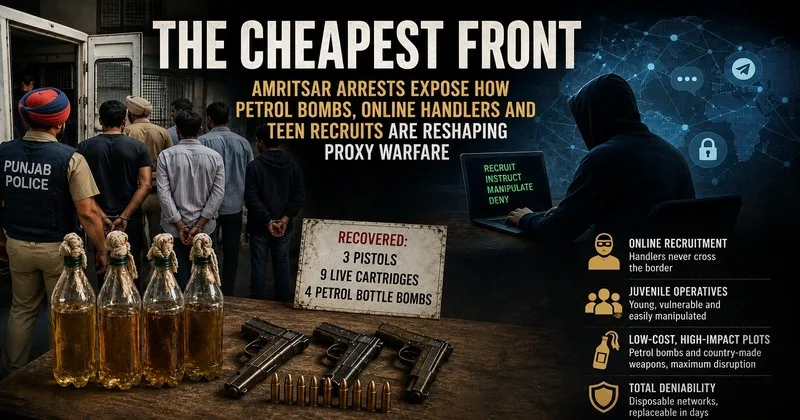
The Amritsar arrests expose a troubling new face of proxy warfare, low-cost, digitally recruited and built around vulnerable young recruits (AI generated image)

The Amritsar arrests expose a troubling new face of proxy warfare, low-cost, digitally recruited and built around vulnerable young recruits (AI generated image)

Facebook
Twitter
WhatsAppTelegramEmail

The Amritsar arrests reveal a proxy war rebuilt around petrol bombs, borrowed teenagers, and total deniability.

When the Amritsar Commissionerate Police announced this week that it had dismantled two alleged ISI-backed modules and arrested nine people, four of them juveniles, the recovered arsenal told its own quiet story. Not rocket-propelled grenades or kilograms of RDX, the kind of haul that has punctuated Punjab’s counter-terror bulletins for two years, but three country-made pistols, nine live cartridges, and four petrol bottle bombs. The plot investigators describe, an attack on Delhi’s Jantar Mantar during a student agitation against an alleged paper leak, was, they allege, to be executed with little more than fuel, improvisation, and a handful of teenagers who had likely never before handled a weapon.

It is tempting to read that modest recovery as reassurance. It should read as a warning.

For much of the last decade, the mental image of a cross-border terror plot has involved trained infiltrators, sophisticated explosives, and a discernible chain of command running back to a handler in Pakistan. That model was expensive, and expense created friction: weapons had to be smuggled, operatives trained, money moved. Every link in the chain was a point at which intelligence agencies could intercept. What the Amritsar case suggests is that our adversaries have studied that friction and engineered it away.

The emerging architecture is brutally economical. A handler never crosses the border. He recruits online, through encrypted apps and a rotating set of phone numbers. He does not send a trained fighter; he persuades a nineteen-year-old to persuade three younger boys. He does not ship RDX; he asks them to buy petrol. The instruction to conduct reconnaissance, to fix a camera near a railway line, to travel to a protest with a bottle of fuel, all of it can be transmitted as text, deniable and disposable. If the cell is caught, as this one was, the handler loses almost nothing. He has invested no training, no materiel, and no personnel he cannot replace by the end of the week.

This is why the juveniles matter more than the pistols. Four of the nine arrested were minors, and that is not incidental to the plot; it is the plot’s design. Younger recruits draw less suspicion, carry no criminal record, and are easier to manipulate with a mixture of money, grievance, and online flattery. They are ideal for the unglamorous work that actually makes an attack possible: watching a police building, photographing a railway track, carrying a package across a district line. A network that can convert local adolescents into unpaid intelligence assets has solved the single hardest problem in proxy warfare, getting people on the ground, without spending a rupee on infiltration.

Also Read: J&K: 21 suspected Bangladeshi nationals detained in Ramban during verification drive, six more held in Delhi

The choice of target is equally deliberate. Jantar Mantar is not a fortress; it is India’s designated public square, a place where farmers, students, and unions gather precisely because the cameras are already there. To an attacker, that is the appeal. A petrol bomb thrown into a crowd of protesting students would cost almost nothing and yet detonate across every news channel and social feed in the country. The objective of such an attack is not military attrition. It is psychological: to convert a scene of democratic assembly into an image of vulnerability, and to seed the suspicion and polarisation that follow any atrocity in a politically charged space. The plot, in other words, was aimed less at the protesters than at the watching nation.

The second module, allegedly uncovered after suspicious cameras were found trained on railway tracks, their footage reportedly shared with foreign handlers, points to the same logic applied to infrastructure. You do not need to destroy a rail network to damage it; you need only to demonstrate that you are watching it, and to force the state into the expensive, permanent posture of defending everything, everywhere. Surveillance is itself a weapon when the goal is to impose cost and anxiety rather than casualties.

None of this is proven. The charges rest, for now, on preliminary police statements and confessions recorded in custody, and the specifics, the identity of the handlers, the money trail, the true reach of the network, will have to survive the scrutiny of a courtroom before they can be treated as fact. India’s counter-terror discourse has a bad habit of converting every arrest into a settled verdict, and it is worth resisting that reflex here. But the pattern the case reveals does not depend on any single confession being upheld. It is corroborated by a string of similar disruptions across Punjab over the past two years, and it is consistent with how insurgencies everywhere have adapted to the age of the smartphone.

If the state wants to stay ahead of this model, it will have to fight it on the terrain the adversary has chosen, and that terrain is not primarily military. It is social and digital. It means treating online recruitment ecosystems as a live intelligence priority rather than an afterthought, because that is now the border being crossed. It means investing in genuine deradicalisation and youth outreach in vulnerable districts, so that a bored, aggrieved teenager has somewhere to turn other than a stranger on an encrypted app. It means hardening the soft, symbolic spaces, protest grounds, stations, gatherings, without turning them into cordons that hand the adversary his propaganda victory by other means. And it means the seamless, real-time intelligence sharing between states that a plot spanning Punjab, Uttar Pradesh, and Delhi so obviously demands.

The good news buried in this case is that the system worked. Human sources, technical surveillance, and inter-agency coordination combined to interrupt a plot before it matured. That is precisely how these things are meant to be stopped, and the officers involved deserve the credit.

The sobering news is the arithmetic. The state must succeed every time, at considerable expense, across an entire country of crowded public spaces. The adversary must succeed once, at almost no cost, and can afford to lose a dozen teenage cells for every attack that gets through. That asymmetry is the real intelligence to be extracted from four petrol bombs and a handful of borrowed boys. It is a cheaper war than the one we were prepared to fight, and cheaper wars are the ones that last.



Topics: Youth RadicalisationPunjab PoliceNational Securityjantar mantarTerror recruitmentAmritsar arrestsISI-backed modulesProxy warfare
Share
Tweet
SendShareSend
✮ Subscribe Organiser YouTube Channel. ✮
✮ Join Organiser's WhatsApp channel for Nationalist views beyond the news. ✮
Previous News

Keralam: CPM cadres get 16-year jail term for bid to murder RSS karyakartas in 2018 Panoor case

Related News

DRDO calls MSMEs to build swarm drones; The game-changing tech to consolidate India’s capabilities in next-gen warfare

Representative Image

India to set up 40 Intelligence Bureau units in Bangladesh border; Shield against infiltration & organised crimes

Punjab Police have arrested four people for the Amritsar police post attack (AI-generated image)

Punjab Police Foils Terror Plot: 4 arrested for incendiary attack on Amritsar Police post

Bangladeshi infiltrators residing in Assam expelled from the state in 48 hours

Assam: 39 Bangladeshi infiltrators expelled in 48 hours as CM Sarma steps up measures to protect state security

Keralam: Police detain suspicious man at Beypore Port; alleged constant chats with Pakistani citizen under probe

Delhi police refutes claims of Jantar Mantar being shut for protests, calls social media reports false and misleading

Fact Check: Delhi Police refutes claims of Jantar Mantar being shut for protests, calls social media reports false

Load More

Latest News

The Amritsar arrests expose a troubling new face of proxy warfare, low-cost, digitally recruited and built around vulnerable young recruits (AI generated image)

Amritsar Arrests Expose the New Face of Proxy War: Petrol bombs, online handlers & vulnerable teen recruits

CPM cadre convicted by Court

Keralam: CPM cadres get 16-year jail term for bid to murder RSS karyakartas in 2018 Panoor case

Tamil Nadu Finance Minister N. Marie Wilson presented the first Budget of the TVK government in Assembly on August 5, 2026

Tamil Nadu: TVK’s first Budget projects Rs 16,000 crore additional revenue, announces welfare push

India’s global crackdown on fugitives has intensified, with 274 offenders brought back from 36 countries since 2019 (AI generated image)

From Vijay Mallya to Tahawwur Rana: India’s global pursuit of fugitives brings 274 offenders back from 36 countries

SDPI National General Secretary Riyaz Parangipete

Karnataka Hate Speech Case: SDPI’s Riyaz Parangipete convicted in 11-year-old case, PFI links back in focus

Press breifing by Adilabad SP Akhil Mahajan, IPS

Telangana: Bangladeshi nationals arrested in Adilabad; police expose cross-border burglary network active since 2015

India’s laws allow police to use proportionate force against unlawful assemblies, subject to legal safeguards

Use of Force by Police: Understanding the law beyond the controversy

I.I.M.U.N. founder Rishabh Shah (Left), RSS Sarsanghchalak Dr Mohan Bhagwat (Right)

‘Not the first time’: RSS Sarsanghchalak Dr Bhagwat returns to I.I.M.U.N. to engage with Gen Z & Gen Alpha in Mumbai

Varanasi is set to welcome a spectacular cricket stadium blending modern sports infrastructure with Kashi’s timeless spiritual identity (AI generated image)

Varanasi: Bhagwan Shiva-inspired cricket stadium set to blend Kashi’s spiritual heritage with modern sporting grandeur

Prabodh Jnana Kendra successfully concluded its National Research Conference-cum-Camp

Greater Noida: National Research Conference 2026 brings together scholars to explore Bharat’s civilisational thought

Load More
  • Privacy
  • Terms
  • Cookie Policy
  • Refund and Cancellation
  • Delivery and Shipping

© Bharat Prakashan (Delhi) Limited.
Tech-enabled by Ananthapuri Technologies

  • Home
  • Search Organiser
  • Bharat
    • Assam
    • Bihar
    • Chhattisgarh
    • Jharkhand
    • Maharashtra
    • View All States
  • World
    • Asia
    • Africa
    • North America
    • South America
    • Europe
    • Australia
  • Editorial
  • Operation Sindoor
  • Opinion
  • Analysis
  • Defence
  • Culture
  • Sports
  • Business
  • RSS @ 100
  • Entertainment
  • More ..
    • Sci & Tech
    • Vocal4Local
    • Special Report
    • Education
    • Employment
    • Books
    • Interviews
    • Travel
    • Health
    • Politics
    • Law
    • Economy
    • Obituary
  • Subscribe Magazine
  • Read Ecopy
  • Advertise
  • Circulation
  • Careers
  • About Us
  • Contact Us
  • Policies & Terms
    • Privacy Policy
    • Cookie Policy
    • Refund and Cancellation
    • Terms of Use

© Bharat Prakashan (Delhi) Limited.
Tech-enabled by Ananthapuri Technologies