NEET protests, foreign narratives & politics of information warfare
July 28, 2026
  • Read Ecopy
  • Circulation
  • Advertise
  • Careers
  • About Us
  • Contact Us
Android AppiPhone AppArattai
Organiser
  • ‌
  • Bharat
    • Assam
    • Bihar
    • Chhattisgarh
    • Jharkhand
    • Maharashtra
    • View All States
  • World
    • Asia
    • Europe
    • North America
    • South America
    • Africa
    • Australia
  • Editorial
  • International
  • Opinion
  • RSS @ 100
  • More
    • Op Sindoor
    • Analysis
    • Sports
    • Defence
    • Politics
    • Business
    • Economy
    • Culture
    • Special Report
    • Sci & Tech
    • Entertainment
    • G20
    • Azadi Ka Amrit Mahotsav
    • Vocal4Local
    • Web Stories
    • Education
    • Employment
    • Books
    • Interviews
    • Travel
    • Law
    • Health
    • Obituary
  • Subscribe
    • Subscribe Print Edition
    • Subscribe Ecopy
    • Read Ecopy
  • ‌
  • Bharat
    • Assam
    • Bihar
    • Chhattisgarh
    • Jharkhand
    • Maharashtra
    • View All States
  • World
    • Asia
    • Europe
    • North America
    • South America
    • Africa
    • Australia
  • Editorial
  • International
  • Opinion
  • RSS @ 100
  • More
    • Op Sindoor
    • Analysis
    • Sports
    • Defence
    • Politics
    • Business
    • Economy
    • Culture
    • Special Report
    • Sci & Tech
    • Entertainment
    • G20
    • Azadi Ka Amrit Mahotsav
    • Vocal4Local
    • Web Stories
    • Education
    • Employment
    • Books
    • Interviews
    • Travel
    • Law
    • Health
    • Obituary
  • Subscribe
    • Subscribe Print Edition
    • Subscribe Ecopy
    • Read Ecopy
Organiser
  • Home
  • Bharat
  • World
  • Operation Sindoor
  • Editorial
  • Analysis
  • Opinion
  • Culture
  • Defence
  • International Edition
  • RSS @ 100
  • Magazine
  • Read Ecopy
Home Bharat

From NEET Protests to Information Warfare: Examining foreign media narratives, fake news and anti-India propaganda

The NEET paper leak was a legitimate issue that deserved accountability, but the protests also exposed how misinformation, foreign narratives, and cross-border propaganda can shape public discourse. The episode raises broader questions about information warfare, media framing, and the responsibility to distinguish democratic dissent from coordinated disinformation campaigns

Diganta ChakrabortyDiganta Chakraborty
Jul 28, 2026, 06:00 pm IST
in Bharat, Delhi
Follow on Google News
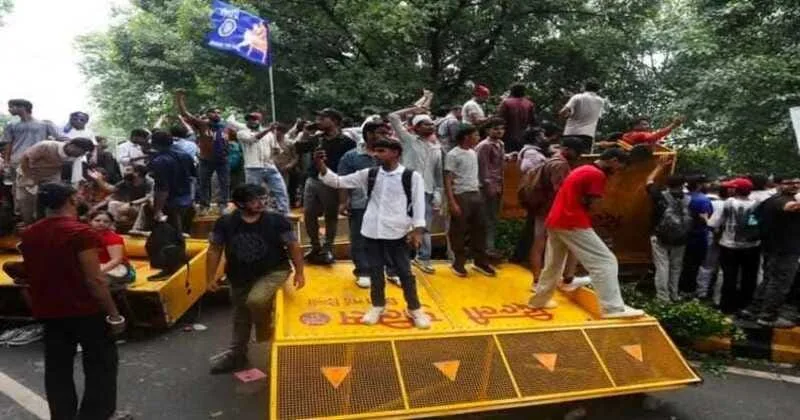
The NEET protests exposed how misinformation, foreign narratives, and propaganda shaped public discourse

The NEET protests exposed how misinformation, foreign narratives, and propaganda shaped public discourse

FacebookTwitterWhatsAppTelegramEmail

New Delhi: NEET paper leak was a genuine issue that deserved to be addressed. There is absolutely no doubt about that. However, some incidents carried out in the name of student protests over the last few days have brought to mind a famous dialogue from Dhurandhar, in which the character portraying India’s NSA says: “Hindustan ka sabse bada dushman Hindustani hi hai. Pakistan toh doosre number pe hai.”

What is particularly alarming is the extent to which anti-India activities have surfaced under the guise of legitimate protest. During a press briefing on July 25, the Delhi Police stated that they had uncovered what they described as a coordinated misinformation campaign surrounding the ongoing Jantar Mantar protest. According to the police, fake claims about a protester’s death, doctored videos, and AI-generated deepfakes were circulated to inflame public sentiment. They further revealed that more than 400 social media accounts operating from Pakistan had been identified as actively spreading false narratives about the protest. Yet this raises a more uncomfortable question: who amplified these narratives within India? External propaganda can gain traction only when there are willing amplifiers at home. It is deeply disturbing that some individuals living in this country appeared eager to circulate unverified or false information that had the potential to malign India’s image and undermine public trust. Freedom of expression and the right to protest are essential pillars of democracy, but they cannot become a shield for the dissemination of misinformation or for narratives that ultimately serve hostile interests at the expense of the nation.

Another point we should remember is how Western and foreign narratives have shaped our minds. In his book Western Media Narratives on India, senior journalist Umesh Upadhyay quotes veteran Indian journalist S. Viswam in this context. Viswam observed: “Three quarters of the world population living in the Third World countries are dominated by the Western countries in regard to the global flow of communication. Since the flow is one way, unbalanced and compulsory, the dominance by the Western media of the developing countries turns out veritably to be a modern and sophisticated form of cultural imperialism.”

In the context of these so-called student protests, the role of sections of the foreign media in amplifying an anti-India or ‘Breaking India’ narrative cannot be overlooked. On 25 July, Reuters published a report under the headline, “India’s Instagram Gen Z dents Modi’s aura ahead of key state polls.” The very framing of this headline raises important questions. Rather than presenting a neutral account of student demonstrations, it appears to interpret the protests through the lens of electoral politics, portraying them as a sign of Prime Minister Narendra Modi’s declining appeal. Such narratives often go beyond reporting events; they shape international perceptions of India’s political landscape and reinforce preconceived narratives that seek to depict the country as politically unstable and deeply divided. Whether intentional or not, this style of reporting contributes to a discourse that is readily appropriated by those invested in projecting India in a negative light.

Even a glance at the Asia section of Al Jazeera reveals an intriguing pattern. At times, it appears as though the platform is more invested in India’s youth and domestic politics than many within the country itself. A headline such as “How India’s ‘Cockroach’ protesters shook the Modi government” is not merely an account of a protest; it carries a carefully framed narrative. Such language projects an image of the Indian government as politically fragile and easily destabilised before a global audience. Whether intentional or not, this style of reporting extends beyond journalism into perception-building, shaping international opinion through a lens that often amplifies political confrontation while reducing the complexities of India’s democratic processes.

Also Read: CJP Protest: Delhi Police identify 2,873 people with criminal records; Murder and rape accused among those flagged

The Guardian, for instance, observed: “The Cockroach Janta Party (CJP) might have started out as an online joke, but – driven by millions of discontented young people in India – it has swiftly grown into one of the most unexpected challenges to the powerful rightwing government of Narendra Modi.” This characterisation is revealing. Rather than treating the issue merely as a student-led movement over an examination controversy, the report presents it as a broader political challenge to the Modi government.

Another striking example came on 20 July, when the Associated Press carried the headline: “India police use tear gas to stop march on Parliament by Cockroach movement supporters.” The report went on to describe the demonstration as “one of the most serious confrontations in the movement’s campaign against Prime Minister Narendra Modi’s government.” Such framing does more than merely report an event—it places it within a political narrative that often reinforces preconceived perceptions about India. Time and again, influential international media outlets appear quick to amplify episodes that fit these narratives, while overlooking context or complexity. This pattern raises a legitimate question: are they reporting on India, or are they projecting a predetermined image of it whenever the opportunity arises?

The NEET paper leak was a genuine issue, and students had every democratic right to demand accountability and justice. Yet, the manner in which the issue was appropriated and amplified by hostile propaganda networks and sections of the foreign media should concern every Indian, regardless of political affiliation. These episodes serve as a reminder that external powers have often sought to shape narratives that weaken India’s global standing and undermine governments pursuing a strong nationalist agenda in pursuit of their own strategic interests. As citizens, we must remain vigilant, not only about our legitimate domestic concerns but also about the realities of global politics. A mature democracy must be capable of demanding accountability without becoming an instrument for those seeking to discredit the nation itself.
 

Topics: Foreign MediaDelhi Policeinformation warfareDelhi protestsNEET paper leakNEET protest
ShareTweetSendShareSend
✮ Subscribe Organiser YouTube Channel. ✮
✮ Join Organiser's WhatsApp channel for Nationalist views beyond the news. ✮
Previous News

Tamil Nadu: Hindu Munnani stages statewide protest demanding abolition of temple darshan fees

Related News

Cab driver Vijay Kumar was allegedly stabbed to death in Delhi's Krishna Nagar; Ayan, Sahil and a juvenile were arrested

Delhi: Hindu cab driver Vijay Kumar’s throat slit in Taliban style; Ayan, Sahil arrested, Aman absconding

Bengaluru Police have registered an FIR against a woman for allegedly displaying posters supporting Umar Khalid and Sharjeel Imam

Karnataka: FIR registered after pro-Umar Khalid, Sharjeel Imam posters surface at Bengaluru NEET protest

Delhi Police sources said facial recognition analysis identified 2,873 individuals with criminal backgrounds at the CJP protest

CJP Protest: Delhi Police identify 2,873 people with criminal records; Murder and rape accused among those flagged

Activist Meghnad S (Left), CJP Faces Heat After Viral Celebration Video

‘They abandoned and starved protesters’: Activist tears into CJP over ‘Resignation party’ video and leaving protesters

Sreelekha Mitra holding PM Modi poster (Left) & BJP leader Keya Ghosh (Right)

West Bengal: Sreelekha Mitra faces FIR over objectionable PM Modi poster during NEET protest

Viral videos showing senior CJP leaders celebrating after their 37-day protest have sparked fresh political controversy

CJP Leaders Party in 5-Star Hotel While Students Bleed: ‘Typhoid-Hit’ Abhijeet Dipke Seen Dancing at Victory Bash

Load More

Latest News

The NEET protests exposed how misinformation, foreign narratives, and propaganda shaped public discourse

From NEET Protests to Information Warfare: Examining foreign media narratives, fake news and anti-India propaganda

Tamil Nadu: Hindu Munnani stages statewide protest demanding abolition of temple darshan fees

No cover-up in AI-171 crash: AAIB tells Supreme Court global experts are helming probe, final report by October

BJP MP Nishikant Dubey

‘Who is the Indian MP behind Backops UK?’: Nishikant Dubey blows the lid off foreign networks targeting India

23 forest officials of Assam return safe after being lost for two days in dense forests

Assam Floods: In line of duty, 23 forest officials return safely after being lost for two days in dense forests

Sovereign AI Models of India: A bold strategic shield to fortify digital sovereignty amid tech weaponisation

UDISE+ Report: Karnataka girls’ Secondary School dropout rate is highest among major states

Accused teachers Kavya and Keerthana

Keralam: Two teachers expelled after police found their bank accounts were used to route drug money in MDMA network

Cab driver Vijay Kumar was allegedly stabbed to death in Delhi's Krishna Nagar; Ayan, Sahil and a juvenile were arrested

Delhi: Hindu cab driver Vijay Kumar’s throat slit in Taliban style; Ayan, Sahil arrested, Aman absconding

Meta apologises for removing PM Modi FaceBook video; Cites technical glitch, Government scrutiny demands explanation

Load More
  • Privacy
  • Terms
  • Cookie Policy
  • Refund and Cancellation
  • Delivery and Shipping

© Bharat Prakashan (Delhi) Limited.
Tech-enabled by Ananthapuri Technologies

  • Home
  • Search Organiser
  • Bharat
    • Assam
    • Bihar
    • Chhattisgarh
    • Jharkhand
    • Maharashtra
    • View All States
  • World
    • Asia
    • Africa
    • North America
    • South America
    • Europe
    • Australia
  • Editorial
  • Operation Sindoor
  • Opinion
  • Analysis
  • Defence
  • Culture
  • Sports
  • Business
  • RSS @ 100
  • Entertainment
  • More ..
    • Sci & Tech
    • Vocal4Local
    • Special Report
    • Education
    • Employment
    • Books
    • Interviews
    • Travel
    • Health
    • Politics
    • Law
    • Economy
    • Obituary
  • Subscribe Magazine
  • Read Ecopy
  • Advertise
  • Circulation
  • Careers
  • About Us
  • Contact Us
  • Policies & Terms
    • Privacy Policy
    • Cookie Policy
    • Refund and Cancellation
    • Terms of Use

© Bharat Prakashan (Delhi) Limited.
Tech-enabled by Ananthapuri Technologies