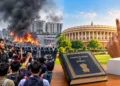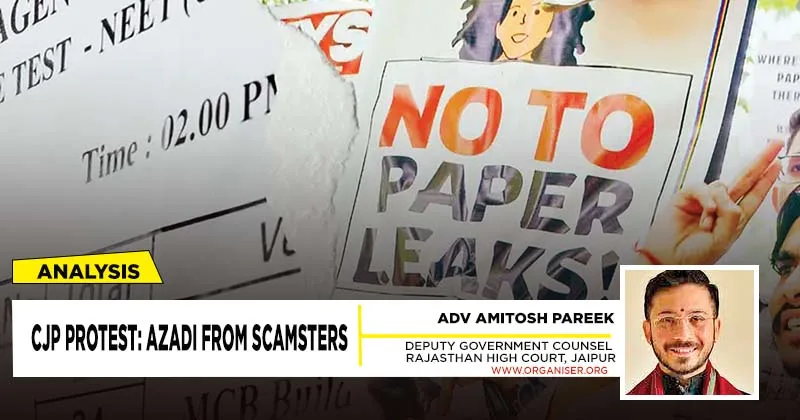
In an important message to countrymen, Prime Minister Narendra Modi announced that those responsible for the NEET paper leak must face the strictest possible punishment. He also stressed that protecting the integrity of the examination is a national responsibility. The Prime Minister also stated that NEET re-examination was conducted expeditiously, without delay, to ensure the future of the aspirants concerned. It is a national crisis, which must be kept above any politics, and therefore, understanding the need of the hour. Prime Minister appealed to NDA partners to stay united in supporting legislative business during the monsoon session and also urged Opposition parties to cooperate in Parliament as everyone shares the responsibility of working for the country’s future and the welfare of young people. It is important to note that re-examination of NEET is being conducted and the CBI had arrested the person as the “Kingpin” behind the leak. Subsequently, the Education Ministry has also launched a website where people can report suspicious claims, unauthorised content and fraudulent activities related to NEET.
For millions of students, competitive examinations are not mere tests but life-deciding factors and opportunities. But when politics and hidden agendas override the cause, it becomes propaganda and an agenda-driven act. From the Rajasthan REET scandal to the nationwide outrage over the NEET UG paper leak controversy, India’s examination system has increasingly come under scrutiny for corruption, institutional failure, organised crime and a major political blame game. Political parties including Congress, Samajwadi, AAP and others) who are shouting for the resignation of the Education Minister on NEET. However, they were very much silent when paper leaks were rampant during their tenure. To clear the air, we must remember the Congress era, where the nation witnessed repeated paper leaks and cancellations between 2004-2014 affecting school boards, university examinations, and major national entrance tests.
No mercy for Scamsters
The Cabinet on July 24 approved amendments to the Public Examinations (Prevention of Unfair Means) Act, 2024, amid continuing nationwide protests over the NEET examination paper leak. Under the proposed amendments, the Government plans to significantly tighten punishments for paper leak offences. The draft Bill provides for a maximum prison term of 10 years and a fine of up to Rs 10 crore for those found guilty of leaking examination papers. It also seeks to raise the minimum imprisonment from three years to five years, strengthening the existing provisions under the Public Examinations (Prevention of Unfair Means) Act, 2024.
Rajasthan, during the Congress tenure led by Chief Minister Ashok Gehlot, became the epicentre of a paper leak, where over 12 lakh students were affected after multiple recruitment examinations were cancelled due to a conspiracy. Ironically, the same ex-Chief Minister of Rajasthan participated in the protest against Education Minister Dharmendra Pradhan and was detained last night on July 21 in Jaipur along with other
Congress members.
There are various incidents when the grave concern of paper leak was not being raised. INDI Alliance was acting as mute spectator. Such behaviour raises questions about those who are now showing concern for the students, as they were shamelessly silent then. These incidents disrupted the academic careers of countless students, highlighting serious lapses in maintaining the integrity of the examination processes.
It was astonished to witness that despite getting to the nerves of the paper leak mafia racket who were deliberately and consciously mocking the system and playing with the future of deserving candidates in 1993 UP Mulayam Singh Yadav openly campaigned that the first thing he will do after winning the elections to repeal Anti Copying Law–He did within 30 minutes of his swearing but no one of the intellectual class said anything against it. It was for the very first time that the stringent law was implemented under the leadership of Narendra Modi at the Union level in Parliament to curb the leak mafia.
Justice PK Shamsuddin Commission Report
A commission was formed to look into the unfavourable academic environment and political campuses in Kerala. After a thorough investigation, the Commission submitted its report to the Kerala High Court. The observation in the report records that most of the complaints received were against SFI, allegedly involved in inhumane attacks on fellow students. It was also recorded that no other student organisation can function where SFI had an upper hand. The important observation recorded was that teachers also helped the student organisation leaders during exams by leaking question papers or illegally providing answer sheets in advance.
It was also found that two of the accused in the attack that took place on 11.06.2019 had secured ranks in the Civil Police Officer Examination conducted by the Kerala Public Service Commission. Another SFI leader, who was ranked second in the police officers exam, had also resorted to malpractice. A major revelation was that the policeman, arrested in connection with the PSC exam scam, has told the investigators that all three were provided answers for the exam’s question paper through mobile phones thereafter. Five, including SFI leaders, were booked over leakage of PSC test paper.
There are various incidents when the grave concern of paper leak was not being raised. INDI Alliance was acting as A mute spectator. Such behaviour raises questions about those who are now showing concern for the students, as they were shamelessly silent then
The above-mentioned Anti-Cheating Law came into effect on June 21 of 2024, after it was notified in the official gazette. It was a decisive move to curb paper leaks and cheating in public examinations. The Act aims to prevent unfair means in public examinations conducted by major bodies such as UPSC, SSC, Railways, Banking and NTA, among others. The important sections of the Act are mentioned below:
CJP & Reflection of AAP
Cockroach Janta Party (CJP) refreshed the memories of the same modus operandi that created an anarchist leader in Delhi. Still, it is, of course, a different matter that those who are trying to brush away corruption with their broom as the party symbol, and now in the experimental form of CJP, are themselves embroiled in allegations of corruption. It is significant to mention herein that CJP is merely a new disguised reflection or avatar of AAP. Let us look at the timeline of CJP, it was reportedly born on May 16, 2026, as an online satirical political movement, and within two months it managed to outpace India’s major political parties in terms of social media presence. Now the question being raised is how CJP could accumulate millions of followers on social media platforms in days—considering the statistics and looking at the statistics, followers primarily from Pakistan (49 per cent), Bangladesh (14 per cent) and the USA (14 per cent) while attracting only 9 per cent from India.
Anti-National Ideologue
The instigator of CJP, namely Abhijeet Dipke, along with several other prominent members, have come under scrutiny for their ideological positions. It is significant to mention herein that Dipke had earlier faced a complaint over a series of social media posts related to Kashmir. In August 2019, Legal Right Observatory filed a complaint in Pune against Dipke for his post amplifying a separatist narrative about post-Article 370. “Today it’s Kasmir, tomorrow it can be your state”.
Stepping down to another prominent member of CJP and close associate of Dipke, namely Saurav Das (spokesperson), has provocative and separatist views toward Article 370 and Kashmir; he considers it a sign of bigger worry and questioned the Supreme Court of India. Supporting Umar Khalid in questioning the Ayodhya Verdict, raising questions against the Indian Army operation against Pakistan are some of his anti-national ideologues. He has repeatedly questioned Khalid’s continued incarceration and participated in campaigns advocating for his release. Subject to military expedition, Das expressed concerns about escalation and rhetoric directed toward Pakistan.
We need to understand that the cocoon of narrative and propaganda being tried by so-called student protests at Jantar Mantar is nothing but an act to create a negative image of Bharat on an international platform. Witnessing the videos of so-called flashed protestors, they consider Umar Khalid and Sharjeel Imam as the future leaders and consider them as their idols. It seems that, being widely exposed, it is not a genuine students’ protest but, in the guise of a students’ protest, Leftists, anti-nationals, and Communists are running their agenda fuelled by Deep State.