उत्सवे व्यसने चैव दुर्भिक्षे शत्रुसंकटे।
राजद्वारे श्मशाने च यस्तिष्ठति स बान्धवः॥
This means, “He alone is a true friend (or kinsman) who stands by you in times of celebration, adversity, famine, danger from enemies, at the king’s court, and even at the cremation ground”.
Hindu Scriptures define the meaning of true friendship in above cited Shloka. Those bondings which are necessitated by short term gains, don’t last long and are detrimental to the interests of both the friends because when need arises, in absence of support, trust of one or another is shattered.
Relations between Bharat and Israel are beyond friendship; they are epitome of ideological kinship. Both the civilisations have been threatened by the Jihadist powers, historically and currently.
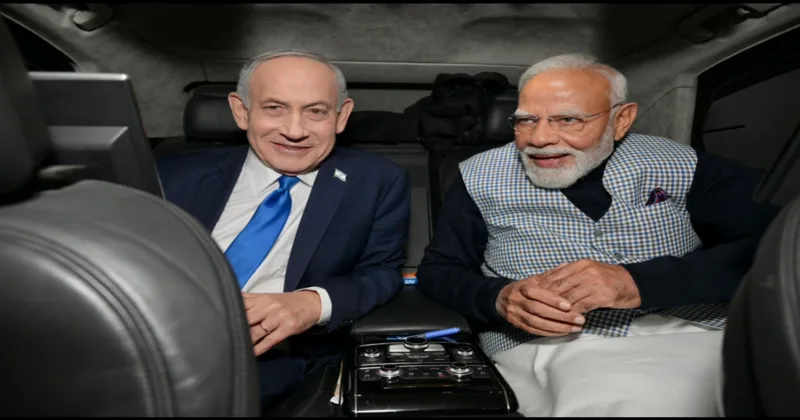
Israeli Prime Minister Benjamin Netanyahu recently described Bharat as a steadfast friend of Israel, noting that a nation of around 1.4 billion people stands with Israel as a supporter and partner. His statement is more than a diplomatic courtesy—it reflects the remarkable transformation in Bharat-Israel relations over the past three decades.
For much of the Cold War, Bharat’s relations with Israel remained limited. Although Bharat recognized Israel in 1950, full diplomatic relations were established only in 1992. Since then, bilateral ties have expanded rapidly, encompassing defence, agriculture, water management, cybersecurity, innovation, trade, and intelligence cooperation.
Netanyahu’s observation underscores Israel’s recognition of Bharat’s growing influence in global affairs. As the world’s most populous country and one of the fastest-growing major economies, Bharat’s position on international issues carries increasing weight. Support or understanding from New Delhi is therefore regarded as strategically significant by many countries, including Israel.
Bharat and Israel have long cooperated on counterterrorism and intelligence. Both countries have experienced attacks by militant groups and have emphasized the importance of protecting civilians from terrorism.
Israel has become one of Bharat’s important defence partners, supplying advanced military equipment such as air defence systems, drones, radar technology, precision-guided weapons and surveillance systems. The partnership also includes joint research and development in several defence technologies.
The relationship has been reinforced by regular exchanges between political leaders, military officials, scientists and business communities. While defence cooperation often receives the most attention, the relationship extends far beyond military matters.
Israeli expertise has contributed to Bhartiya agriculture through Centres of Excellence that demonstrate modern irrigation, horticulture and water-efficient farming practices. Drip irrigation, greenhouse cultivation and precision agriculture have benefited farmers in several Bhartiya states.
Cooperation in water conservation, desalination, wastewater recycling, healthcare, digital technologies, artificial intelligence and startup innovation has also strengthened bilateral ties. Trade between the two countries has diversified considerably, moving beyond diamonds into sectors such as chemicals, pharmaceuticals, electronics, engineering goods and information technology.
Bharat’s friendship with Israel exists alongside its longstanding ties with Arab nations.. Successive Bhartiya governments have sought to maintain relations with all major stakeholders in West Asia.This balanced approach reflects India’s broader foreign policy of maintaining strategic autonomy rather than aligning exclusively with one side in regional disputes.
When Netanyahu referred to Bharat’s 1.4 billion people as friends and supporters, he was highlighting the importance Israel attaches to its relationship with Bharat. Such remarks also acknowledge the increasing people-to-people contacts between the two countries through tourism, education, business, technology, and cultural exchanges.
The statement can also be interpreted as recognition of Bharat’s emergence as a major global power whose diplomatic positions are closely watched internationally.
Like any major bilateral relationship, Bharat- Israel ties continue to evolve within a changing geopolitical landscape. Developments in West Asia, shifting global alliances, energy security, and regional conflicts all influence the context in which the partnership operates. Bharat-Israel cooperation in innovation, defence manufacturing, renewable energy, semiconductors, cybersecurity, food security, and emerging technologies offers considerable scope for future growth.
Israel has a population of around 10 million; there is shortage of labour in the semi-skilled job sector. Bharat is fulfilling the shortage by supplying requisite numbers. At present around fifty thousand Bhartiya workers are employed in Israel and as per recently signed agreement, other fifty thousand will find jobs there in the next few years.
On a people to people level, a great number of tourists from each country are visiting another regularly. Many Bollywood movies have been shot in the Israeli landscape recently. A good amount of cultural exchanges are also taking place which are providing people with opportunities to know ancient cultures.
Prime Minister Benjamin Netanyahu’s description of Bharat as a nation of 1.4 billion friends reflects the depth that Bharat-Israel relations have attained over the past three decades. While the exact interpretation of public statements should be understood in their diplomatic context, there is little doubt that both countries today regard each other as important strategic partners.
Bharat’s relationship with Israel is built on shared interests, expanding economic and technological cooperation and regular political engagement. At the same time, Bharat continues to pursue an independent foreign policy that seeks constructive relations across West Asia. As both nations navigate an increasingly complex international environment, their partnership is likely to remain an important feature of the region’s strategic landscape.