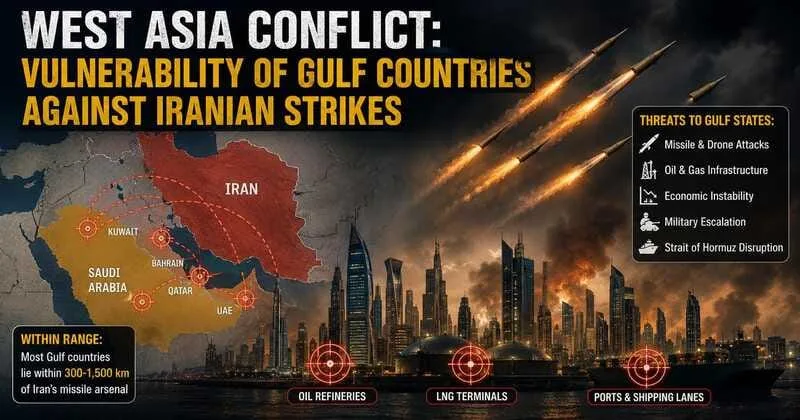
In the ongoing West Asia conflict, the Gulf countries have suffered maximum collateral damage through the Iranian strikes. In the current phase of conflict escalation, the Memorandum of Understanding between the US and Iran has collapsed, and both nations have resumed the strikes. In the last 12 days, the US has targeted both military and civilian infrastructure targets inside Iran. Iran, on the other hand, has retaliated against the American bases and civilian targets located inside the Gulf countries. Even with most modern air defence systems and the latest missiles held, the American bases located in the Gulf countries have suffered damage at the hands of Iranian strikes. Most of the Gulf countries also hold the most modern military hardware and yet seem helpless in neutralising the Iranian strikes.
It also has to be understood that all the conflicting parties or nations utilise any ceasefire period to beef up the military hardware, accelerate defence production, import critical military weapons and raise more fighting force through recruitment. During the ceasefire, the US has also deployed more forces around Iran, and the US Central Command involvement against Iran certainly would have beefed up the capability for a long fight.
Even the damage to the American bases inside the Gulf countries would have carried out replenishment and rapid repairs. But the Iranian resilience despite the US and Israeli strikes has surprised their adversaries and military analysts. Iran is left with no credible air force and has lost most of its naval ships. Therefore, the Iranians have resorted to a dispersed defence structure and asymmetric attrition. It is feasible that Iran has clandestinely imported missiles, drones and rockets from Russia and China during the ceasefire period. So, Iran is far from being militarily defeated in the ongoing West Asia conflict.
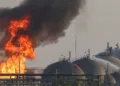
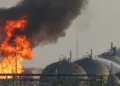
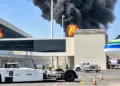
It is therefore not surprising that Iran has reprised the US strikes by targeting the Gulf countries with pinpoint accuracy. The defences in these Gulf countries have been found inadequate because Iran has repeatedly launched large volleys of ballistic missiles, cruise missiles and drones simultaneously. Even the layered air defence system of the American bases deployed in the Gulf countries (Patriot, THAAD, naval Aegis and local systems) get overloaded with a massive array of Iranian strikes. This leads to some munitions penetrating the defences and causing considerable damage to the American bases and civilian targets. Also, many Gulf-based US facilities are closely located near the Iranian border, and thus the warning and reaction time is too short to respond. In addition, soft targets like fuel depots, hangars and logistic nodes are harder to defend and can even be damaged by near-misses or limited penetrations. Thus, Iran has successfully demonstrated its military muscle against the Americans by targeting their bases in the Gulf countries.
Another question arises: why have the Gulf countries not retaliated against the Iranian strikes and have largely adopted a defensive posture? The Gulf countries like Bahrain, Kuwait, the UAE, Qatar and Jordan have particularly been targeted by Iran. These countries rely on US security guarantee and therefore are avoiding a direct confrontation with Iran. Iran has also been smart to limit the strikes largely towards American bases to the extent possible. Iran has also avoided any major strikes inside Saudi Arabia as of now. Also, though all these Gulf countries boast of the latest air defence systems, their own soldiers lack the professional expertise to exploit them optimally. These Gulf countries also fear from the proxies of Iran, particularly Hezbollah and the Houthis, shifting the conflict inside their country towards terrorism and guerrilla warfare.
From the Indian perspective, the West Asia conflict has many lessons. But the most important one is to beef up the air defence systems, both defensive and offensive in nature. In the western sector, India’s military targets and the civilian infrastructure are located close to Pakistan. Pakistan has also created the Army Rocket Forces Command; a force modelled on China’s PLA Rocket Force. Pakistan has also imported a large quantity of rockets, missiles and drones, particularly from China and Türkiye. Pakistan has also shifted the terrorist camps deep inside and away from the borders, besides dispersing them in multiple locations. Thus, Indian armed forces and the civil administration have to upgrade their response mechanism in every field to deal with the emerging threat from Pakistan, now duly backed by China.