On the evening of July 26, 2008, Ahmedabad was rocked by a coordinated series of 21 bomb blasts within a span of approximately 70 minutes(roughly 06:45 PM –07:55 PM). The attacks targeted public buses, markets, residential areas and — notably — hospitals treating blast victims from earlier round. The blasts killed 56 people and injured more than 200 others, marking one of the deadliest terror incidents in Gujarat’s history that year.
The Indian Mujahideen(IM) claimed responsibility minutes before the explosions via a 14-page email manifesto titled “Await 5 minutes for the revenge of Gujarat,” explicitly linking the attack to the 2002 Gujarat riots. The incident formed part of a broader 2008 terror campaign that included the Bangalore serial blasts (July 25) and later the Delhi bombings (13th September), sometimes referred to in intercepted communications as “Operation BAD”.
A lengthy investigation by Gujarat Police led to the arrest of numerous suspects, mostly linked to the banned Students’ Islamic Movement of India (SIMI). In February 2022, a special court convicted 49 out of 78 accused. On February 18, 2022, it awarded the death penalty to 38 convicts and life imprisonment to 11 others. Recently, on July 7, 2026 the Gujarat High Court upheld the convictions and sentences in full and directed the state government to pay enhanced compensation to victims’ families.
Casualties and Immediate Impact:
- Deaths: 56 (the toll rose over subsequent days from initial reports of around 40)
- Injuries: Over 200 (some contemporary reports cited up to 243)
- Damage was concentrated on buses and public spaces; several unexploded or defused devices were recovered.
Prime Minister Manmohan Singh visited Ahmedabad and announced ex-gratia payments (later raised to ₹3.5 lakh for kin of the deceased and ₹50,000 for the injured). Gujarat Chief Minister Narendra Modi announced ₹5 lakh per victim family.
Claim of responsibility and motives
Minutes before the first blast (around 06:41 PM), several television channels received a 14-page email from the Indian Mujahideen. The subject line read: “Await 5 minutes for the revenge of Gujarat.”
Key excerpts included:
“In the name of Allah the Indian Mujahideen strike again! Do whatever you can, within 5 minutes from now, feel the terror of Death!”
The email threatened Maharashtra politicians, businessman Mukesh Ambani (over a Waqf land dispute), and certain Bollywood actors. It referenced the 2002 Gujarat violence and ongoing trials of Muslims in other blast cases. Some sources also attributed or linked the attacks to HuJI (Harkat ul Jihad Islami) operatives.
 Investigation
Gujarat Police led the probe, supported by central agencies. Key breakthroughs included:
- Tracing the claim email to a Navi Mumbai IP address (leading to questioning of a U.S. national whose residence was raided).
- Analysis of mobile phone records — multiple SIM cards activated together months earlier using fake documents and deactivated just before the blasts.
- Recovery of stolen explosive-laden vehicles, CCTV footage (including from a Pune toll plaza) and identification of the source of LPG cylinders and wooden crates used in the devices.
- Intercepted communications referencing the Bangalore and Ahmedabad operations.
A detailed chargesheet (over 2,000 pages) was filed naming dozens of accused and hundreds of witnesses.
Arrests, trial and verdicts
Seventy-seven to seventy-eight people were chargesheeted. Many were SIMI activists or associates from Gujarat, Uttar Pradesh, Maharashtra, Madhya Pradesh, Rajasthan, Kerala, and other states. Key figures included former SIMI leader Safdar Nagori and several module commanders.
Trial Court (Special Court, Ahmedabad)
- Verdict: February 8, 2022 — 49 convicted, 28 acquitted for lack of evidence.
- Sentencing: February 18, 2022 — 38 death sentences and 11 life imprisonments for murder, attempted murder and related charges. This was one of the largest numbers of death sentences handed down in a single Indian terror case.
Gujarat High Court (July 7, 2026)
A division bench upheld the special court’s verdict in its entirety, confirming the 38 death sentences and 11 life terms. The court also directed the Gujarat government to pay ₹10 lakh to the next of kin of each deceased victim and ₹5 lakh to those with grievous injuries. Disbursement was ordered by 30th March 2027. The state government welcomed the verdict as a “historic victory against terrorism.”
The case became one of India’s longest-running terror trials(over 13 years from incident to trial court verdict).
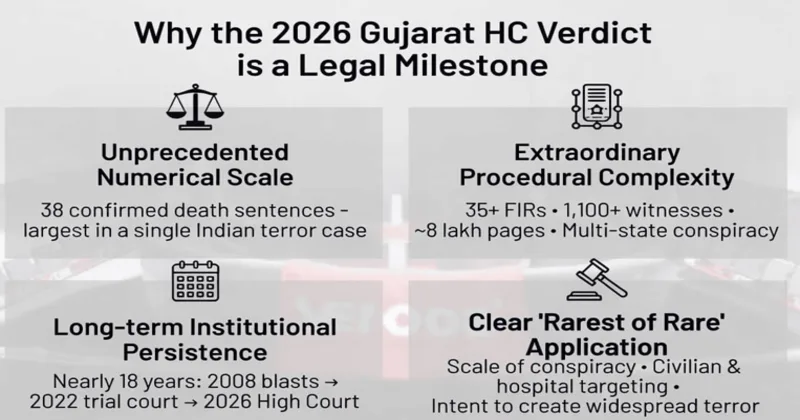
The case was one of India’s largest terror investigations and trials:
- It involved the merger of 35 FIRs (20 from Ahmedabad + related cases from Surat and elsewhere).
- Over 1,100–1,160 witnesses were examined
- Nearly 6,000 exhibits and a record of about 7.88 lakh pages
- Multi-state conspiracy spanning Gujarat, Kerala, Uttar Pradesh, Maharashtra, Madhya Pradesh, and others, involving training camps, logistics, and coordinated execution by Indian Mujahideen (IM) operatives linked to SIMI.
The High Court’s confirmation came after nearly four years of appeals validated this massive body of evidence (forensics, call records, electronic data, approver statements, recoveries, etc.).
Why is this judgement significant?
In February 2022, a special court became the first court in Indian history to sentence 38 people to death in a single case. On July 7, 2026, the Gujarat High Court fully upheld those 38 death sentences (plus life imprisonment for 11 others). This makes it one of the largest confirmed capital punishment verdicts ever delivered by an Indian court.
The High Court explicitly upheld the death penalty under the Bachan Singh Principles, citing:
- The “humongous” scale of the conspiracy.
- Deliberate targeting of civilians in markets, buses, and especially hospitals (to maximise casualties among the injured and disrupt rescue efforts).
- Clear intent to create an atmosphere of widespread terror and challenge the state’s authority.
- Calculated, multi-city planning (linked in modus operandi to other 2008 attacks).
The detailed 2,223-page High Court judgment provides thorough legal reasoning that can guide future terror cases. This sets a strong precedent for how courts should treat large-scale, meticulously planned terror conspiracies involving mass civilian targeting.
Comparison with other complex trials
If we compare this case with the second largest capital punishment case of Rajiv Gandhi Murder, on 28th January, 1998 a Special Designated TADA Court in Poonamallee, Chennai, found all 26 facing trial guilty of criminal conspiracy and involvement in the suicide bombing and sentenced all 26 accused to death. However, upon mandatory appeal, the Supreme Court of India drastically scaled back the convictions on 11th May, 1999.
The Supreme Court freed 19 convicts entirely of the conspiracy charges. Three convicts had their capital sentences reduced to life imprisonment. The apex court confirmed the death penalty for only four key conspirators. Further, none of the four remaining death sentences were ever executed; instead, they were legally commuted over a span of 14 years.
In summary, the verdict is a milestone because it combines unprecedented numerical scale (38 confirmed death sentences), extraordinary procedural complexity, long-term institutional persistence and a clear, well-reasoned application of the rarest-of-rare standard to a major domestic terror conspiracy. It is widely described as one of India’s strongest judicial responses to terrorism in recent decades.