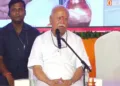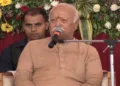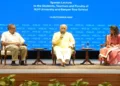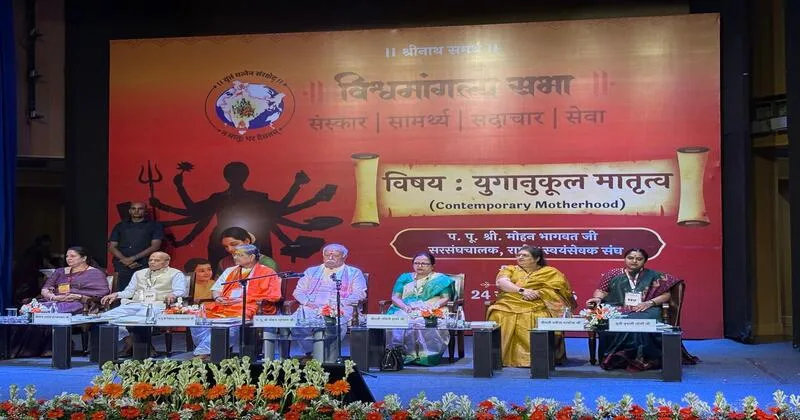
New Delhi: Dr Bhagwat said that motherhood has remained the foundation of creation from the very beginning and that the upbringing of future generations rests upon the mother, who is the first Guru of every human being.
Dr Bhagwat observed that asking him to speak on motherhood was, in one sense, paradoxical, as motherhood naturally belongs to women. He noted that several eminent thinkers, including Swami Vivekananda, Mahatma Gandhi and Rabindranath Tagore, had already reflected extensively on the subject. The discussion has become necessary because modern society has begun to forget certain eternal truths, he said.
He remarked that motherhood is not merely a topic of intellectual discourse but “a truth of life”. Whether one accepts it or not, truth remains unchanged. Humanity remains on the right path only when it lives in accordance with truth.
Explaining the central role of motherhood, the RSS Sarsanghchalak said that every new birth necessarily involves a mother. While other living beings are guided by instinct, human beings possess the faculty of thought. Because human beings can distinguish between right and wrong, they require guidance, values and Samskaras. The first person who provides that direction is the mother. From infancy, she shapes the child’s temperament, character and outlook, and even after children become adults, the emotional refuge they seek throughout life remains their mother.
Dr Bhagwat said that the eternal truths of motherhood never change with time. Rather, they produce generations capable of transforming the age. However, changing circumstances have compelled society to discuss what “Motherhood in Tune with the Times” should mean.
Tracing the historical background of the present situation, he observed that Bharat possesses one of the world’s oldest continuous civilisational experiences. Over centuries, society evolved a collective wisdom regarding what ought to be done and what ought to be avoided. Gradually, however, that wisdom began to fade. The destruction following the Mahabharata, repeated invasions and later British rule contributed to this process of forgetfulness.
He stated that British colonial rule did not merely conquer the country politically but also attempted to reshape Bharatiya minds. Bharatiyas were made to believe that their own traditions and accumulated knowledge were backward, while everything Western represented progress. As a result, society gradually lost confidence in its own civilisational foundations.
The consequences of that intellectual colonisation are visible today, when even motherhood and family have become subjects of debate. Materialistic thought encourages the belief that the individual alone matters, that personal enjoyment is life’s highest goal, and that family responsibilities merely restrict individual freedom. Such thinking reduces relationships to temporary arrangements based on convenience rather than duty and commitment, he said.
The Sarsanghchalak observed that extreme individualism and consumerism have created deep crises even in the societies where these ideas originated. Modern science itself, he said, increasingly recognises its own limitations and has begun searching for answers beyond material explanations. Bharat, however, has long possessed a holistic understanding rooted in the experience of Consciousness.
“Our tradition has always understood that the Consciousness pervading the entire universe is one,” he said. Human beings are not masters of creation but integral parts of a larger whole, and therefore have the responsibility to sustain creation rather than dominate it.
Dr Bhagwat stressed that there is no reason to reject technology. Every age develops new tools, and society should use them for human welfare. However, technology must remain humanity’s servant rather than becoming its master. He cautioned against allowing technological convenience to weaken human capacities or family relationships, emphasising that every advancement must remain subject to the principles of ecology, economy and ethics.
Contrasting Bharat’s worldview with materialistic philosophy, Dr Bhagwat said that the latter begins with the assumption that individuals have no intrinsic relationship with one another. Rights become paramount, while duties are viewed merely as instruments for securing those rights. Since resources are limited and desires are unlimited, competition and conflict become inevitable, ultimately producing the principle of “survival of the fittest”.
Dr Bhagwat underlined that creation itself proceeds through the harmonious complementarity of Purusha and Prakriti. Neither man nor woman is superior to the other; both are indispensable for the continuity of society. He observed that the materialistic discourse emerging from the West has increasingly encouraged competition between men and women, reducing their relationship to a struggle for equality based on rivalry rather than complementarity.
“Our perspective is entirely different,” he said, adding that in the Bharatiya view neither man nor woman constitutes the fundamental unit of society. The basic unit is the Kutumb (family). It is within the family that wealth is generated, values are nurtured, responsibility is learnt and individuals receive the Samskaras necessary for life. Since every human being is an expression of the same Supreme Reality, there can be no question of superiority or inferiority. Equality, however, does not imply sameness; men and women possess distinct yet complementary roles in sustaining society.
Dr Bhagwat said that marriage is not merely an arrangement to fulfil biological or personal needs but a civilisational institution consciously created to preserve the family and ensure the continuity of society. Mutual happiness between husband and wife certainly forms part of marriage, but its larger purpose is the nurturing of future generations and the stability of society. Seeking only the pleasures of marriage while rejecting its responsibilities, he observed, reflects an incomplete understanding of life.
He noted that many external social arrangements naturally change with time. Earlier, joint families were easier to maintain; today, circumstances often make that difficult. However, physical separation need not weaken the emotional and cultural bonds of the family. What must be preserved is the spirit of belongingness. Festivals, family gatherings, shared traditions and continuous interaction across generations help transmit values naturally to children, enabling them to understand their heritage and identity.
Referring to Bharat’s history, Dr Bhagwat said that generations before us protected civilisation and Dharma even under the most adverse circumstances. Many sacrificed their lives, migrated from their ancestral homes or endured immense hardships but refused to abandon their civilisational ideals. Such examples demonstrate that while circumstances may change, the fundamental principles of life cannot be compromised.
Quoting Swami Vivekananda, Dr Bhagwat observed that, Swami Vivekananda reminded Bharat that her rise should never be merely for economic success or worldly power but for serving humanity through the ideals of sacrifice, service and selflessness. He also emphasised that the women of Bharat should continue to uphold the ideals exemplified by Mata Sita and Savitri.
He also urged families to reassess their priorities. While career and wealth have their rightful place as among the Purusharthas, they cannot become the sole purpose of life. Parents must ask themselves whether they wish merely to build successful careers or to raise children rooted in values who remain connected with their families and society. Wealth and personal advancement acquire meaning only when pursued within the framework of Dharma and social responsibility.
Dr Bhagwat referred to a nationwide survey conducted among women from diverse sections of society, which indicated a remarkably high level of happiness among Bharatiya women despite varying social and economic circumstances. He said the findings reflected the strength of Bharat’s family-centred social structure. At the same time, he stressed the need for Prabodhan, continuous awakening and education for both men and women so that they understand their own civilisational foundations and are equipped to respond to contemporary challenges.
Addressing family life in the present age, Dr Bhagwat observed that relationships today require greater dialogue than before. Earlier generations often accepted parental guidance without question, whereas today’s youth seek reasoning and discussion.
Therefore, affection, conversation and personal example have become indispensable means of transmitting Samskaras. Parents cannot rely solely on schools or textbooks to educate children about Bharatiya traditions; they must themselves understand those traditions and demonstrate them through their own conduct.
He also emphasised the importance of preserving the extensive network of family relationships that characterises Bharatiya society. Maintaining ties with relatives across generations broadens one’s outlook and prevents excessive individualism. He said, changing social circumstances require men to share household responsibilities more actively. As women increasingly participate in every sphere of national life, family responsibilities too should be shared collectively. Recalling the example of the late Prof Yashwantrao Kelkar’s family, he noted how all members of the household worked together as one team, ensuring harmony and mutual participation.
Referring to the Vibhuti Yoga of the Shrimad Bhagavad Gita, Dr Bhagwat observed that while Bhagavan Shri Krishna identifies himself among men through particular personalities, He describes women through divine qualities such as Kirti (Fame), Shri (Prosperity), Smriti (Memory), Medha (Intelligence), Dhriti (Fortitude) and Kshama (Forgiveness). These qualities, he said, are naturally present in womanhood. Bharatiya civilisation has therefore regarded woman as Jagat Janani, the Mother of the Universe.
At the same time, he cautioned that society should neither reduce women to mere domestic nor confine them to symbolic reverence alone. They are equal partners in family and national life, with their thoughts, aspirations and responsibilities receiving the same respect they themselves extend to others.
Concluding his address, the RSS Sarsanghchalak said, a strong and value-based Kutumb remains the foundation of an organised society, and an organised society alone can contribute to the welfare of humanity.
Calling upon Matru Shakti to lead this process of transformation, Dr Bhagwat urged those present to study, reflect and, above all, translate these ideas into practice. He observed that women themselves are the true custodians of motherhood, while his own observations were based upon study and experience shared by others. If these ideals are consciously lived within families, society will naturally move towards harmony, and Bharat will continue to fulfil its civilisational responsibility towards humanity. Around 1,000 distinguished women across the country participated in the event.
Earlier, on the first day of the two-day orientation meeting of the Vishwamangalya Sabha, commenced on July 23 at the World Youth Centre in New Delhi with the participation of women representatives from different states. Around 250 women workers attended the first day of the programme. Representatives from Jammu, Srinagar, Anantnag, Leh-Ladakh, Arunachal Pradesh, Manipur, West Bengal, and several other regions were also present.
The inaugural session was attended by the founder of Vishwamangalya Sabha and the 18th Peethadheeshwar of the Guruji Shri Datta Peeth Parampara, Param Pujya Acharya Swami Shri Jitendranath Ji Maharaj.
National Organisation Secretary Vrushali Joshi said that Vishwamangalya Sabha, guided by the motto “Matru Nirman Se Rashtra Nirman” (Nation-building through nurturing motherhood), is working across the country to organise Matrushakti and build a value-based society. She said that along with the organisation’s full-time women volunteers, homemakers are also fulfilling their responsibilities towards family, society, and the nation while contributing to the creation of a value-oriented future generation. She emphasised the need to preserve the cultural values of Bharatiya motherhood and a family environment rooted in Bharatiyata.
Acharya Swami Shri Jitendranath Ji Maharaj said that the changing social environment calls for serious reflection on the role and challenges of motherhood. Prashant Haltarkar observed that the greatest strength of any organisation lies in its dedicated and committed workers, who carry forward the task of nation-building with the spirit of a joint family.
The two-day orientation meeting serves as a major platform for deliberations on motherhood, family, values, and nation-building in the changing social landscape, besides planning the organisation’s annual activities.