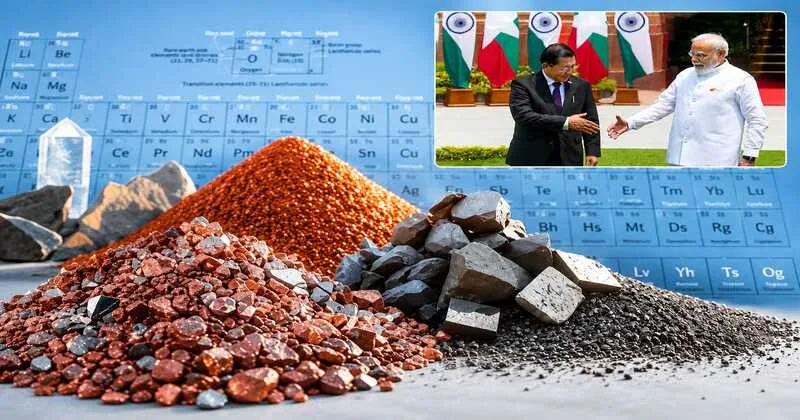
New Delhi: India and Myanmar are expanding bilateral cooperation in the rare earths sector as New Delhi seeks to diversify supplies of critical minerals amid China’s tight control over global rare earth processing and export restrictions. The growing engagement reflects India’s strategic efforts to strengthen supply chain resilience for minerals essential to clean energy technologies, electronics and advanced manufacturing.
Speaking at the opening of a mining forum in Mandalay on July 22, India’s Ambassador to Myanmar, Abhay Thakur, said cooperation in the mining sector has gained significant momentum over the past two years. He highlighted the increasing focus on rare earths and critical minerals as a key pillar of bilateral engagement between the two countries.
According to Thakur, India has already dispatched two official delegations on rare earths and critical minerals to Myanmar, with visits taking place in December 2024 and February 2026. These visits were aimed at advancing cooperation in the strategic mining sector and exploring opportunities for long-term collaboration.
Myanmar’s rare earth resources gain strategic importance
The ambassador also noted that the issue received attention at the highest political level during the official visit of Myanmar’s president Min Aung Hlaing to India in May–June, underlining the importance both sides attach to cooperation in critical minerals.
Emphasising the mutual benefits of the partnership, Thakur said, “India’s need for harnessing critical minerals, coupled with the benefits to Myanmar from sustainable mining, presents solid, win-win, short and long-term opportunities.” He indicated that India’s expanding demand for critical minerals aligns with Myanmar’s potential to develop its mining sector through sustainable practices.
Amb Abhay Thakur addressed (https://t.co/eq4wmY7YSM) the India-Myanmar Mining & Minerals Forum in Mandalay y'day. Over 200 enthusiastic participants in the Forum & B2B meet included Regional Government, 6 Indian companies & 9 Business/Mining Associations or Chambers from Myanmar. https://t.co/OSm7XoRsGo pic.twitter.com/EdLDVzPk73
— India in Myanmar (@IndiainMyanmar) July 22, 2026
Myanmar occupies a strategically significant position in the global rare earth supply chain. Nearly half of the world’s supply of heavy rare earths is extracted from mines in Kachin State, from where the minerals are shipped to China for processing into high-performance magnets used in electric vehicles, wind turbines and other advanced technologies, according to previous Reuters reporting.
Reuters has also previously reported that India sought rare earth samples through the Kachin Independence Army (KIA), the rebel group that controls Myanmar’s principal rare earth mining hubs near the Chinese border. The report further stated that discussions involved exploring the collection and transportation of mineral samples from KIA-controlled mining areas.
At the Mandalay mining forum, Thakur said several Indian companies are actively participating in the engagement, including IREL, NTPC Mining, Himadri Speciality, Oceanic Sands, PrNd Metal & Magnets, and Jai Puri Holdings. He further stated that Midwest from India has maintained close engagement with Myanmar in recent months and years, although he did not specify the nature of that involvement.
Earlier Reuters reporting identified the state-owned miner IREL and private firm Midwest Advanced Materials among the companies involved in discussions related to collecting and transporting rare earth samples from mines under KIA control, highlighting India’s continuing efforts to secure alternative sources of strategic minerals as global competition over rare earth supply chains intensifies.