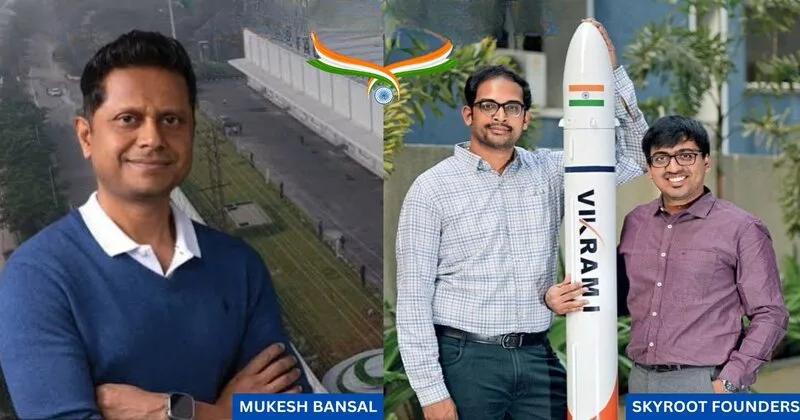
Vikram-1 lifted off from Sriharikota on July 18, 2026 and sucessfully placed the payloads in the Low Earth Orbirt(LEO), earmarking India’s maiden orbital-class rocket, launched by a private space entity. The Skyrocket’s Vikram-1, is not just a historic space accomplishment, but also represented the culmination of a bold step, in India’s space startup ecosystem. It began as a small space company in Hyderabad in 2018, when two former ISRO scientists resolved to pursue a dream, which many considered as impossible.
Equally significant is the vision and action of entrepreneur Mukesh Bansal, who weaved wings to the dreams of young scientists and fuelled initial investment to realise the ambitious space goals of former ISRO Scientis Pawan Kumar Chandana and Naga Bharath Daka. Mukesh Bansal was the first investor to back Skyroot Aerospace, with an initial pay check of Rs. 12 crore, thus propelling one of the country’s most consequential deep-tech investments.
ISRO scientists who pioneered India’s maiden private orbital launch
The story of Skyroot Aerospace began in 2017, when ISRO scientists Pawan Kumar Chandana and Naga Bharath Daka came across the draft of India’s proposed Space Activities Bill. The legislation indicated that the government was considering opening the country’s tightly controlled space sector to private enterprises.
Recognising this legislation of the government as a milestone opportunity, the duo resigned from ISRO and founded Skyroot Aerospace in Hyderabad in 2018. However they were enntangled with initial bottlenecks as India’s regulatory framework for private space sector were in preliminary stages and the idea of a private Indian company, designing and launching orbital rockets was widely viewed as unrealistic or mission impossible.
Rocket development demands years of engineering, heavy capital expenditure and carries enormous technical risks. A single failed test can wipe out years of work and millions of dollars in investment, making space technology an unattractive proposition for investors seeking quicker returns. Thus, Skyroot Aerospace was denied investment to accelerate the space ambitions, from many investors and entreprenuers.
Skyroot, struggled to attract institutional venture capital, because of the complexities of the space sector and as India’s private space ecosystem was still in its infantry stages and the investors were sceptical or apprehensive about the returns or success of the missions. Most investors preferred consumer internet businesses with shorter investment cycles, where returnes are high & gauranteed, rather than hardware-intensive ventures with uncertain regulatory prospects.
Mukesh Bansal’s resolve to swim against the market tide
At a time when institutional investors & Venture capitalists stayed away, entrepreneur Mukesh Bansal, founder of Myntra and Cult.fit, saw an opportunity that others overlooked. In 2018, Bansal became Skyroot’s first and only angel investor, backing the startup nearly two years before venture capital firms entered the company.
According to Tracxn data, he invested around $1.3 million(approximately ₹12 crore) across multiple funding rounds, thus placing one of India’s earliest significant private bets on the country’s emerging space sector. Remarkable feature is, his investment came before the Indian government had formally liberalised the industry.
In 2020, the Centre officially opened the space sector to private participation, creating the regulatory clarity that startups like Skyroot had anticipated. The policy thus, further transformed & channelised the company’s prospects. Institutional investors soon followed, enabling Skyroot to accelerate development of its launch vehicles at a rocket speed.
Skyroot: Marking maiden milestones in India’s private space sector
The breakthrough came in November 2022, when Skyroot successfully launched Vikram-S, India’s first privately built rocket to reach space. The achievement demonstrated that Indian private companies could develop indigenous launch capabilities, setting the stage for larger orbital missions.
The momentum continued in May 2026, when Skyroot raised around $60 million (approximately ₹570 crore), becoming India’s first spacetech unicorn with a valuation of $1.1 billion (around ₹10,600 crore). The company’s defining milestone arrived on July 18, when Vikram-1 successfully lifted off from Sriharikota, making Skyroot Aerospace the first Indian private company to achieve an orbital launch.
A 60x return and the rise of India’s space economy
Mukesh Bansal’s early conviction and trust in the space startup has translated into extraordinary returns. According to Tracxn, he continues to hold 5.7 per cent of Skyroot Aerospace, a stake currently valued at approximately $63.2 million (over Rs. 600 crore). He has also realised more than Rs. 100 crore through partial exits over the years, taking the combined value of his investment to over Rs. 700 crore, representing nearly 60 times his original investment of about Rs. 12 crore.
The company’s rise also reflects the broader transformation of India’s space ecosystem following the government’s decision to liberalise the sector. According to government data, the number of Indian space startups has grown from just one in 2014 to more than 400 in 2026. The government has also set an ambitious target of expanding India’s space economy from its current $8.4 billion to $44 billion by 2033.
In 2018, venture capital funding in India was largely concentrated in consumer internet businesses such as e-commerce, food delivery and edtech. Deep-tech sectors like aerospace, semiconductor manufacturing and advanced hardware received limited investor attention because of their long gestation periods and significant technical risks. However, Skyroot’s success has demonstrated that patient capital invested in frontier technologies can generate not only substantial financial rewards but also strategic national capabilities. Mukesh Bansal’s foundational and breakthrough vision and action, hence has harnessed a fertile ground in the emerging private space ecosystem of the country.
For Skyroot Aerospace, Vikram-1 is not merely the successful launch of a rocket—it is the validation of an idea that private enterprise can become a key pillar of India’s space ambitions. And for Mukesh Bansal, the first entrepreneur who chose to believe in that vision, the mission stands as proof that backing transformative technology before the market recognises its potential can reshape both industry and nation’s global stature in the space domain, as India now shines among the elite space club, who have private space potential.