Sonam Wangchuk has offered to withdraw his indefinite hunger strike, after the Centre accepts three key demands, the most significant being a written assurance that no participant in the July 20 ‘Chalo Sansad’ protest will face legal, punitive or retaliatory action.
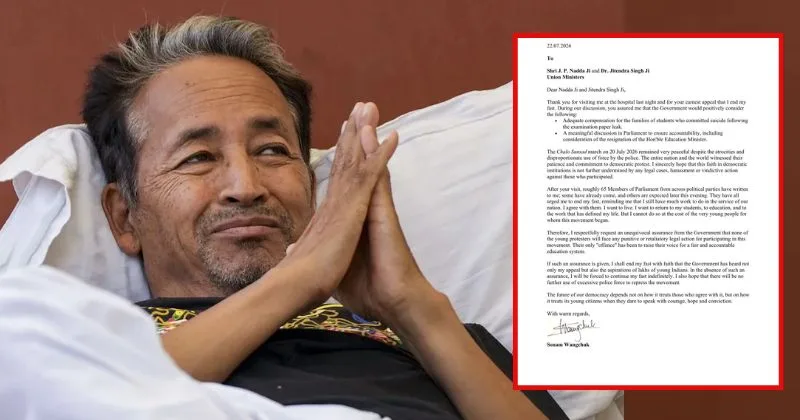
In a letter dated July 22 addressed to Union Ministers J.P. Nadda and Dr Jitendra Singh, Wangchuk thanked the ministers for visiting him in hospital and appealing to him to end his fast. He stated that the government had assured him it would positively consider two of the demands discussed during their meeting.
The first demand seeks compensation for the families of students who allegedly died by suicide following the NEET-UG 2026 paper leak controversy. The second calls for a meaningful discussion in Parliament on the examination controversy and accountability, including consideration of the resignation of Union Education Minister Dharmendra Pradhan.
However, Wangchuk introduced a third condition before agreeing to end his fast, a written assurance from the government that none of those who participated in the agitation would face legal or punitive consequences.
“Therefore, I respectfully request an unequivocal assurance from the Government that none of the young protesters will face any punitive or retaliatory legal action for participating in this movement,” he wrote.
He added that if such an assurance is provided, he would end his fast in the belief that the government had responded to the aspirations of young Indians. Otherwise, he said, he would continue his hunger strike indefinitely.
Demand for Legal Protection
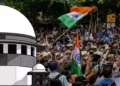
The demand assumes significance as Delhi Police continues its investigation into the July 20 ‘Chalo Sansad’ protest, during which demonstrators clashed with security personnel in central Delhi, resulting in injuries to police personnel and multiple FIRs.
“I sincerely hope that this faith in democratic institutions is not further undermined by any legal cases, harassment or vindictive action against those who participated,” the letter states.
He also appealed to the government to ensure that excessive police force would not be used against future demonstrations.
Claims of Political Support
Wangchuk claimed that around 65 Members of Parliament from different political parties either visited him or wrote to him during his fast, urging him to end the agitation while assuring him that the issues would be raised in Parliament.
According to the letter, although he wished to return to his work with students and education, he believed he could not abandon the movement until its demands were addressed.
Three Conditions Before Ending the Fast
According to the letter, Wangchuk is prepared to end his hunger strike only if the government agrees to:
1. Provide compensation to families of students who allegedly died by suicide after the NEET paper leak controversy.
2. Hold a parliamentary discussion on the examination controversy, accountability and the Education Minister’s resignation.
3. Give a written assurance that no protester will face legal, punitive or retaliatory action.
Protest Moves Beyond Examination Issue
The latest letter has added another political dimension to an agitation that has steadily expanded beyond allegations of examination irregularities. While the movement was projected as a campaign seeking justice for students affected by the alleged NEET paper leak, the demand for legal protection for protesters shifts the focus from educational accountability to the consequences of the July 20 mobilisation.
The insistence on immunity from legal action is likely to become contentious as law enforcement agencies continue probing allegations of unlawful assembly, attacks on police personnel, obstruction of public servants and damage to public property during the ‘Chalo Sansad’ march.
The demand has also renewed questions over the trajectory of the agitation. Wangchuk, who first came to national prominence through his work on education and environmental issues, has increasingly taken centre stage in politically charged protests.
His involvement in the NEET agitation transformed what began as an education-related campaign into a broader political mobilisation that attracted opposition parties, activist groups and organised protest networks ahead of Parliament’s Monsoon Session.
His latest letter further reinforces that shift. Rather than limiting his demands to examination reforms or compensation for affected families, he has made legal protection for protesters a precondition for ending his fast. The expansion of the demands has prompted questions over whether the movement remains focused on educational reforms or has evolved into a larger political campaign.
The timing has also drawn attention. The agitation gathered momentum just as Parliament convened for the Monsoon Session, when the government was expected to take up several significant legislative measures.
With opposition leaders openly backing the protests and the demands expanding beyond education policy, the movement has increasingly come to be viewed as part of a wider political confrontation with the Centre rather than a campaign confined to examination-related grievances.