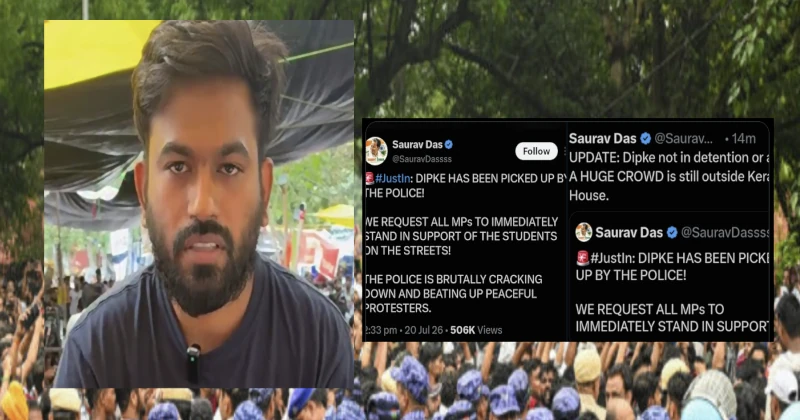
What was projected as a “peaceful” Parliament march by the Cockroach Janta Party (CJP) has ended not only in violence on the streets of Delhi but also in serious allegations of misinformation allegedly spread by the organisation and amplified by sections of the media.
On July 20, as thousands of protesters marched towards Parliament, CJP spokesperson Saurav Das claimed on social media that the Narendra Modi government had reached out to the organisation for talks. The announcement appeared to suggest that the Centre had acknowledged the protest and was willing to negotiate at the highest level.
https://twitter.com/FrontalForce/status/2079147429233041514?s=20
Das posted that he and Ashutosh Ranka were on their way to meet BJP national president JP Nadda after the government had allegedly contacted them that morning.
“It’s 11:52 AM. Ashutosh Ranka and I, on behalf of the Cockroach Janta Party, are on our way to meet J.P. Nadda. The government had reached out for talks in the morning. Our demands are clear. The youth has gathered in huge numbers.”
The claim quickly gained traction on social media and was picked up by several journalists and media organisations, giving the impression that the Centre had initiated dialogue under pressure from the protest.
Among those who circulated the claim was The Hindu’s Vijaita Singh, who cited unnamed “sources” to report that the government had opened communication channels with CJP leaders.
According to her post, the government had allegedly offered talks first with the District Magistrate, then with a Union Government Secretary, and later with a Minister of State. It further claimed that CJP had rejected these offers, insisting on direct talks with either PM Modi or a Cabinet Minister.
The narrative projected the protest as having compelled the government to negotiate, portraying the movement as politically successful. However, government sources have categorically denied the claims, stating that the Modi government never initiated talks with the Cockroach Janta Party.
According to government sources, no outreach was made to CJP leadership, directly contradicting the narrative circulated by Saurav Das and amplified by sections of the media. Subsequent media reports also reflected the government’s version, indicating that the earlier claims regarding official negotiations were inaccurate.
The development has raised questions over whether the initial claims were deliberately floated to manufacture a perception of political victory even before the protest had concluded.
The controversy over the alleged fake claims unfolded alongside widespread violence during the “Sansad Chalo” march. Videos and reports from the protest showed protesters breaking through police barricades, pelting stones at security personnel and engaging in violent clashes with law enforcement.
The Delhi Police reportedly responded with lathi-charge and tear gas after attempts to control the situation failed. The violence marked a dramatic departure from the movement’s repeated assertions that it was a peaceful protest conducted in the interest of students.
The sequence of events reflects a recurring pattern. First, a dramatic political claim is circulated often without official confirmation to create momentum and portray the movement as successful. The narrative spreads rapidly across social media and is amplified by sympathetic sections of the media.
Later, when official facts emerge contradicting the initial claims, corrections receive far less public attention than the original sensational assertion.
By then, the intended political messaging has already reached millions. Observers argue that this strategy enables protest organisers to create an impression that the government has yielded to pressure, regardless of whether such negotiations actually occurred.
The alleged misinformation comes at a time when the protest itself appears to have fallen short of its stated objectives. The indefinite hunger strike by Abhijit Dipke reportedly ended within 48 hours, while Sonam Wangchuk is said to have moderated his demands during the course of the agitation.
Far from culminating in a breakthrough, the movement ended amid scenes of confrontation with police, raising uncomfortable questions about the leadership’s repeated assurances of peaceful demonstrations.