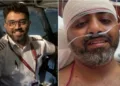
The United Arab Emirates (UAE) on October 9 revealed that Omani co-pilot Hamam al-Hammami had planned a suicide attack targeting Israel’s Ben Gurion Airport aboard Flydubai Flight FZ1073, drawing inspiration from the September 11, 2001, terrorist attacks in the United States.
The investigation also traced his radicalisation to 2017, when he was studying in Australia, where he came into contact with individuals associated with a centre linked to the Muslim Brotherhood. UAE Attorney General Hamad Saif al-Shamsi said the Omani terrorist had used earlier flights to Tel Aviv to prepare for the attack before assaulting the Indian captain Smit Machchhar with an emergency axe while the aircraft was flying over Saudi Arabia.
The plot was thwarted after the injured captain Machchhar managed to open the cockpit door, allowing passengers and other pilots to overpower the Omani co-pilot and secure the aircraft.
Muslim Brotherhood-linked association emerges in investigation
The UAE Attorney General’s statement provided the most detailed account yet of the terror plot and the Omani terrorist’s ideological background. Investigators traced signs of his radicalisation to 2017, when he was studying in Melbourne, Australia, and became influenced by extremist literature, online material glorifying Islamic terrorist organisations and content promoting suicide attacks.
According to the investigation, the Omani co-pilot regularly attended a mosque affiliated with the Royal Melbourne Institute of Technology (RMIT). During these visits, he became acquainted with individuals associated with a centre known as My Centre, which was managed by a Lebanese man known as “Abu Hamza”.
The terrorist told investigators that the centre received support from an association linked to the Muslim Brotherhood. The connection emerged as part of the inquiry into the ideological influences that shaped his beliefs and his preparations for the attack.
Investigators said the Omani terrorist subsequently developed extremist views advocating violence and terrorism. He also drew inspiration from the September 11, 2001, attacks, eventually developing the ambition to carry out a similar operation using an aircraft.
According to his confession, that ambition influenced his decision to pursue a career in aviation. Al-Shamsi said the Omani co-pilot had prepared psychologically and physically for the terror plot by repeatedly viewing material promoting terrorism and taking boxing lessons under a private coach.
The investigation is continuing to examine the his contacts and whether anyone else was involved in planning or facilitating the attack. Although he confessed to acting alone, authorities said further inquiries were necessary to establish whether accomplices had any role in the plot. The association with the Muslim Brotherhood remains part of the investigation into his ideological background.
Two earlier flights used to prepare for attack
Investigators found that the Omani co-pilot had used two previous flights to Tel Aviv to familiarise himself with the route and Ben Gurion Airport before attempting to carry out the suicide attack on September 30.
According to reports citing his statements to investigators, he had visited the airport several times in previous months while working as a pilot. During a visit in June, he concentrated on gathering intelligence and planning the operation.
He reportedly considered carrying out the attack in July but abandoned the plan at the last moment because he was friends with a crew member on that flight.
The Omani terrorist was quoted as telling investigators that he had researched airlines operating flights to Tel Aviv and selected Flydubai before he was even accepted for employment. His preparations indicate that the flight route and the airport were central to his planning.
The 29-year-old Omani national had previously worked for several airlines. He was employed by Oman Air between 2020 and 2024 before joining Royal Air Maroc in early 2025, where he reportedly underwent three months of training.
The Moroccan airline subsequently rejected his application for employment. He joined Flydubai in January 2026.
The investigation also examined Flydubai’s recruitment procedures. Authorities found that the Omani terrorist had met the professional and security requirements for employment, including holding a pilot’s licence, submitting a certificate of good conduct and completing the required checks.
However, according to al-Shamsi, none of these procedures revealed indications of his extremist views or his intention to carry out a terrorist plot. The findings have brought renewed attention to the challenge of identifying extremist influences during recruitment and professional screening in the aviation sector.
Indian captain thwarts cockpit attack as plane plunges
The terror plot unfolded on September 30 aboard Flydubai Flight FZ1073, which was travelling from Dubai to Tel Aviv with passengers, most of them Israeli nationals.
While the aircraft was flying over Saudi Arabia, the co-pilot attacked Indian captain Smit Machchhar with a crash axe, an emergency tool normally kept in the cockpit. The assault left the captain seriously injured.
Despite his injuries, Machchhar managed to open the cockpit door. Passengers and two other pilots travelling aboard the aircraft then intervened and overpowered the suspect.
During the struggle, the aircraft plunged approximately 16,000 feet (4,900 metres) in 30 seconds. Investigators suspect that the Omani co-pilot attempted to crash the aircraft after his plan to reach Tel Aviv was thwarted.
Passengers reportedly described him attempting to damage cockpit equipment while they struggled to restrain him. The aircraft was eventually landed safely at Tabuk Airport in Saudi Arabia. The Omani terrorist was subsequently transferred to the United Arab Emirates, where Flydubai is based.
The incident prompted investigations into the circumstances of the cockpit assault, the Omani co-pilot’s motives and his preparations for the attack. Israeli security service Shin Bet officials were reported to be in the UAE to participate in his interrogation.
Al-Shamsi said the investigation had examined statements from those involved, along with technical and forensic evidence. The authorities are continuing to investigate possible connections to accomplices despite the Omani terrorist’s confession that he acted alone.
Meanwhile, the Ynet news website quoted a senior Emirati source on October 4 as saying that the Omani co-pilot could face the death penalty. According to the report, Abu Dhabi intends to seek the harshest possible punishment.
The UAE’s October 9 announcement has provided further details about the attack, including the Omani co-pilot’s preparations, his aviation career and the reported contacts he made while studying in Australia. The investigation remains ongoing as authorities examine the full circumstances of the Flydubai incident and any possible involvement of others.