
A common urban myth that often arises in discussions, even among educated and well-meaning Bharatiyas, is the belief that Bharat as a nation was created by the British. This argument posits that Bharat is merely an artificial construct, unified under a single political entity only during certain historical periods, and that it was the British who conceived of Bharat as a cohesive nation and established it as a political state. Additionally, there is an underlying assumption that developed Western nations have significantly greater continuity of nationhood and legitimacy compared to Bharat.
This myth is not coincidental; it has been purposefully propagated through the British educational system. For instance, John Strachey noted in his 1888 work, “India: Its Administration and Progress,” that India lacked any form of unity—physical, political, social or religious—throughout its history.
Teaching this colonial narrative served the British strategy of divide and rule and its continued existence suggests the need to dispel it. The people of Bharat view their sacred land as a unified territory with a continuous history. We recognize that a nation is not merely a geographical area; it encompasses its people, rivers, forests, cultures, traditions, values and shared aspirations.
Bharat’s rich history spans centuries, and our collective experience is complex and cannot be simply narrated linearly. Its essence has been diverse and layered since its beginnings.
A significant verse from the Vishnu Purana (Chapter 2, Part 3, Verse 1) provides a clear illustration of Bharat’s ancient geographical and cultural identity. Thousands of years ago, when many countries had undefined borders, Bharatiya Rishis (Ancient Scientist) established a coherent ‘geo-cultural’ identity for the subcontinent. The essence of this verse is:
उत्तरं यत्समुद्रस्य हिमाद्रेश्चैव दक्षिणम् ।
वर्षं तद् भारतं नाम भारती यत्र सन्ततिः ।।
“The land north of the ocean and south of the Himalayas is referred to as ‘Bharat,’ and its inhabitants are known as ‘Bharatis’ (descendants of Bharata).”
Key elements that this verse outlines regarding Bharat’s ancient geographical and cultural boundaries are:
Geographical Definition: The verse articulates clear geographical boundaries, with the northern boundary being the Himalayas—a protective natural barrier—and the southern boundary being the ocean, indicating an awareness of a distinct subcontinent.
Bharatvarsha: The term ‘Bharat’ refers not to a small kingdom but to the entire subcontinent, recognized in ancient geography as ‘Bharatvarsha,’ which encompassed the land between the Himalayas and the ocean.
Cultural Unity: The phrase ‘Bharati yatra santatih’ signifies that despite ancient political fragmentation, there existed a shared cultural identity among the people, united by a sense of common ancestry, transcending linguistic or regional differences.
Spiritual Importance of Bharatvarsha: In the Puranas, Bharatvarsha is seen as a ‘Karmabhumi,’ a sacred land where one’s actions contribute to spiritual liberation or heavenly reward.
The verse includes the line “Varsham tad Bharatam nama” (That area is called Bharat). In ancient Bharatiya geography, the Earth was segmented into several ‘Varshas’ (continents or extensive geographical regions like Jambudvipa, Plakshadvipa, etc.). Among these, the specific area located between the Himalayas and the ocean was identified as ‘Bharatvarsha.’ This term referred not just to a minor kingdom but to the entire subcontinent.
‘Bharati Santati’ – Cultural and emotional bonding
A crucial element is found in the phrase ‘Bharati yatra santatih’ (where the descendants of Bharata dwell). Historically, Bharat was politically divided into numerous kingdoms—both large and small—alongside Janapadas and Mahajanapadas (like Magadha, Kosala, Kuru, Chola, Pandya, etc.). Despite this fragmentation, the inhabitants of this extensive land shared a unified cultural identity.
The notion that they were all descendants of a common ancestor—be it Emperor Bharata (son of Rishabhadeva) or Bharata (son of Dushyanta and Shakuntala)—served to unite them. The awareness of nationhood, recognizing that regardless of language differences, regional traditions and rulers, they collectively formed a culturally ‘one’ entity, is embedded in this verse.
The Idea of the Chakravarti King
In ancient times, the notion of a ‘Chakravarti Samrat’ was associated with this geographical boundary. A king who conquered all territories from the Himalayas to Kanyakumari (the ocean) and brought them under a single reign was referred to as a ‘Chakravarti.’ Emperors like Ashoka and Samudragupta aimed to achieve political unity in this very ‘Bharatvarsha.’
Importance as a ‘Karmabhumi’
In the Puranas, Bharatvarsha is seen not just as a landmass but as a ‘Karmabhumi’ (a land of righteous actions). It was believed that one’s actions in this land could lead to Moksha (liberation) or Swarga (heaven). This belief granted the region spiritual and sacred significance. People undertook pilgrimages across the sacred land, considering visits to holy sites a religious obligation.
Even before modern transportation, individuals traveled great distances for this purpose, undeterred by physical discomfort. During these long journeys, they took breaks that led to the establishment of numerous sacred locations. These pilgrims viewed the country as a unified cultural whole rather than distinct nations, stretching from the mountains to the seas. This blend of nature and spirituality fostered patriotism and cultural harmony, exemplified by events like the Kumbh Mela.
The unity of Sanatana Dharma serves as a clear and quintessential representation of Bharat’s togetherness. All Bharatiyas adhered to the ancient and timeless Sanatana system, worshiping the same (Supreme Brahman) god in various forms and sharing similar rituals at a fundamental level.
While one might point out the diverse names and methods of different rituals, the core framework remains consistent. For instance, the naming ceremony occurs throughout Bharat under various names, yet the essence of the ritual is consistent. The same applies to post-death rituals, despite varying names and procedures; their underlying essence is uniform across the country.
Culture is vital to community development, serving as the identity that shapes values and behaviors within a society. Bharat has been a nation in ways that were likely overlooked by colonial narratives. The idea of Bharat has persisted for millennia, binding the sacred land culturally. Ancient Hindus traveled for pilgrimages, students sought education across its expanse and saints like Adi Shankara established mutts throughout Bharat.
This journeying created a network of sacred sites, reinforcing the notion of a culturally unified Bharat rather than a fragmented collection of nations. Events like the Kumbh Mela exemplify this unity, highlighting a shared civilizational consciousness that existed before colonial influences and persists today.
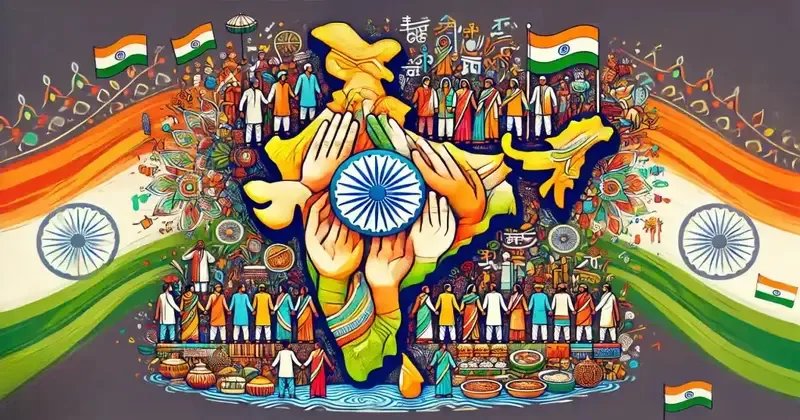
In contrast, the British viewed Bharat as a collection of disjointed countries through a Eurocentric lens, overlooking the intrinsic unity fostered by its geography. Bharat, surrounded by mountains and oceans, has consistently been referred to as Bharat. If we consider the concept of nation as a monochromatic image, Bharat emerges as a vibrant civilization rich in color, characterized by cultural unity within a diverse federation of beliefs, all contributing to a central culture while retaining their unique identities.