
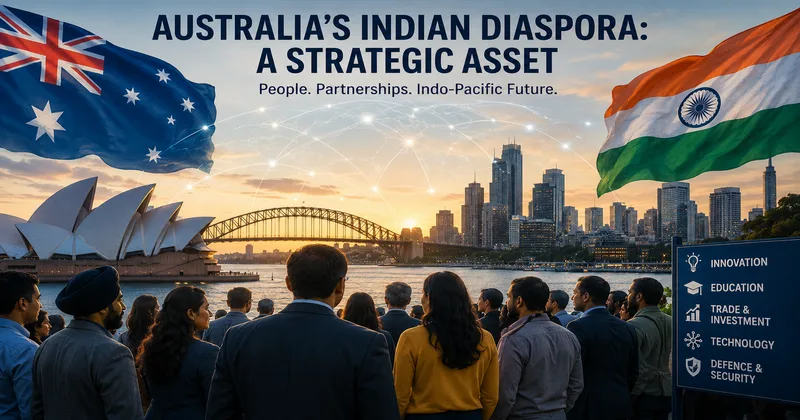
As Prime Minister Narendra Modi arrived in Australia on his third official visit, the symbolism surrounding the tour extends far beyond bilateral agreements and diplomatic protocol. This visit coincides with a demographic milestone that is quietly redefining Australia’s national identity: for the first time since European settlement, people born in India constitute Australia’s largest overseas-born community, surpassing those born in England.
This is more than a statistical curiosity. It marks the culmination of a profound social transformation and offers an opportunity to rethink the India–Australia relationship through its most enduring asset—its people.
For decades, discussions on India–Australia ties revolved around the familiar “three Cs”: Cricket, Curry and the Commonwealth. Those cultural touchpoints remain important, but they no longer capture the strategic depth of a partnership that has expanded dramatically over the past decade.
Today, the relationship is better understood through the “four Ds”—Democracy, Defence, Diaspora and Dosti.
These four pillars have acquired unprecedented relevance in an era marked by geopolitical competition in the Indo-Pacific, resilient supply chains, technological cooperation and shared concerns over regional security. India and Australia have emerged as trusted strategic partners, working together in the QUAD alongside the United States and Japan to uphold a free, open and rules-based Indo-Pacific.
Yet among these pillars, it is the diaspora that provides the partnership with its human dimension.
A community that mirrors the new India
Unlike the Indian communities in the United Kingdom, East Africa or North America, Australia’s Indian diaspora is relatively young.
While the dismantling of the White Australia Policy in the early 1970s opened Australia’s doors to Asian migration, large-scale Indian migration accelerated only in recent decades. The overwhelming majority of Indian Australians today are first-generation migrants who arrived as students, skilled professionals, entrepreneurs, academics, healthcare workers and researchers.
Many of them belong to the generation shaped by India’s economic resurgence after 2014—a period marked by expanding opportunities, growing global confidence and stronger international engagement. They remain deeply connected to Bharat through family, investments, cultural traditions, philanthropy and increasingly through strategic and technological collaborations.
This distinguishes the Australian Indian community from many older diaspora populations that have undergone several generations of assimilation. Indian Australians often maintain dual emotional commitments: contributing wholeheartedly to Australia’s prosperity while remaining actively engaged with developments in Bharat.
Rather than representing divided loyalties, these multiple identities create bridges between two democracies whose interests are becoming increasingly aligned.
From migration story to strategic asset
The Indian diaspora contributes substantially across virtually every sector of Australian society.
Indian-origin professionals serve in hospitals, universities, financial institutions, technology companies, infrastructure projects, scientific laboratories and public administration. Indian entrepreneurs create employment, drive innovation and strengthen Australia’s engagement with Asian markets.
Educational links remain one of the strongest foundations of this relationship. Thousands of Indian students choose Australian universities each year, enriching campuses intellectually while creating lifelong people-to-people networks that later evolve into business partnerships, research collaborations and diplomatic goodwill.
This human capital has become one of Australia’s greatest competitive advantages in engaging the Indo-Pacific.
For India, the diaspora functions as an informal diplomatic force. Every successful Indian-origin doctor, engineer, academic, entrepreneur or public servant strengthens India’s image abroad far more effectively than any public diplomacy campaign.
Prime Minister Modi has consistently recognised this reality. His interactions with overseas Indians have transformed diaspora engagement from ceremonial gatherings into platforms celebrating shared aspirations and national confidence. The anticipated “Melbourne Meets Modi” event reflects not merely the popularity of an Indian leader but the growing self-confidence of a community that increasingly sees itself as an integral stakeholder in both nations.
The challenges behind the celebration
However, demographic success inevitably attracts political attention.
Across much of the Western world, immigration has become a contentious electoral issue. Australia has not remained immune to this trend.
Growing concerns over housing affordability, infrastructure pressures and employment competition have fuelled broader anti-immigration narratives. Within this environment, the visibility and rapid growth of the Indian community have occasionally made it a focal point for sections of nationalist politics.
Public demonstrations questioning immigration levels and expressing anxieties about cultural change reflect deeper debates over Australia’s evolving identity. While such voices do not represent mainstream Australian society, they illustrate the challenges that accompany demographic transformation.
This makes the current moment particularly significant.
The success of Australia’s multicultural model cannot be measured solely by economic indicators or migration statistics. It must also be evaluated by whether diverse communities develop genuine belonging, mutual trust and equal participation in civic life.
Numbers alone cannot answer these questions.
Understanding the diaspora beyond statistics
Governments frequently celebrate diaspora achievements through impressive figures: educational attainment, household income, business ownership, remittance flows or bilateral trade.
These metrics are valuable but incomplete.
Far less attention is devoted to understanding the everyday experiences of settlement, identity formation, civic participation and intergenerational integration.
How do young Indian Australians negotiate multiple identities? How are religious and linguistic diversities accommodated within broader multicultural frameworks? What role do community organisations play in fostering social cohesion? How do migrants perceive political participation and public institutions?
These questions deserve rigorous academic research and sustained policy attention.
If the diaspora is genuinely regarded as one of the four pillars of India–Australia relations, then understanding its aspirations and challenges becomes a strategic necessity rather than a sociological curiosity.
Civil society organisations, universities, policy think tanks and community leaders must become active partners in documenting these evolving experiences. Evidence-based policymaking will strengthen not only integration outcomes but also bilateral trust.
A new Indo-Pacific identity
Australia’s demographic evolution also carries wider geopolitical implications.
For much of its modern history, Australia’s strategic imagination was anchored primarily in Europe and the Anglo-American world. Today, geography, economics and demographics increasingly point toward the Indo-Pacific.
India occupies a central position within this emerging strategic landscape.
The growing Indian-origin population naturally deepens Australia’s cultural literacy regarding India while expanding networks in commerce, education, science, technology and defence cooperation. These human connections complement governmental initiatives under the Comprehensive Strategic Partnership and reinforce collaboration within the Quad.
In many respects, Australia’s future identity will be increasingly Indo-Pacific rather than exclusively Anglo-European.
This transformation need not diminish Australia’s historical heritage. Instead, it enriches it by reflecting the realities of a diverse twenty-first-century democracy.
Looking beyond political optics
Prime Minister Modi’s visit will undoubtedly produce important announcements across trade, defence, education and technology. These outcomes matter. But the most enduring legacy may lie elsewhere—in recognising that the India–Australia relationship has matured beyond government-to-government engagement.
Its strongest foundation now rests upon millions of ordinary people whose daily interactions generate trust that treaties alone cannot create. The Indian diaspora is no longer merely a bridge between two nations; it has become an integral part of Australia’s evolving national story and a strategic asset for both democracies.
The challenge before policymakers is therefore clear. The diaspora must not be reduced to applause at public rallies or celebrated only through impressive census numbers. It should be recognised as a living constituency whose experiences, aspirations and contributions deserve sustained engagement.
If democracy, defence, diaspora and dosti are indeed the four enduring pillars of the India–Australia partnership, then the fourth pillar must be strengthened not by symbolism alone, but by deeper understanding, inclusive policies and shared purpose.
Australia’s demographic transformation is permanent. The opportunity before both nations is to ensure that this transformation becomes not a source of division but a model of democratic pluralism—one in which the Indian diaspora continues to shape the future of both Australia and the broader Indo-Pacific.