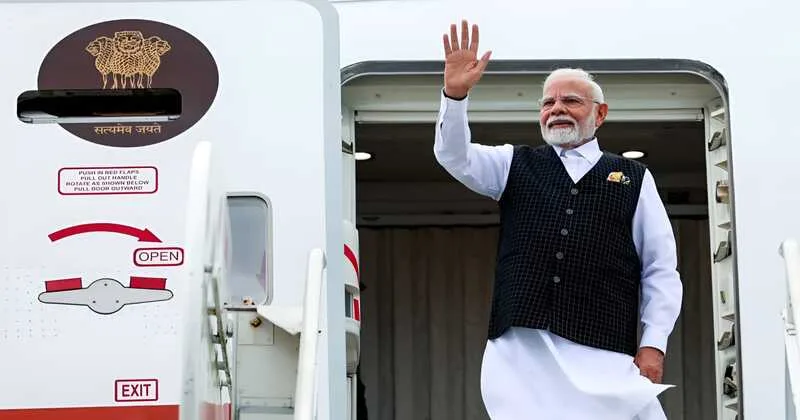
Prime Minister Narendra Modi’s six-day visit to Indonesia, Australia and New Zealand from July 6 to 11 is far more than a routine diplomatic tour. It represents a carefully sequenced engagement with three countries that occupy critical positions in India’s evolving Indo-Pacific strategy.
At a time when geopolitical competition is reshaping global supply chains and maritime security and technology partnerships, New Delhi is deepening relations with countries that can strengthen its long-term strategic resilience.
The itinerary itself reflects this strategic logic. Beginning in Indonesia, moving to Australia and concluding in New Zealand, the visit spans the arc from Southeast Asia through the South Pacific, linking maritime security, critical minerals, trade, technology and people-to-people partnerships under one diplomatic framework.
Unlike earlier phases of India’s Act East engagement, which largely focused on expanding economic relations with ASEAN, the current approach places greater emphasis on securing maritime interests, strengthening resilient supply chains and building trusted partnerships across the Indo-Pacific.
Maritime geography remains the foundation
Indonesia occupies a unique place in India’s strategic calculations. Situated astride the Malacca Strait, one of the world’s busiest maritime passages, the country plays a central role in safeguarding sea lanes through which a substantial share of India’s trade and energy supplies pass.
During the official briefing, Ministry of External Affairs Secretary (East) Rudrendra Tandon underlined this shift by observing that India’s focus has increasingly moved towards the eastern maritime zones of the Indian Ocean and deeper Act East engagement.
The visit also comes at a time when India and Indonesia continue implementing their Comprehensive Strategic Partnership established in 2018. Maritime cooperation has steadily expanded, reflecting shared interests in maintaining stability in one of the world’s most strategically significant waterways.
Delhi: On Prime Minister Narendra Modi's visit, MEA Secretary (East) Rudrendra Tandon says, "As you are aware, the Prime Minister will be visiting Indonesia… After that, he will be in Melbourne, Australia, on July 10, and then in New Zealand on July 11. In Indonesia, his main… pic.twitter.com/9VbwcezvAU
— IANS (@ians_india) July 3, 2026
However, the visit is not confined to security issues alone. Indonesia has emerged as India’s largest trading partner within ASEAN and an important supplier of key commodities, including coal and palm oil. Even more significant is Indonesia’s vast reserve of nickel, an essential mineral for electric vehicle batteries and clean-energy technologies.
As global competition for critical minerals intensifies, Indonesia’s importance in Bharat’s industrial transition continues to grow. The bilateral relationship increasingly combines traditional trade with future-oriented economic cooperation.
Modi’s scheduled visit to Yogyakarta and the UNESCO-listed Prambanan Mandir adds another dimension to the partnership. The proposed collaboration on conservation work at the Mandir highlights the civilisational connections that continue to complement strategic engagement between the two countries.
Critical minerals and resilient supply chains define the next phase
If Indonesia represents maritime connectivity, Australia represents resource security. The third India-Australia Annual Summit in Melbourne is expected to focus heavily on sectors that increasingly determine national competitiveness, critical minerals, cybersecurity, emerging technologies, clean energy and supply-chain resilience.
These are no longer peripheral areas of cooperation. They have become central pillars of the bilateral partnership. Australia possesses significant reserves of lithium, cobalt and rare earth minerals, all of which are indispensable for electric vehicles, renewable energy infrastructure and semiconductor manufacturing. For India, securing reliable access to these resources supports its wider manufacturing ambitions while reducing vulnerabilities arising from concentrated global supply chains. The discussions are therefore expected to move beyond conventional trade issues towards building long-term industrial partnerships.
At the invitation of the President of Indonesia, Prabowo Subianto, PM Narendra Modi will pay a visit to Indonesia from 6-8 July, 2026. During the visit, Prime Minister will hold bilateral discussions with President Prabowo and review the progress made in the partnership. In… pic.twitter.com/uhxuFnaMs4
— ANI (@ANI) July 3, 2026
Equally important is the Prime Minister’s participation in the India-Australia CEOs Forum. Engagement between business leaders provides the commercial foundation required to translate strategic understandings into investment, technology partnerships and manufacturing collaboration.
The inclusion of supply-chain resilience in bilateral discussions reflects changing global realities. Countries increasingly seek trusted economic partners capable of reducing excessive dependence on a limited number of production centres. Bharat’s expanding manufacturing base and Australia’s resource advantages create complementary opportunities within this broader restructuring of global commerce.
Another notable aspect of the summit is the inclusion of student mobility. The Ministry of External Affairs confirmed that concerns relating to delays in Australian student visas for Indian applicants will form part of discussions between the two leaders. This demonstrates that the India-Australia relationship is evolving beyond defence cooperation into a broader partnership that incorporates education, professional mobility and people-to-people engagement.
Such issues carry increasing significance as educational exchanges contribute to technological cooperation, research partnerships and long-term economic integration. India is also expected to reiterate its concerns regarding terrorism and violent extremism during bilateral interactions, reinforcing the security dimension of the partnership.
The South Pacific becomes an important diplomatic frontier
The final leg of the tour carries substantial symbolic and strategic importance. Prime Minister Modi’s visit to New Zealand will be the first by an Indian Prime Minister in nearly forty years, reflecting renewed political attention towards a country that has assumed growing importance within the wider Indo-Pacific landscape.
New Zealand Prime Minister Christopher Luxon has described the visit as historic, emphasising India’s growing importance as one of the world’s fastest-growing major economies. The visit follows the conclusion of the New Zealand-India Free Trade Agreement, which is expected to eliminate tariffs on 95 per cent of New Zealand’s exports while creating fresh opportunities across agriculture, food processing, dairy technology, education and investment.
For India, the agreement opens another avenue for diversifying economic partnerships within the Indo-Pacific. Rather than relying excessively on any single market, New Delhi continues pursuing multiple trade relationships that strengthen economic resilience. The visit also demonstrates the increasing importance attached to the South Pacific within India’s foreign policy.
Traditionally, India’s engagement with this region remained relatively limited compared with Southeast Asia. The Prime Minister’s visit signals a broader diplomatic outreach that seeks to expand India’s presence across the wider Indo-Pacific while strengthening relations with countries that share an interest in a stable, open and rules-based regional order.
Taken together, the three-nation tour illustrates how India’s Indo-Pacific strategy has matured into a multidimensional framework. Maritime security, resource security, trade, technology, cultural diplomacy and human mobility are no longer treated as separate policy areas but as interconnected components of national strategy.
VIDEO | Delhi: During the MEA's weekly briefing, Secretary (East) Rupendra Tandon says, "… The leaders will review the relationship and seek to take it forward across all aspects, particularly maritime cooperation, defence, trade and economic ties, and the deepening of the… pic.twitter.com/r6YnqikDTk
— Press Trust of India (@PTI_News) July 3, 2026
Indonesia safeguards vital maritime routes and provides access to strategic resources. Australia contributes to critical mineral security, advanced technology cooperation and industrial resilience. New Zealand strengthens economic diversification and expands India’s diplomatic engagement in the South Pacific.
The sequence of the visit itself reflects this integrated approach. Rather than announcing new doctrines, the tour focuses on consolidating partnerships that directly support India’s long-term strategic interests. It reinforces the Act East Policy while advancing India’s vision of a free, open and rules-based Indo-Pacific through practical cooperation.
As geopolitical competition increasingly revolves around supply chains, technology, maritime connectivity and trusted partnerships, India’s engagement with Indonesia, Australia and New Zealand signals a foreign policy that is becoming more comprehensive, more economically grounded and more strategically aligned with the realities of the Indo-Pacific century.