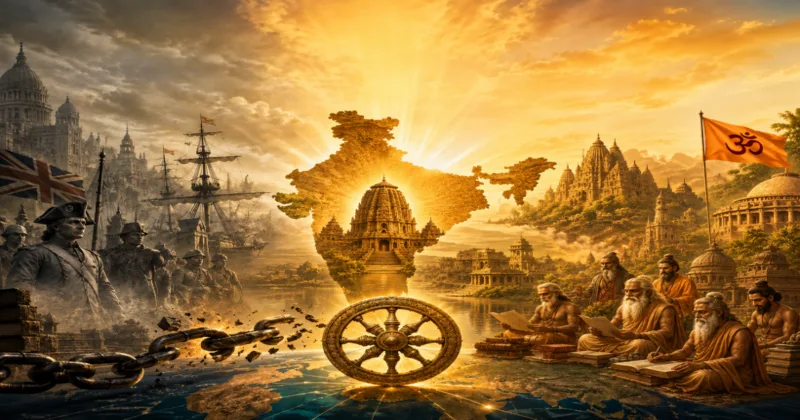
For centuries, the world has been told that Europe is the cradle of modern civilization, the supreme force shaping global destiny. This narrative, repeated in classrooms, media, and political discourse, has become so entrenched that it feels natural. Yet history reveals that Europe’s supremacy was not an organic truth but a deliberately constructed narrative, imposed through colonial power, religious overlays, and selective memory.
Historical rewriting
Columbus and Vasco da Gama were celebrated as “discoverers.” But what were they seeking? India. Their voyages themselves acknowledge India’s centrality. Europe’s claim to supremacy began by recasting its own limitations as triumphs — rewriting history to place itself at the center while diminishing older civilizations.
Driven by the triad of God, Gold, and Glory, both explorers set out not as neutral adventurers but as agents of empire. Their true intention was to reach India — the land of spices, wealth, and ancient wisdom — bypassing Arab and Venetian intermediaries. While their journeys reshaped global trade, they also revealed to Europe the richness of Indian civilization.
Both explorers carried a religious mandate — Columbus under Spain’s Catholic Monarchs, Da Gama under Portugal’s priests — to spread Christianity and weaken Islamic influence. The lure of spices and precious metals drove their voyages. Pepper and cinnamon from India were worth their weight in gold in Europe. Their success promised personal fame and national prestige, immortalizing them as symbols of Europe’s expansion.
Encounters with Indian civilization
When Vasco da Gama reached the Malabar coast in 1498, he expected riches and trade. What astonished him most was not merely the organized markets of Calicut, but the sophistication of Indian society itself. India was not a land to be “discovered” but a thriving, ancient civilization with its own systems of commerce, governance, and culture.
In Malabar, the Portuguese encountered the Nair community, whose matrilineal social order placed women at the center of property, inheritance, and family affairs. This was a revelation to Europeans, who came from societies where women were confined to the household, treated as political dependents or “domestic slaves”.
The Portuguese were stunned to find a civilization where women commanded respect, controlled wealth, and shaped governance. To them, this was as remarkable as the opulence of Indian cities, the hygiene of daily life, or the perfection of Indian naval architecture.
Beyond wealth and splendor
European accounts often emphasized the grandeur of Indian markets, the brilliance of textiles and the strength of Indian fleets. Yet what truly unsettled them was the contrast in social order. In India, women were visible in public life, guardians of lineage and custodians of property. In Europe, by contrast, women were bound by feudal and ecclesiastical restrictions, their voices silenced in politics and science.
The Portuguese discovery of India was thus not only about spices and trade routes. It was a civilizational encounter that forced Europe to confront its own limitations. The hygiene, prosperity, and pluralism of Indian society challenged the European narrative of superiority. Most strikingly, the government of women in Malabar revealed a social sophistication Europe had long denied its own women.
Civilization as a mirror
The voyages of Vasco da Gama and Columbus inadvertently exposed Europe to the positive aspects of Indian civilization: thriving trade, cultural pluralism, maritime expertise, and matrilineal social order. For the Portuguese, the greatest surprise was not India’s wealth but its empowered women — a reminder that civilization is measured not only by markets and armies but by the dignity accorded to its people.
Indian navigators had long mastered the monsoon winds and ocean routes. Europeans learned from these practices, integrating Indian maritime knowledge into their own voyages. Ironically, Columbus never reached India, landing instead in the Caribbean, while Da Gama’s violent methods revealed the clash between Europe’s greed and India’s openness. Yet both voyages confirmed India’s centrality in global imagination — the true prize of exploration.
Religion overlaid on politics
Europe’s supremacy was not born of civilizational depth but of political manipulation of religion. The transformation of Christianity under Constantine in the 4th century marked a decisive moment. As John William Draper observed in History of the Conflict between Religion and Science: “The reign of Constantine marks the epoch of the transformation of Christianity from a religious into a political system”.
Faith became a tool of empire, enabling rulers to project a “civilized order” that justified conquest, suppression of older traditions, and the rewriting of history in Europe’s favor. This overlay of religion on politics allowed Europe to present itself as the guardian of civilization, even as it erased older connections to Asia, Africa, and India.
Conflict of religion and science
Draper’s thesis highlights how Europe’s supremacy was built by suppressing scientific inquiry under dogma. The Church dictated cosmology, medicine, and philosophy, silencing voices of reason. By conflating divine authority with political power, Europe created a narrative of moral superiority while stifling intellectual freedom.
India, by contrast, had sustained a civilizational model where religion, science, and philosophy coexisted harmoniously. Vedic astronomy, Ayurveda, and philosophical schools thrived alongside spiritual traditions. Knowledge was not suppressed but integrated into daily life.
Impact on India’s civilizational continuity
When Europe projected its supremacy outward, it misrepresented India’s pluralism as “paganism” and its scientific traditions as superstition. Colonial narratives entrenched this distortion, portraying India as backward while appropriating its contributions in mathematics, medicine, and philosophy.
Thus, Constantine’s transformation of Christianity into a political system indirectly led to the delegitimization of India’s civilizational strengths in global discourse. Europe’s “civilized order” was thrust upon the world by erasing India’s role as a knowledge center and spiritual anchor.
Strategic narratives
The “Great Game” between Britain and Russia illustrates how Europe framed geopolitics around its own survival, portraying India and Central Asia as pawns. In reality, India was the center of trade, culture and spiritual influence. Europe’s supremacy was thus a strategic narrative, not a natural fact.
Symbols of Indian civilization — deities, myths, and rituals — appear across continents. Yet Europe claimed originality, presenting itself as the sole source of culture. Even today, remnants of India’s civilizational memory exist in Europe, hidden beneath layers of appropriation.
Europe’s supremacy was never a natural civilizational reality. It was deliberately thrust upon the world through colonial power, religious overlays and historical rewriting. For India, the consequence was profound: its ancient civilization, which had harmonized science and spirituality, was overshadowed by Europe’s imposed narrative.
Today, reclaiming India’s civilizational memory means exposing how Europe’s supremacy was thrust upon the world — not earned, but constructed. In the 21st century, India is reclaiming its natural place at the center of geopolitics and culture. What was once obscured is now resurfacing: India as a civilizational anchor, not Europe.