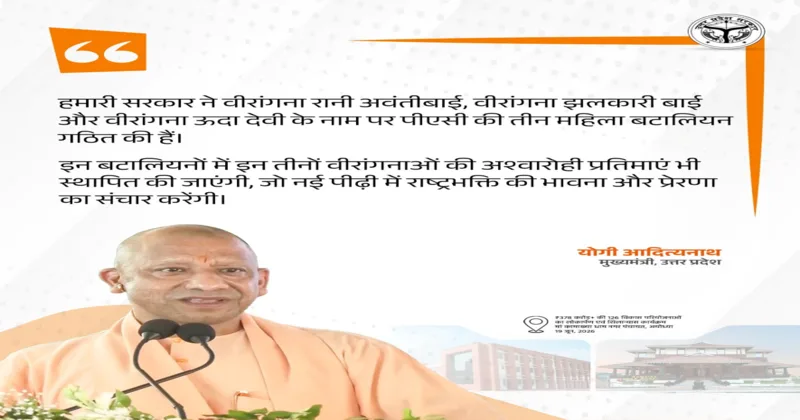
Chief Minister Yogi Adityanath in Ayodhya on June 19, 2026, dedicated 126 development projects worth over Rs 378 crore at the newly elevated Maa Kamakhya Dham Nagar Panchayat. He focused on women empowerment, while projects of the horseback statues are yet to be unveiled and three battalions of women will stand one day beneath them. The Uttar Pradesh government has raised three all-women Provincial Armed Constabulary (PAC) battalions named after the veeranganas Rani Avantibai, Jhalkari Bai and Uda Devi, inside each battalion campus an equestrian statue of its warrior will rise as intended in the Chief Minister words, to kindle the spirit of patriotism and inspiration in the coming generation.
हमारी सरकार ने वीरांगना रानी अवंतीबाई, वीरांगना झलकारी बाई और वीरांगना ऊदा देवी के नाम पर पीएसी की तीन महिला बटालियन गठित की हैं।
इन बटालियनों में इन तीनों वीरांगनाओं की अश्वारोही प्रतिमाएं भी स्थापित की जाएंगी, जो नई पीढ़ी में राष्ट्रभक्ति की भावना और प्रेरणा का संचार करेंगी।… pic.twitter.com/ZIo8meZCOJ
— CM Office, GoUP (@CMOfficeUP) June 19, 2026
It is a simple idea to take women names whose courage survived in folk song and regional memory, give their names to formations staffed entirely by women and let that inheritance work on every young woman who reports for duty there. Empowerment is not a slogan but a sequence and it begins by deciding which women a state chooses to remember.
She guards the state that forgot her
To understand why these three names matter, it helps to know how nearly they vanished. Uda Devi Pasi, born in 1830 in what is now Gomti Nagar in Lucknow, joined the women’s battalion raised under Begum Hazrat Mahal during the Indian Rebellion of 1857. After her husband fell in battle, she is said to have climbed a peepal tree at Sikandar Bagh and as a sniper, held off British soldiers until she was killed that November. A British officer own memoir later recorded the astonishment of his troops on discovering that the marksman who had cut down so many of them was a woman. For generations, her story lived more vividly in community memory than in any official syllabus.
Maharani Avantibai Lodhi, born in 1831, served as regent of Ramgarh and took up arms against the British East India Company during the same upheaval, dying in March 1858 at the age of twenty-six. Almost everything known of her survival through folklore rather than archive, is this queen remembered only because people refused to forget her. To name a modern security force after such women is an act of historical restitution as much as policing reform, it lifts them from the margins of memory and stamps their names onto institutions that thousands of the state daughters will now serve in. A woman who was nearly erased now guards the very state that once let her fade and every recruit who carries that name forward narrows the distance between forgetting and honour.
The Begum’s battalion was reborn
History also tells that Uda Devi did not fight alone in 1857, she fought inside a women’s battalion, an armed formation of women raised under Begum Hazrat Mahal in Awadh. One hundred and sixty-eight years later, Uttar Pradesh raises all-women battalions in her name, the same idea of women standing together in disciplined formation, separated by more than a century and a half, closing into a single unbroken line. What was once an emergency improvisation of war is now a permanent institution and the women who fill it arrive not as a last resort but as trained professionals claiming a place that is theirs by design.
The third name, Jhalkari Bai who sharpens the theme of women turning their own identity into strength. Fighting alongside Rani Lakshmibai of Jhansi, she is remembered for disguising herself as the queen to draw British fire and cover her sovereign’s escape, a soldier who made her resemblance to her ruler a weapon of war. These are not the marquee names of the freedom movement and that is precisely the point. By selecting Avantibai, Jhalkari Bai and Uda Devi rather than the most celebrated figures, the state widens the circle of who counts as a role model and tells a girl from any background that the woman she descends from may already be a warrior whose name a battalion bears.
Symbol made operational
Memory alone empowers no one, it has to be built into something a woman can join. The three women’s PAC battalions represent exactly that structural shift. Where women in the force were once distributed thinly across mixed units, these battalions are staffed entirely by women, with campuses under construction in Badaun, Lucknow and Gorakhpur. The momentum will not stop there, three further women’s battalions are taking shape in Balrampur, Mirzapur and Jalaun and the recruitment for all of them is reserved exclusively for women.
The Chief Minister has noted that earlier dispensations let the constabulary, historically a check on rioters, drift toward closure and that his administration revived 34 PAC companies. The all-women battalions are the most forward-looking expression of that revival, not a restoration of the old, but something the state had never possessed. The equestrian statues planned for each campus are the connective tissue between heritage and mission.
A recruit will not merely belong to the Avantibai battalion as a line on a posting order, she will train and drill in the shadow of the woman the unit is named for proximity converting abstract history into felt identity in a way no textbook chapter can. The statue is not decoration but instruction, a reminder in stone that her uniform was earned by women who wore nothing of the kind and fought anyway.
Wheels, uniforms and wages: The empowerment pipeline
A battalion command is the top of a ladder and the more telling story is the rungs laid beneath it. Empowerment here is sequenced, mobility, safety, employment, leadership and each stage carries its own scheme, several also drawing on the names of warrior-queens.
Mobility has already in society through the Rani Laxmibai Scooty Yojana, for which the UP Budget 2026-27 has earmarked Rs 400 crore, sustaining the previous year allocation, to provide free scooters to roughly 50,000 meritorious girl students. The logic is plainly practical, a girl who cannot reach a distant college or coaching centre cannot compete for the jobs that follow. By putting wheels under her, the state removes the quietest barrier to her advancement, the distance between home and opportunity, turning a daily ordeal of dependence into independent movement.
Mission Shakti, launched to coincide with Navratri and the worship of Goddess Durga, paired with the Safe City project and Anti-Romeo squads, was built around a stated principle of zero tolerance toward crimes against women, the promise that a woman’s freedom to move would not be bought at the price of fear. Employment follows the state reserved 20 per cent of police recruitment for women, an opening that flows directly into the new battalions, so that the safety apparatus is increasingly staffed by the constituency it protects.
What emerges is a continuum, the scooter that carries a seventeen year old to her exam centre, the helpline that lets her travel after dark, the quota that lets her wear the uniform and the battalion named after Uda Devi where she might one day command, stages of a single journey the state is attempting to underwrite end to end.
Heritage as a role model for governance
Underneath the schemes lies a philosophy the Chief Minister articulated plainly in Ayodhya that reverence toward the nation’s heroes and heroines is itself the wellspring of patriotism. From that conviction, he said that the government has launched numerous schemes and campaigns named not only after Avantibai, Jhalkari Bai and Uda Devi, but also after Rani Lakshmibai and Rani Durgavati, assembling a deliberate pantheon of women warriors and threading their names through the machinery of the modern state.
This is heritage deployed as governance rather than commemoration sealed off in a park. The approach embeds these women in functioning institutions, scooter scheme, police battalion, recruitment drive, so that remembrance and service reinforce one another. That the announcement came in Ayodhya, amid projects spanning shelter homes, food halls and rural connectivity, situates women empowerment within the larger story the state tells about itself, heritage-rooted development, where reviving sacred geography and elevating forgotten heroines are facets of one project.
The genuine test will not be settled by statues or budget lines but by outcomes, how many scooters actually reach the girls who need them most, how fully the new battalions are staffed and trained. Whether the safety promises hold in the districts where they are hardest to keep. The symbolism is powerful, a state asking its daughters to draw courage from women who rode into battle against an empire and answering with budgets, recruitment and campuses rather than ceremony alone. The deeper measure is whether the pipeline beneath it carries them all the way, so that a generation from now, a recruit beneath a statue of Uda Devi feels she is not merely guarding the state but inheriting it.