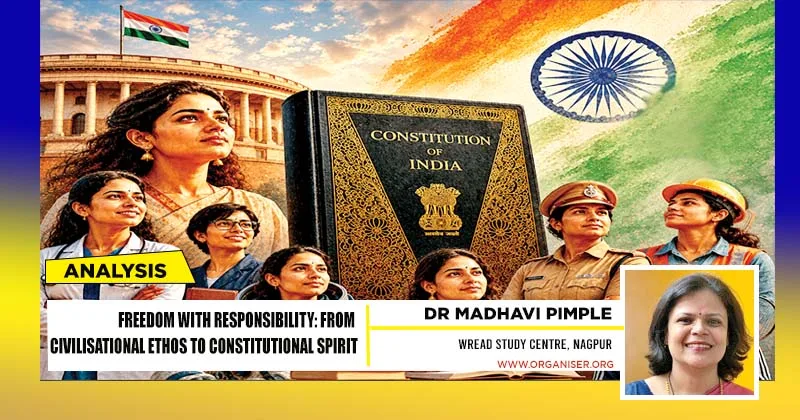
The Bharatiya sanskritik tradition has traditionally revered women as Shakti, the divine energy that infuses life with vitality. Similarly, the Bharatiya Constitution recognises and safeguards women’s rights and dignity in various ways. Its very beginning — We, the people of India — encompasses every single citizen irrespective of gender, class, or age. On one hand, it strongly upholds the rights of every citizen and seeks to ensure justice; on the other, it also emphasises responsibilities with the objective of safeguarding national integrity with a ‘Nation First’ approach.
The most beautiful aspect of the Bharatiya Constitution lies in its guarantees of equality, freedom from discrimination, and personal dignity. Equal opportunity, the right to life, humane conditions at work, and the reservation of seats for women in Panchayats and Municipalities all contribute to women’s progress. The Constitution enables the State to make special provisions, including affirmative action, for women. The Maternity Benefit Act and the Sexual Harassment of Women at Workplace Act are a few significant measures taken to ensure women can live with dignity.
Following Independence, the Constitution of India granted women universal suffrage in 1950, whereas during the British Raj, voting was restricted by property ownership, education, or marriage. Consequently, women did not need to protest against the system of Independent Bharat to achieve the right to vote; their opinions were considered just as significant as those of men. In contrast, women in the United Kingdom and the United States had to struggle intensely to receive voting rights. Even developed European countries like France and Switzerland denied women the right to cast votes in elections for a long time, while Saudi Arabia only recently allowed women to vote in December 2015.
From 1950 to 2026, over a span of more than 75 years, women have faced a challenging journey. Backed by constitutional provisions, they have been overcoming adversities to prove their mettle in every walk of life. Education has given wings to their dreams, allowing them to reach new pinnacles of success. Furthermore, the Bharatiya institution of family shapes their tenacity and equips them to handle life at both personal and professional levels.
The Constitution has ultimately proved to be a powerful instrument for women’s development. It has transformed their societal status and image from marginalised and often subdued members of society to legally protected, dignified and equal citizens. Today, there is hardly any field in which women have not proved their calibre.
The figures showing the increase in women’s representation in various fields in Bharat over time are very inspiring. A huge increase has been seen in women’s participation in the fields of education, sports, and space science. The women’s literacy rate has risen from 9 per cent to 70 per cent since independence. The number of women enrolled in higher education is greater than that of men. Girls frequently top national school board exams. Women are successfully holding positions of national importance. They are flying fighter jets and serving on warships. They dare to lead significant missions in space programmes and are leaving their mark on the IT sector. Scaling mountain peaks like Everest or bringing laurels to the country by winning the World Cup in cricket, once considered a Sahib’s sport, are no longer just dreams for Bharatiya women. With their dedication and perseverance, they have proved themselves worthy of great admiration. They are making the country proud in every possible way. From Gen X to Gen Alpha, each generation is contributing significantly to taking women’s achievements and capabilities to new heights.
Freedom with Responsibility
Respect for the individual is a precious value enshrined in our Constitution. Freedom of speech is another such constitutional guarantee where citizens are allowed to give verbal expression to their complaints and grievances against the system. The Constitution gives citizens the right to speak and sanskriti teaches us to speak with grace and wisdom. Unfortunately, the recent protest at Jantar Mantar in Delhi presented a disturbing picture of the language used by some young women participants. It is shocking to witness the language used by some young women participants which was highly condemned across the nation. Controversial, abusive language used by these girls during the protest has raised a question — Was it appropriate for these young women to cross the limits of politeness, decency and decorum? Moreover, the derogatory language was used for the elected honourable Prime Minister of the nation.
Can it be justified?
A woman plays the role of a mentor for the succeeding generation. In a civilised society, decorum in behaviour and language is expected of citizens in a civilised society. Undoubtedly, wrongs in the system must be exposed and solutions must be found. The constitutional framework seeks to establish order and justice in the system while simultaneously upholding the dignity of the individual. By using derogatory language from the platform of the protest, the young women not only have shown their disrespect to individual dignity but the Constitution also.
The Bharatiya Constitution provides the framework for the world’s largest democratic republic. It gives us the right to life, the right to education, the right to vote, and the right to practice our own belief systems. It emphasises human rights while significantly urging us to fulfil our responsibilities towards the nation through our behaviour. Hence, the Constitution is regarded as sacred and sacrosanct. Women of Bharat have proven their capabilities as successful administrators, academicians, entrepreneurs, philosophers, artists, athletes, and mothers. They have consistently put ‘Nation First’ in their deeds and beliefs. Let us not change this approach. Instead, let us build upon the success of self-realisation and national interest. Let us pursue the freedom of thought, expression, belief, faith, and worship with great respect, sincerity, and awareness to pave the way for generations to come.