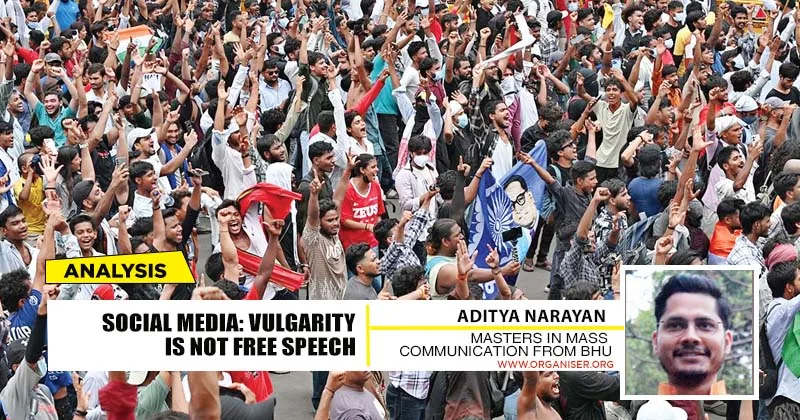
In the recent protest at Jantar Mantar, we witnessed quite a few of these slang terms, and many of us attributed the creativity to Gen Z. In search of viewership, so-called creators on YouTube and Instagram claiming to be media persons have put forth all their strength and often blurred the fine line between vulgarity and responsible reporting. Glorifying abuse as proof of strength or a badge of fearlessness. There is ample evidence circulating online where these creators are accused of instigating students to hurl abuses, or they have deliberately shown abusive posters throughout the video, just to boost views.
Abusive language shouldn’t be accepted at any level, at any point, and at any place. Still, frustration finds its way through abuse. This pattern is becoming alarming, especially when mass media adds up to it. However, it is interesting to note how social media is setting new narratives shaping opinions.
Fourth Pillar of Democracy Race
For decades, the press has been called the “Fourth Pillar of Democracy” because of its responsibility to hold power accountable through facts, verification, and public interest journalism. With the rise of social media, today several YouTube creators claim to be the new custodians of this role, dismissing large sections of television news as “Godi Media.” In a democratic debate, it is legitimate to question the independence of any media organisation. But it’s equally valid to ask whether independent digital creators are themselves meeting the standards they demand of others.
The concern arises when criticism of others becomes the central product itself. If a creator spends more time declaring every competing platform compromised than presenting independently verified reporting, the audience may receive more rhetoric than journalism. In the recent protests, it has become clear that almost all creators were claiming to be the most authentic media while there most of the focus was to dismiss others.
One of the most concerning consequences of increasingly polarised media narratives is their impact on the treatment of on field reporters. During the recent protests, videos circulated showing a television journalist being heckled by a group of students, who repeatedly labelled him “Godi Media” while he was attempting to report from the scene. The episode illustrated how quickly media labels can become personal attacks.
It is important to distinguish between criticism of a media organsation and hostility towards an individual journalist carrying out field reporting. A reporter at the scene is responsible only for gathering facts, interviewing participants, and documenting events.
Viewership War
Then you have the economics of social media, which makes it more complicated. Algorithms on platforms reward engagement, and emotionally charged narratives get more views, shares and subscriptions than detailed breakdown stories. It also encourages creators to focus on confrontation, to oversimplify complex issues, or to frame events in a way that gets the most attention from the audience. That is not to say that all creators do this, but it does point to the commercial pressures of creator-run media.
According to the Wikimedia pageview logs, media coverage of the protest found that it was not very visible to the public until after the FIFA World Cup was over. The tournament, one of the world’s biggest sporting events, absorbed much of the public attention and media resources, resulting in comparatively little digital engagement with the protest. But after the World Cup, the conversation on the topic exploded on the internet, with many YouTube channels and social media creators uploading long-form content about it.
This surge of coverage fundamentally changed the conversation. Instead of just documenting what happened, many creators framed the issue in highly emotional and confrontational terms, often encouraging audiences to think of the conflict in a “us versus them” way. In some cases, the focus shifted from factual reporting to stories based on opinion that achieved high engagement through outrage and polarisation.
The architecture of social media favours compelling narratives and attention-grabbing hooks. Creators in a competitive digital ecosystem are forced to create dramatic, emotionally charged content that can keep the engagement going. This can create an environment where controversy and confrontation are prioritised over careful reporting.
At the recent protests, certain creators seemed to place excessive emphasis on emotionally charged moments, such as confrontational slogans, abusive language, or inflammatory placards shown by the participants. In some cases, this kind of material stayed clearly visible in the videos without any obvious efforts being made to discourage it.
This brings up a significant ethical issue concerning the responsibilities of digital journalists and creators. Since freedom of expression is fundamental to democracy, responsible journalism also demands that editorsexercise judgement.
Having a microphone, a camera, and many subscribers does not make someone a journalist, nor does holding an opinion count as journalism. Journalism is a field based on thorough research, the checking of facts, an understanding of the context, editorial judgment, a sense of ethical responsibility, and a dedication to serving the public interest rather than one’s own popularity.
At the recent protest, certain creators seemed to place excessive emphasis on emotionally charged moments, such as confrontational slogans, abusive language, or inflammatory placards shown by the participants
A journalist’s credibility is not determined by the number of views, likes, or followers they have, but rather by their readiness to question each and every source, to give attention to multiple points of view, to tell the difference between facts and opinions, to admit when they have made a mistake, and to stick to professional ethics even if this is less rewarding than creating sensational content.
The genuine “Fourth Pillar of Democracy” is not determined by the medium used to deliver information such as television, the newspaper, YouTube, or any other medium that may come along later. It is instead defined by the principles which govern those who are responsible for informing the public. Journalism cannot be replaced by independence without accountability; any more than credibility can be guaranteed simply by having an institutional affiliation. Now that anyone can send messages to millions of people, genuine journalism more than ever needs to be carried out.
The future of democratic discussion will not be determined by who speaks the loudest, but by who speaks with integrity, supported by evidence, shows fairness, and has a steadfast dedication to the truth.