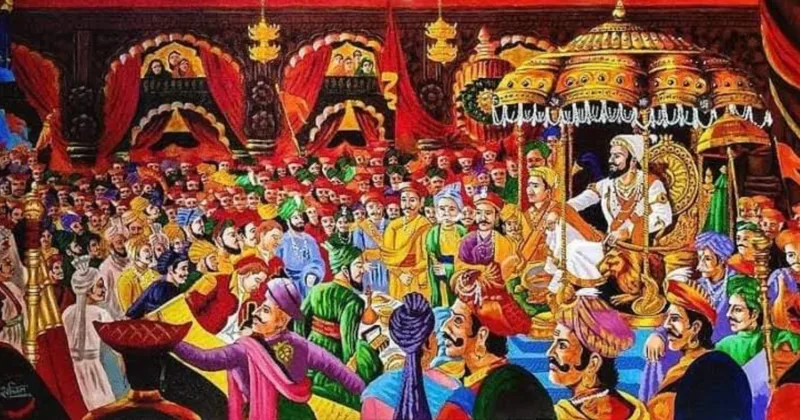
Few events in Indian history possess the symbolic and political significance of the coronation of Chhatrapati Shivaji Maharaj at Raigad Fort in June 1674. More than a royal ceremony, it represented the formal proclamation of Swaraj a sovereign political order rooted in indigenous traditions, values, and aspirations. The event marked the culmination of decades of military struggle, administrative innovation, and social mobilisation under Shivaji Maharaj’s leadership. It restored confidence among a population that had experienced centuries of political subordination and demonstrated that indigenous statecraft could successfully challenge powerful imperial forces.
The coronation was not merely the elevation of an individual ruler; it was the institutionalisation of a political vision. It provided legitimacy to a state that had already been established through military success and efficient governance. By assuming the title of Chhatrapati, Shivaji Maharaj transformed the Maratha polity into a recognised sovereign kingdom and laid the foundations of a new political era in Bharat.
The significance of the event is documented in several contemporary sources, including Marathi chronicles, English Factory Records, and the diary of the English envoy Henry Oxenden, who witnessed the proceedings. These accounts collectively portray the grandeur of the ceremony and underscore its far-reaching political implications.
The Coronation at Raigad
The coronation ceremonies commenced with elaborate Vedic rituals conducted according to established Hindu traditions. On the eve of the coronation, Ganesh Pujan, Swasti Pujan, and Matruka Pujan were performed to invoke divine blessings. Shivaji Maharaj and his queen, Soyrabai, participated in the worship of the ceremonial pavilion where the sacred rites were to be conducted.
The coronation pavilion was carefully arranged according to ritual prescriptions. Four vessels made of gold, silver, copper, and clay were placed in the four cardinal directions. Filled with sacred substances such as ghee, milk, and water, they symbolised prosperity, purity, and cosmic harmony. Water brought from numerous sacred rivers and seas was assembled for the consecration ceremony, emphasising the pan-Indian character of the event.
The rituals began with the chanting of Vedic mantras and the lighting of the sacred fire. Shivaji Maharaj underwent ceremonial purification through ritual baths with holy water and panchamrit before changing into royal attire. Following further religious observances, he proceeded to the consecration area, where sacred waters were poured over him amidst the recitation of Vedic hymns.
The culmination of the ceremony was the enthronement of Shivaji Maharaj. Contemporary observer Henry Oxenden recorded the magnificence of the royal court and the symbols surrounding the throne. These included golden emblems, ceremonial standards, horse-tail insignia, and a golden balance representing justice. The symbolism conveyed a clear political message: the establishment of a righteous and sovereign authority committed to the welfare of its subjects.
A Turning Point in Indian History
The coronation of Shivaji Maharaj occupies a unique place in Indian history because it signified the re-emergence of indigenous political sovereignty after centuries of foreign domination. It represented the formal assertion that political authority in Bharat need not derive legitimacy from external imperial centres. Instead, it could emerge from native traditions, cultural values, and the consent of the people.
For ordinary men and women across the Deccan, the event carried profound emotional significance. Shivaji Maharaj had already become a symbol of resistance against oppression and arbitrary rule. His coronation transformed that symbolic status into constitutional authority. The ceremony reassured the people that the ideals of self-rule and justice were no longer aspirations but realities embodied in a functioning state.
The timing of the coronation was equally significant. The political landscape of the seventeenth-century Deccan was dominated by powerful empires and sultanates. The memory of the fall of the Vijayanagara Empire still weighed heavily on the collective consciousness of the region. Against this backdrop, the rise of an independent Hindu kingdom under Shivaji Maharaj appeared extraordinary. His coronation announced to both allies and adversaries that a new political force had emerged, one capable of defending its sovereignty and shaping its destiny.
The event also altered diplomatic relations in the region. Contemporary records indicate that neighbouring rulers acknowledged the growing influence of Shivaji Maharaj. The coronation elevated the status of the Maratha state and enhanced its legitimacy in the eyes of regional powers. It transformed a successful military enterprise into a recognised kingdom with defined institutions, political authority, and international standing.
Perhaps the most important achievement of the coronation was the legitimisation of a state that had already demonstrated administrative effectiveness. Before 1674, Shivaji Maharaj had established an efficient military organisation, a disciplined revenue system, and a responsive administrative framework. The coronation provided these institutions with religious and constitutional sanction, thereby strengthening the foundations of Swaraj.
In this sense, the ceremony was not merely a celebration of past achievements; it was a declaration of future intent. It signalled the emergence of a political order dedicated to justice, good governance, cultural self-respect, and the protection of the people. The coronation thus became a defining moment in the history of Bharat and an enduring symbol of civilisational resurgence.
Governance, Legitimacy and the Institutionalisation of Swaraj
While the coronation of Shivaji Maharaj is often remembered for its symbolic and political significance, its institutional consequences were equally profound. The ceremony transformed Swaraj from a military achievement into a constitutionally recognised state. It established a framework of governance rooted in justice, accountability, and public welfare, setting it apart from many contemporary political systems.
One of the most significant aspects of the coronation was the oath undertaken by Shivaji Maharaj. In the presence of sacred fire, learned scholars, and religious authorities, he pledged to govern according to dharma and law. This public commitment reflected a vision of kingship that emphasised responsibility rather than arbitrary authority. Governance was not viewed merely as an exercise of power but as a sacred duty towards the welfare of the people.
Historian R. V. Oturkar aptly observed that through this solemn pledge Shivaji Maharaj promised not only political independence but also good governance. Unlike many rulers whose authority rested solely on military strength, Shivaji Maharaj consciously sought moral and legal legitimacy. The coronation therefore represented the fusion of political sovereignty with ethical statecraft.
The ceremony also strengthened the institutional foundations of the Maratha state. The structure and responsibilities of the Ashtapradhan Mandal, or Council of Eight Ministers, were formalised and reinforced. Each minister was entrusted with clearly defined administrative functions, contributing to a system of governance characterised by accountability and specialisation. Such arrangements demonstrated Shivaji Maharaj’s understanding that enduring states require strong institutions rather than dependence on individual rulers alone.
His adoption of the title Chhatrapati carried deep significance. Unlike conventional royal titles that emphasised power and conquest, Chhatrapati symbolised protection and guardianship. It reflected the ruler’s responsibility towards all sections of society, irrespective of caste, creed, or social background. This inclusive conception of kingship became a defining feature of the Maratha state.
Cultural Revival and Civilisational Assertion
The coronation was not merely a political event; it was also a powerful act of cultural revival. Shivaji Maharaj recognised that political independence could not be sustained without cultural self-confidence. Consequently, the ceremony sought to reconnect governance with indigenous traditions and intellectual heritage.
The use of Vedic rituals during the coronation reflected this larger objective. At a time when many political institutions had become heavily influenced by Persian administrative traditions, Shivaji Maharaj consciously emphasised indigenous cultural symbols and practices. This was not an expression of exclusion but rather an assertion of civilisational continuity and self-respect.
One of the most important outcomes of the coronation was the promotion of Sanskrit and Marathi in administration. Persian terminology, which had become dominant in many official spheres, was gradually replaced with indigenous alternatives. The compilation of the Rajvyavaharkosh was a landmark initiative in this regard. Designed as an administrative lexicon, it sought to standardise official terminology and reduce dependence on Persian vocabulary.
The introduction of a new era dating system and the minting of independent currency further reinforced the sovereignty of the Maratha state. Such measures conveyed a clear message that Swaraj was not simply a political arrangement but the manifestation of an independent civilisational identity.
The coronation thus became a declaration of cultural confidence. It demonstrated that indigenous traditions possessed the intellectual and institutional resources necessary for governance. In doing so, it challenged prevailing assumptions regarding political legitimacy and cultural superiority.
Swaraj Through Suraj: The Vision of Good Governance
A distinguishing feature of Shivaji Maharaj’s political philosophy was his conviction that Swaraj could only be sustained through Suraj-good governance. Independence, in his view, was meaningful only when accompanied by justice, prosperity, and administrative efficiency.
This principle is evident in numerous policies implemented during his reign. His revenue administration sought to protect cultivators from exploitation while ensuring the financial stability of the state. Land revenue assessments were conducted systematically, and arbitrary exactions were discouraged. Such measures reflected an awareness that the prosperity of the state depended ultimately on the welfare of its agricultural population.
His concern for public welfare is illustrated in a letter written to a subedar in September 1676. In this communication, Shivaji Maharaj instructed officials to provide interest-free loans to needy cultivators for the purchase of seeds and oxen. The loans were to be repaid gradually over an extended period, ensuring that farmers could recover from economic hardship without falling into debt traps. Such policies reveal a ruler deeply attentive to the needs of ordinary people.
Similarly, his efforts to regulate trade and protect local economic interests demonstrate a sophisticated understanding of economic governance. By imposing duties on Portuguese salt imports from Bardez, he sought to safeguard indigenous traders and merchants from unfair competition. His economic policies reflected a commitment to strengthening local production and commercial networks.
The same foresight characterised his military administration. A famous letter issued in April 1674 instructed officers at Chiplun to ensure that adequate provisions were arranged before the onset of the monsoon. Such directives reveal careful planning and attention to logistical details, qualities that contributed significantly to the success and resilience of the Maratha state.
Contemporary Relevance of the Coronation
More than three centuries after the event, the coronation of Shivaji Maharaj continues to hold enduring relevance. Its significance extends beyond historical memory and offers valuable lessons for contemporary India. First, the coronation exemplifies visionary leadership. Shivaji Maharaj demonstrated that transformative leadership requires courage, strategic thinking, and an unwavering commitment to public welfare. Despite formidable challenges, he succeeded in creating institutions that outlived him and shaped the course of Indian history.
Second, the event underscores the importance of cultural self-confidence. In an era of rapid globalisation, the coronation reminds us that engagement with the wider world need not come at the expense of indigenous traditions and identities. Shivaji Maharaj’s example illustrates how cultural rootedness can coexist with political innovation and administrative excellence.
Third, the coronation highlights the importance of inclusive governance. Shivaji Maharaj’s administration welcomed talent from diverse social and religious backgrounds and emphasised merit over inherited privilege. His commitment to justice and fairness offers an enduring model for democratic governance.
Finally, the event symbolises the spirit of resistance against oppression. Shivaji Maharaj challenged powerful imperial forces not merely through military action but through the creation of a viable alternative political order. His struggle demonstrates that lasting change is achieved not only by opposing injustice but also by building institutions grounded in justice and accountability.
The coronation of Chhatrapati Shivaji Maharaj was one of the defining events in the history of Bharat. It represented far more than the formal accession of a ruler; it marked the institutionalisation of Swaraj, the revival of indigenous political authority, and the reassertion of civilisational confidence. Through this ceremony, Shivaji Maharaj established a sovereign state founded upon justice, good governance, and cultural self-respect.
Its significance lay not only in the political independence it proclaimed but also in the values it embodied. The coronation restored confidence among the people, legitimised a new constitutional order, encouraged cultural renewal, and strengthened the foundations of an inclusive and accountable state.
The enduring legacy of the event continues to inspire successive generations. It serves as a reminder that nation-building requires visionary leadership, strong institutions, cultural confidence, and an unwavering commitment to public welfare. More than three centuries later, the coronation of Shivaji Maharaj remains a powerful symbol of sovereignty, resilience, and the enduring quest for Swaraj rooted in Suraj.