«”Where the lamp of righteousness burned bright,
There stood Shivaji in fearless light.
Upon the throne sat not a king alone,
But India’s awakened soul, forever known.”»
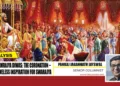
The history of India is not merely a chronicle of kingdoms and battles; it is the story of a civilization that has repeatedly risen from adversity through the courage and vision of extraordinary leaders. Among them, Chhatrapati Shivaji Maharaj occupies a unique and revered place. His coronation on 6 June 1674 (Jyeshtha Shukla Trayodashi, Vikram Samvat 1731) at Raigad Fort marked far more than the ascension of a monarch. It signified the rebirth of indigenous sovereignty, the restoration of national self-respect, and the reaffirmation of India’s civilizational identity.
For several centuries before Shivaji Maharaj’s rise, large parts of India had witnessed prolonged political instability and foreign domination. Many regions endured conflict, insecurity, and the erosion of traditional institutions. In such an atmosphere of uncertainty, hope appeared distant, and the confidence of society had been deeply shaken.
It was during this challenging period that Shivaji Maharaj emerged with a transformative vision—Hindavi Swarajya, a system of self-rule rooted in justice, public welfare, cultural confidence, and responsible governance. This vision was inspired by the values imparted by his mother, Rajmata Jijabai, and strengthened by his unwavering commitment to his people and homeland.
Unlike many rulers of his time, Shivaji Maharaj did not inherit a vast empire or an enormous army. His greatest strength lay in his leadership, strategic brilliance, and the unwavering loyalty of the Maval warriors. Through determination, innovative military tactics, and an intimate knowledge of the rugged Sahyadri mountains, he achieved victories that reshaped the political landscape of western India.
His campaigns demonstrated that courage, discipline, and intelligent strategy could overcome overwhelming odds. Yet, his greatest achievement was not military success alone—it was the establishment of a stable, accountable, and people-centric administration.
The coronation at Raigad transformed Shivaji Maharaj from a regional ruler into a sovereign monarch with formal legitimacy. Conducted according to Vedic traditions in the presence of distinguished scholars, the ceremony symbolized the restoration of indigenous political authority after centuries of foreign dominance in many parts of the subcontinent. It proclaimed that governance rooted in justice, public welfare, and cultural confidence could once again flourish on Indian soil.
Shivaji Maharaj’s administration became a model of efficient governance. His Ashta Pradhan (Council of Eight Ministers) reflected a structured administrative system. He introduced revenue reforms that protected farmers, ensured accountability in governance, strengthened forts and defence infrastructure, and promoted law and order throughout his kingdom.
One of the most remarkable aspects of his rule was his emphasis on ethical conduct. Strict instructions were issued to protect women, civilians, and places of worship during military campaigns. This commitment to discipline and humane governance distinguished his leadership and earned him enduring respect across generations.
Recognising the strategic importance of maritime security, Shivaji Maharaj also established one of India’s earliest organised naval forces. Coastal forts such as Sindhudurg became symbols of India’s determination to safeguard its maritime frontiers and commercial interests.
Beyond military and administrative achievements, Shivaji Maharaj contributed significantly to cultural revival. He encouraged the use of Indian languages in administration, promoted indigenous traditions, and strengthened confidence in India’s civilizational heritage. For him, Swarajya was not merely political independence; it represented cultural self-respect, social responsibility, and national unity.
Today, Hindu Empire Day is not simply a remembrance of a historical event. It is an occasion to reflect upon timeless ideals—leadership founded on integrity, governance dedicated to public welfare, courage in adversity, and unwavering commitment to one’s nation and culture.
For the youth of modern India, Shivaji Maharaj remains a source of enduring inspiration. His life teaches that true leadership is measured not by power or wealth, but by character, vision, discipline, and service to society. His legacy reminds us that a determined people, united by purpose and guided by noble values, possess the strength to shape history.
As we commemorate this historic day, let us renew our commitment to national unity, cultural confidence, ethical leadership, and the spirit of selfless service. That will be the most meaningful tribute to Chhatrapati Shivaji Maharaj and the enduring ideals of Swarajya.
«”Whenever India’s honour shall rise,
Shivaji’s legacy will illuminate the skies.
Whenever freedom and self-respect endure,
Raigad’s spirit shall remain forever pure.
Swarajya is not merely history’s call—
It is the eternal soul of a united nation.”»
Jai Bhavani! Jai Shivaji!
Glory to Hindavi Swarajya!
Victory to Mother India!