“This task of making the foundation of Bharatiya nationhood deeper and stronger is not an easy one. While it will be dangerous to encourage the growth of political minorities based on caste and religion, it is obviously the duty of the vast majority of Bharat’s population to assure all classes of people who are truly loyal to their motherland that they will be entitled to full protection under the law and to complete equality of treatment in all matters— social, economic and political. Our party gives this assurance unreservedly. We do recognise that there are large sections of Bharatiya people who are today backward and downtrodden. Full opportunity must be given to them so that their social and economic status may become higher and they may function as worthy participants with their more fortunate brethren in building up a new Bharat” – Dr Syama Prasad Mookerjee, in his presidential address at the first Convention of All India Bharatiya Jana Sangh held in Delhi on 21st October, 1951
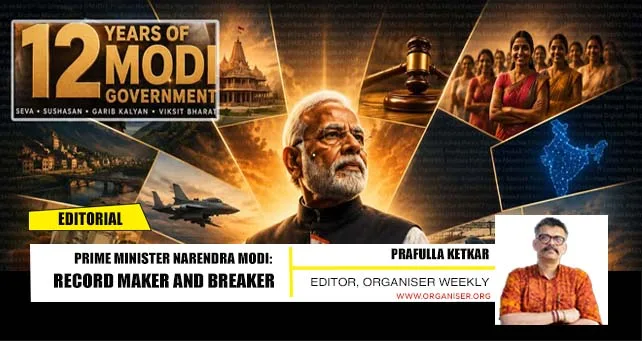
On June 10, 2026, Prime Minister Narendra Modi surpassed Jawaharlal Nehru as the longest-serving elected head of the independent Republic of Bharat. The occasion obviously raised political discussion revolved around the comparison between the two Prime Ministers, representing different eras. Prime Minister Modi’s track record over the years warrants a different kind of analysis that goes beyond politically motivated deliberations.
Before PM Modi assumed leadership of national affairs, governance in Bharat was grappling with instability, indecisiveness, and regional influences on critical issues. Narendra Modi’s twelve years have been distinguished by stability, continuity, and decisiveness in governance. Foreign policy was considered his weakest point when he assumed office in 2014. Defying initial scepticism, through invitations to leaders of neighbouring countries for the swearing-in, securing international acknowledgement of ancient Bharatiya wisdom such as Yoga, reconfiguring bilateral relations, initiatives like the International Solar Alliance, and by the historic hosting of the G-20 Summit, he set his own benchmarks on the global platform.
Domestically, spearheading policy initiatives such as Swachh Bharat Abhiyan, JAM Trinity, Make in India, Kisan Samman Nidhi, and Jal Jeevan Mission elevated implementation standards through participatory governance. Infrastructure development in all sectors took place at an unprecedented speed and scale, the fact even ardent critics of Modi cannot refute. Implementing GST with a cooperative federalist approach fostered new synergy and competition among States. Defence modernisation, targeted strikes, and command integration created a renewed security paradigm. Zero tolerance for terrorism and rooting out the armed Naxal movement are perhaps the greatest achievements of the Modi Government. Modi’s persona and leadership, his continuous commitment to delivering for the people, his adherence to civilisational values while embracing advanced technological tools in governance, and his direct communication with the public to inspire them for individual and collective accomplishment, are unmatched.
Many global leaders have ruled their countries for decades, however Modi stands apart. He is a leader who has been democratically elected for the third consecutive term and maintained top approval ratings in an era information overload. His tenure defies traditional views of anti-incumbency. Governing 1.4 billion aspirational people with immense diversity and frequent opposition from old elites and foreign-backed entities is a huge challenge. A key reason for his success is the ideological foundation he received.
As the first PM, Nehru perhaps viewed Bharat primarily through the lens of building a modern state, often downplaying its ancient civilisational foundation, and applying his own interpretations of secularism and socialism. In contrast, PM Modi’s approach highlights a reinvigoration of civilisational consciousness, seeking to blend modern technology and governance with inherited civilisational values. This ideological divergence is evident in their differing perspectives on issues such as Jammu and Kashmir, Somnath to Ayodhya, and the majority-minority dynamic, with Nehru often seen as sustaining a colonial framework, whereas Modi aligns with the Bharatiya perspective advanced by leaders like Dr Syama Prasad Mookerjee and Pt Deen Dayal Upadhyaya. The approach to poverty alleviation and belief in the capabilities of ordinary Bharatiya citizen is much more positive. The way Bharatiya languages, values and practices have been symbolically and substantially established in the governance processes is remarkable. Analysing the record-making and record-breaking stint of PM Modi in public life, beyond his Prime Ministership, thus involves engaging with the civilisational selfhood that Bharat stands for, and contextualising his ‘Charaiveti, Chairaveti‘ mantra as part of this ongoing ideological contrast.