India’s rural development story is no longer confined to promises on paper. Across villages, tribal habitations and economically vulnerable communities, a wide-ranging network of welfare, infrastructure, livelihood and social-security interventions is reshaping access to basic necessities and opening new pathways to economic opportunity.
The scale of the transformation is visible in the numbers.
Under the Jal Jeevan Mission, household tap-water connections have surged from 3.23 crore in August 2019 to more than 15.91 crore as of August 12, 2026. As many as 2.89 lakh villages have reported 100 per cent tap-water coverage.
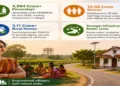
Expanding the Development Horizon ✨
India’s development story is reaching deeper into rural and tribal communities, transforming access, opportunity, and quality of life.
From basic services and resilient infrastructure to livelihoods, skills, education, and financial… pic.twitter.com/4XcOOyXxyp
— PIB India (@PIB_India) August 14, 2026
The sanitation push has expanded on a similar scale. More than 12.19 crore individual household toilets have been constructed under Swachh Bharat Mission-Grameen, while the number of operational GOBARdhan biogas plants has risen from just 14 in 2018-19 to over 1,288.
For millions of women, access to cleaner cooking fuel has also become a reality. More than 10.57 crore free LPG connections have been provided to women from below-poverty-line households under the Pradhan Mantri Ujjwala Yojana. The total number of LPG connections in India has meanwhile climbed from 14.52 crore in 2014 to 33.39 crore in 2026.
Healthcare coverage has expanded through the Ayushman Bharat architecture. More than 45.51 crore Ayushman Cards have been issued, while 96.43 crore ABHA accounts have been created. More than 1.86 lakh Ayushman Arogya Mandirs are currently functional.
From welfare delivery to empowered communities
The shift is not limited to delivering benefits. Increasing fiscal transfers to local institutions are strengthening decentralised governance. Direct fiscal transfers to gram panchayats are projected to rise from Rs 2.36 lakh crore under the 15th Finance Commission for 2021-26 to Rs 4.35 lakh crore under the 16th Finance Commission for 2026-31.
The Union Budget allocation for rural development has also increased sharply—from Rs 87,765 crore in 2016-17 to Rs 2.73 lakh crore in 2026-27. Tribal affairs allocations have risen from Rs 4,826 crore to Rs 15,421.97 crore over the same period.
This expansion points towards a model in which rural India is not merely a recipient of government assistance but an increasingly connected participant in development.
Roads, houses and digital villages
Infrastructure remains the backbone of this transformation.
Under Pradhan Mantri Awaas Yojana-Grameen, more than 3.91 crore houses have been sanctioned, with 3.13 crore completed as of August 12, 2026.
Under the Pradhan Mantri Gram Sadak Yojana, 99.6 per cent of eligible habitations had been connected with all-weather roads by June 2026. The completed road length rose from 3.86 lakh km between May 2000 and May 2014 to 4.13 lakh km between May 2014 and August 2026. The number of completed bridges has risen dramatically from 484 to 10,404.
Connectivity is also moving beyond roads.
Under BharatNet, 2.19 lakh gram panchayats were connected as of May 2026. Through eGramSwaraj, more than Rs 3 lakh crore in payments had been processed by June 2026, while over 1.28 lakh gram panchayats were using SabhaSaar for meeting summaries.
The rural transformation is therefore increasingly physical and digital at the same time. Women moving from beneficiaries to economic drivers. One of the most striking changes is visible in the expansion of women-led rural livelihoods.
Under the Deendayal Antyodaya Yojana-National Rural Livelihoods Mission, 10.19 crore households have been mobilised into 94.46 lakh self-help groups. By July 29, 2026, 3.46 crore Lakhpati Didis had been created.
More than 9 lakh Community Resource Persons are active across areas including agriculture, banking, insurance and nutrition. This network includes more than 50,548 Bank Sakhis, 1.91 lakh Krishi Sakhis, 2,012 Matsya Sakhis and 1.70 lakh Pashu Sakhis.
The proposed Self-Help Entrepreneur Mart, announced in the Union Budget 2026-27, seeks to take this transformation further by creating community-owned retail spaces for women within the SHG ecosystem, with an intended reach of one crore women.
The employment and enterprise ecosystem has expanded beyond SHGs as well. More than 1.64 crore youth have received skill training under the Pradhan Mantri Kaushal Vikas Yojana since inception, while DDU-GKY has trained 18.45 lakh candidates till August 11, 2026, with 12.35 lakh placed.
Financial inclusion reaches unprecedented scale
Financial security is another pillar of the rural transformation. Pradhan Mantri Jan Dhan Yojana beneficiaries have risen from 17.9 crore in August 2015 to 58.90 crore as of August 12, 2026.
MUDRA loans have grown from 3.49 crore sanctioned loans in 2016 to more than 59.14 crore by July 2026. PM SVANidhi beneficiaries have increased from 26.37 lakh in November 2021 to 78.17 lakh, with Rs 18,971.18 crore in loans disbursed.
Social-security coverage has expanded alongside financial inclusion. Atal Pension Yojana beneficiaries rose from 48.80 lakh in 2016-17 to 9.29 crore by June 2026. Nearly 27.90 crore people have been covered by Pradhan Mantri Jeevan Jyoti Bima Yojana, while 58.78 crore have been covered under Pradhan Mantri Suraksha Bima Yojana.
The e-Shram database has also expanded from 14.40 crore registrations in December 2021 to 31.87 crore as of August 12, 2026.
Education and opportunity beyond the village
Development cannot be sustainable without education. Female dropout rates at the primary level have fallen from 4.6 per cent in 2013-14 to 0.1 per cent in 2025-26, while the secondary-level female dropout rate has declined from 14.5 per cent to 8 per cent.
The Gross Enrolment Ratio at the higher-secondary level has risen from 46.4 per cent in 2014-15 to 61.7 per cent in 2025-26. Girls’ secondary-level GER has increased from 75.5 per cent to 83.4 per cent over the same period.
Digital education is adding another layer. SWAYAM has recorded more than 6.5 crore enrolments, while DIKSHA has 2.35 crore registered users as of August 12, 2026.
Tribal development moves towards mission mode
Perhaps one of the most significant aspects of the expanded development approach is the increasing focus on tribal communities and Particularly Vulnerable Tribal Groups.
Under PM-JANMAN, 540 Van Dhan Vikas Kendras have been sanctioned, benefiting 46,042 people from PVTG communities.
Under the Pradhan Mantri Janjatiya Vikas Mission, 4,172 Van Dhan Vikas Kendras have been sanctioned, benefiting 12.48 lakh tribal people.
The Pradhan Mantri Janjatiya Unnat Gram Abhiyan represents a broader shift towards coordinated intervention. Bringing together 17 ministries, the programme seeks to address long-standing gaps across tribal-majority villages and PVTG habitations.
Over the past 12 years, 7.60 lakh tribal houses have been completed, 28,303 tribal villages have gained access to drinking water, and 59,812 tribal households and public institutions have been electrified. Hundreds of Anganwadi Centres have also been operationalised and 692 hostels sanctioned for tribal students.
Education infrastructure for tribal children has expanded sharply. Operational Eklavya Model Residential Schools have risen from 129 in 2014-15 to 511 as of August 12, 2026, with enrolment reaching 1.68 lakh students.
Beyond numbers: Dignity as the development metric
The figures span water, toilets, electricity, housing, roads, healthcare, education, skills, credit, pensions and livelihoods. Taken together, they point to a broader transformation in how development is being pursued from isolated welfare schemes towards an interconnected ecosystem of basic services, infrastructure, financial inclusion and community-led economic participation.
For rural and tribal India, the change is ultimately measured not merely by kilometres of roads built or the number of accounts opened, but by whether households gain greater security, women gain greater economic agency, children gain better educational opportunities and communities gain stronger access to the formal economy.