India's labour codes impart social protection: Surendran Bojji
July 22, 2026
  • Read Ecopy
  • Circulation
  • Advertise
  • Careers
  • About Us
  • Contact Us
Android AppiPhone AppArattai
Organiser
  • ‌
  • Bharat
    • Assam
    • Bihar
    • Chhattisgarh
    • Jharkhand
    • Maharashtra
    • View All States
  • World
    • Asia
    • Europe
    • North America
    • South America
    • Africa
    • Australia
  • Editorial
  • International
  • Opinion
  • RSS @ 100
  • More
    • Op Sindoor
    • Analysis
    • Sports
    • Defence
    • Politics
    • Business
    • Economy
    • Culture
    • Special Report
    • Sci & Tech
    • Entertainment
    • G20
    • Azadi Ka Amrit Mahotsav
    • Vocal4Local
    • Web Stories
    • Education
    • Employment
    • Books
    • Interviews
    • Travel
    • Law
    • Health
    • Obituary
  • Subscribe
    • Subscribe Print Edition
    • Subscribe Ecopy
    • Read Ecopy
  • ‌
  • Bharat
    • Assam
    • Bihar
    • Chhattisgarh
    • Jharkhand
    • Maharashtra
    • View All States
  • World
    • Asia
    • Europe
    • North America
    • South America
    • Africa
    • Australia
  • Editorial
  • International
  • Opinion
  • RSS @ 100
  • More
    • Op Sindoor
    • Analysis
    • Sports
    • Defence
    • Politics
    • Business
    • Economy
    • Culture
    • Special Report
    • Sci & Tech
    • Entertainment
    • G20
    • Azadi Ka Amrit Mahotsav
    • Vocal4Local
    • Web Stories
    • Education
    • Employment
    • Books
    • Interviews
    • Travel
    • Law
    • Health
    • Obituary
  • Subscribe
    • Subscribe Print Edition
    • Subscribe Ecopy
    • Read Ecopy
Organiser
  • Home
  • Bharat
  • World
  • Operation Sindoor
  • Editorial
  • Analysis
  • Opinion
  • Culture
  • Defence
  • International Edition
  • RSS @ 100
  • Magazine
  • Read Ecopy
Home Bharat

India’s new labour codes impart security & social protection: BMS Secretary Surendran Bojji at Int Labour Conference

BMS Organising Secretary Surendran Bojji highlighted how reformed labour codes in India can ensure social justice and protection to the workers specifically to the unorganised sectors

WEBDESKWEBDESK
Jun 12, 2026, 01:30 pm IST
in Bharat, Economy, Employment
Follow on Google News
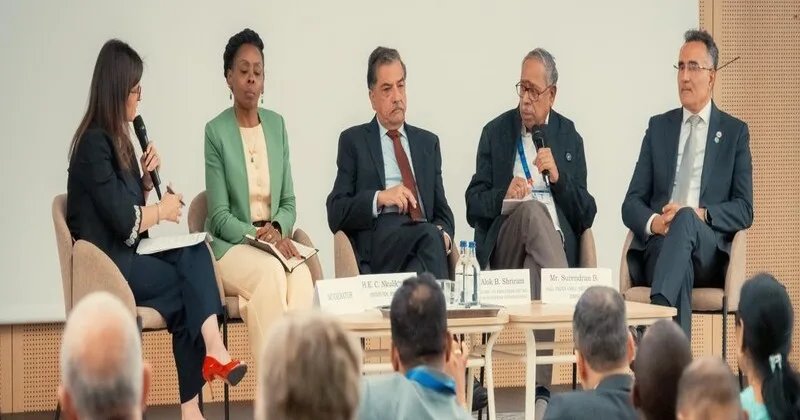
Surendran Bojji, All India Organising Secretary of the Bharatiya Mazdoor Sangh(BMS) speaking at Geneva

Surendran Bojji, All India Organising Secretary of the Bharatiya Mazdoor Sangh(BMS) speaking at Geneva

FacebookTwitterWhatsAppTelegramEmail

Geneva: Surendran Bojji, All India Organising Secretary of the Bharatiya Mazdoor Sangh(BMS) spoke about India’s new labour codes at the global dialogue organised by the Global Coalition for Social Justice on June 10, on the sidelines of the 114th session of International Labour Conference in Switzerland. In a panel discussion titled, “From National Reforms to Global Action- Sharing Experiences, Shaping Solutions for Social Justice”, Surendran Bojji spoke about the impact of new labour codes on Indian workers.

BMS Organising Secretary Surendran Bojji highlighted how reformed labour codes in India can ensure social justice and protection to the workers specifically to the unorganised sectors. Secretary Surendran highlighted the provisions in the new labour codes of India which enables base expansion of ESI and EPF, provision of VDA linked minimum wages, responsibility of both contractor & principal employer towards workers, right to medical check up etc. He also reiterated that implementation is the key otherwise these codes remain as just good intentions.

Reforms has broad support from the labourers as they extend tangible benefit

In the panel discussion, Surendran Bojji said that from the workers’ perspective, reforms succeed only when they improve income security, social protection, dignity at work and opportunities for better livelihoods. Workers support reforms when they experience tangible benefits in their daily lives. In this direction, India’s Code on Wages, 201G has introduced several transformational measures, which includes:

• The introduction of a National Floor Wage, linked to minimum living standards, provides a strong foundation for wage justice while ensuring that States cannot fix lower than the National Floor Level, which guarantees universal wage protection.

• Compulsory revision of minimum wages once in five years and inflation adjustment through Variable Dearness Allowance (VDA), thereby protecting workers against rising living costs.

• The requirement that Basic Pay and Dearness Allowance together should constitute at least 50 per cent of total wages ensures that workers receive higher statutory benefits such as Provident Fund, Gratuity and Bonus by preventing artificial splitting of wages through allowances.

• Strengthening enforcement by making both contractors and principal employers responsible for payment of minimum wages, requiring wage slips and timely wage payments and empowering workers and trade unions to seek legal remedies where statutory wages are denied.

• No gender discrimination in wages, recruitment and working conditions has been ensured.

• Employees have the right to a medical check-up and for all employers employing more than 10 workers, safety and health provisions have been made compulsory.

From the workers’ perspective, these measures improve transparency, accountability and fairness in wage administration and contribute towards greater industrial harmony. We believe that labour reforms gain broad support when they deliver fair wages, legal protection, social security and dignity of labour, while simultaneously supporting economic growth and employment generation, Surendran Bojji further added.

Reforms in India’s labour codes ensure security & dignity of workers

Surendran Bojji further explained how the changing world of work requires a new approach to social protection. In this path, the Code on Social Security, 2020 marks a historic step by extending universal social security coverage beyond the organised sector and by recognising gig workers and platform workers within India’s social security architecture.

Also Read: How India achieved a global first by running double-stack container trains under an electrified railway network

India has 93 per cent of its workers in the informal sector. The ultimate goal of these social protection mechanisms is to bring 400 million workers under social security coverage, which is a revolutionary initiative in the history of independent India. Surendran Bojji thus highlighted transformative measures in this direction.

ESIC

• The Employees’ State Insurance (ESI) Scheme will now cover all 802 districts (as of date) of 28 States and 8 Union Territories for establishments employing 10 or more employees, excluding seasonal factories, significantly expanding the scope of ESIC.

• Earlier, ESIC covered only 566 districts with approximately 3.5 crore registered insured persons (IPs).

• Now the ESI will cover all hazardous employment in which even a single worker is employed

EPF

• The Employees’ Provident Fund (EPF) will now apply to all establishments with 20 or more workers, rather than only the 187 scheduled industries currently notified by the Government. • Currently, there are approximately 8.5 crore contributing members across India out of the estimated 50 crore working population.

Surendran Bojji also emphasized on how the Code empowers the Government to formulate dedicated welfare schemes for gig workers, platform workers, unorganised workers and self-employed workers, thereby advancing the objective of universal social security. The expansion of ESIC coverage across the country, wider applicability of EPF and recognition of occupational diseases as employment injuries further strengthen worker protection and social justice, he added.

There is a dire need to focus on “skill upgradation among middle-aged adults”. In Engineering, Pharma and the IT sector, this aspect is emerging as a new challenge.  The Governments, international agencies and skill development agencies have to chalk out a special plan for this. Then only the reforms will yield the expected results, BMS Secretary Surendran Bojji further asserted.

Effective implementation is critical

Surendran Bojji also firmly reiterated that effective implementation of the labour codes and other welfare measures is critical for the well-being and security of the labourers. From the workers’ perspective, legislation must be supported by effective implementation. Every worker in the digital economy should have access to social security, fair remuneration, transparent working conditions, grievance redressal mechanisms and opportunities for continuous skill development, Surendran Bojji added.

“We believe that technology should empower workers, not marginalise them and that the future of work must be built upon the principles of security, dignity, inclusion and social justice for every worker. In India, we believe in the Industrial Family concept and there are good relations among the employees, employers and governments. We don’t always see the darkness. Thus, together, we find answers to all types of problems, find solutions and collectively help India progress among the comity of nations”, Surendran Bojji concluded by emphasising on the strength of the labour ecosystem in India which is capable of solving bottlenecks and lending tangible solutions.


Topics: LABOUR CODESGig Workerslabour reformsSocial ProtectionBharatiya Mazdoor Sangh(BMS)BMS Organising Secretary Surendran BojjiIndiaGeneva
ShareTweetSendShareSend
✮ Subscribe Organiser YouTube Channel. ✮
✮ Join Organiser's WhatsApp channel for Nationalist views beyond the news. ✮
Previous News

How India achieved a global first by running double-stack container trains under an electrified railway network

Next News

Dharmasthala ‘Mass Burial’ Case: Actor Prakash Raj named in Rs 200-crore conspiracy; Karnataka HC seeks SIT report

Related News

India and North Macedonia eye expanding cooperation across three Ts- trade, technology, tourism: MEA

India-North Macedonia eye expanding cooperation across three Ts- trade, technology, tourism: MEA

AI Generated Image

Bharat Beyond Western Lens: How science, tech, education, defence & infrastructure progress are powering nation’s rise

MEA condemns MV Golden Leo attack, death of 4 Indians; Summons Russian diplomat over maritime security

AI Generated Image

Beyond Numbers: Why Australia’s Indian diaspora is the strategic heart of the India–Australia partnership

PM Modi’s diplomatic arc across the Indo-Pacific and strategic calculations to seal national security

India is restoring ancient temples and heritage sites across Asia, using cultural diplomacy to preserve shared civilisational heritage

From Prambanan to Angkor Wat: How India is preserving ancient heritage to strengthen global cultural ties

Load More

Latest News

New Delhi, Jul 22 (ANI): Protesters in large numbers continue their protest at Jantar Mantar in support of the Cockroach Janata Party (CJP), demanding the resignation of Union Education Minister Dharmendra Pradhan over alleged examination irregularities and NEET paper leak, in New Delhi on Wednesday. (ANI Photo/Rahul Singh)

Delhi protest turns violent again; Five Police Personnel injured as CJP supporters clash with security forces

(Left) Protesters at Jantar Mantar (Right) Mana sitting in a police van

CJP Protest in Delhi: Who is Mana? Know all about her as she incites mob to lynch police, uses extremely foul language

Telangana BJP president N. Ramchander Rao and party workers detained by Hyderabad Police

Telangana: BJP leaders detained for protesting against demonstration by Rahul Gandhi near PM Modi’s residence

Khalistan terror group enters CJP protests: SFJ’s Pannun offers $1 million, threatens India’s disintegration

Ayurveda is rapidly emerging as one of India's strongest tools of global health diplomacy and soft power

From Jamnagar to the World: How Ayurveda is transforming India’s global health diplomacy and soft power

BJP Keralam vice president Adv. Shon George (Left)

Keralam: BJP’s Shon George says Supreme Court order vindicates party’s stand on Kerala Waqf Board

Writer Taslima Nasrin

Taslima Nasrin: A voice under attack from fundamentalism and leftist groups

Government of India Must Constitute a High-Level Committee to Ensure Transparency and Institutional Reforms in Competitive Examinations: ABVP

Students will not become instruments for narrow political interests and anti-national conspiracies: ABVP

Tamil Nadu: TVK Minister attends CJP protest over NEET; BJP questions the government’s stand

Odisha CM Mohan Charan Majhi

NITI Aayog’s IFI 2026: Odisha emerges as a leading investment destination, ranks among India’s top five states

Load More
  • Privacy
  • Terms
  • Cookie Policy
  • Refund and Cancellation
  • Delivery and Shipping

© Bharat Prakashan (Delhi) Limited.
Tech-enabled by Ananthapuri Technologies

  • Home
  • Search Organiser
  • Bharat
    • Assam
    • Bihar
    • Chhattisgarh
    • Jharkhand
    • Maharashtra
    • View All States
  • World
    • Asia
    • Africa
    • North America
    • South America
    • Europe
    • Australia
  • Editorial
  • Operation Sindoor
  • Opinion
  • Analysis
  • Defence
  • Culture
  • Sports
  • Business
  • RSS @ 100
  • Entertainment
  • More ..
    • Sci & Tech
    • Vocal4Local
    • Special Report
    • Education
    • Employment
    • Books
    • Interviews
    • Travel
    • Health
    • Politics
    • Law
    • Economy
    • Obituary
  • Subscribe Magazine
  • Read Ecopy
  • Advertise
  • Circulation
  • Careers
  • About Us
  • Contact Us
  • Policies & Terms
    • Privacy Policy
    • Cookie Policy
    • Refund and Cancellation
    • Terms of Use

© Bharat Prakashan (Delhi) Limited.
Tech-enabled by Ananthapuri Technologies