India's labour codes impart social protection: Surendran Bojji
June 12, 2026
  • Read Ecopy
  • Circulation
  • Advertise
  • Careers
  • About Us
  • Contact Us
Android AppiPhone AppArattai
Organiser
  • ‌
  • Bharat
    • Assam
    • Bihar
    • Chhattisgarh
    • Jharkhand
    • Maharashtra
    • View All States
  • World
    • Asia
    • Europe
    • North America
    • South America
    • Africa
    • Australia
  • Editorial
  • International
  • Opinion
  • RSS @ 100
  • More
    • Op Sindoor
    • Analysis
    • Sports
    • Defence
    • Politics
    • Business
    • Economy
    • Culture
    • Special Report
    • Sci & Tech
    • Entertainment
    • G20
    • Azadi Ka Amrit Mahotsav
    • Vocal4Local
    • Web Stories
    • Education
    • Employment
    • Books
    • Interviews
    • Travel
    • Law
    • Health
    • Obituary
  • Subscribe
    • Subscribe Print Edition
    • Subscribe Ecopy
    • Read Ecopy
  • ‌
  • Bharat
    • Assam
    • Bihar
    • Chhattisgarh
    • Jharkhand
    • Maharashtra
    • View All States
  • World
    • Asia
    • Europe
    • North America
    • South America
    • Africa
    • Australia
  • Editorial
  • International
  • Opinion
  • RSS @ 100
  • More
    • Op Sindoor
    • Analysis
    • Sports
    • Defence
    • Politics
    • Business
    • Economy
    • Culture
    • Special Report
    • Sci & Tech
    • Entertainment
    • G20
    • Azadi Ka Amrit Mahotsav
    • Vocal4Local
    • Web Stories
    • Education
    • Employment
    • Books
    • Interviews
    • Travel
    • Law
    • Health
    • Obituary
  • Subscribe
    • Subscribe Print Edition
    • Subscribe Ecopy
    • Read Ecopy
Organiser
  • Home
  • Bharat
  • World
  • Operation Sindoor
  • Editorial
  • Analysis
  • Opinion
  • Culture
  • Defence
  • International Edition
  • RSS @ 100
  • Magazine
  • Read Ecopy
Home Bharat

India’s new labour codes impart security & social protection: BMS Secretary Surendran Bojji at Int Labour Conference

BMS Organising Secretary Surendran Bojji highlighted how reformed labour codes in India can ensure social justice and protection to the workers specifically to the unorganised sectors

WEBDESKWEBDESK
Jun 12, 2026, 01:30 pm IST
in Bharat, Economy, Employment
Follow on Google News
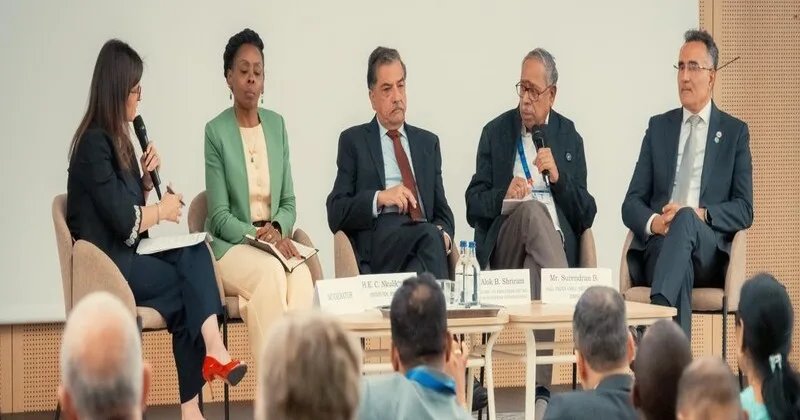
Surendran Bojji, All India Organising Secretary of the Bharatiya Mazdoor Sangh(BMS) speaking at Geneva

Surendran Bojji, All India Organising Secretary of the Bharatiya Mazdoor Sangh(BMS) speaking at Geneva

FacebookTwitterWhatsAppTelegramEmail

Geneva: Surendran Bojji, All India Organising Secretary of the Bharatiya Mazdoor Sangh(BMS) spoke about India’s new labour codes at the global dialogue organised by the Global Coalition for Social Justice on June 10, on the sidelines of the 114th session of International Labour Conference in Switzerland. In a panel discussion titled, “From National Reforms to Global Action- Sharing Experiences, Shaping Solutions for Social Justice”, Surendran Bojji spoke about the impact of new labour codes on Indian workers.

BMS Organising Secretary Surendran Bojji highlighted how reformed labour codes in India can ensure social justice and protection to the workers specifically to the unorganised sectors. Secretary Surendran highlighted the provisions in the new labour codes of India which enables base expansion of ESI and EPF, provision of VDA linked minimum wages, responsibility of both contractor & principal employer towards workers, right to medical check up etc. He also reiterated that implementation is the key otherwise these codes remain as just good intentions.

Reforms has broad support from the labourers as they extend tangible benefit

In the panel discussion, Surendran Bojji said that from the workers’ perspective, reforms succeed only when they improve income security, social protection, dignity at work and opportunities for better livelihoods. Workers support reforms when they experience tangible benefits in their daily lives. In this direction, India’s Code on Wages, 201G has introduced several transformational measures, which includes:

• The introduction of a National Floor Wage, linked to minimum living standards, provides a strong foundation for wage justice while ensuring that States cannot fix lower than the National Floor Level, which guarantees universal wage protection.

• Compulsory revision of minimum wages once in five years and inflation adjustment through Variable Dearness Allowance (VDA), thereby protecting workers against rising living costs.

• The requirement that Basic Pay and Dearness Allowance together should constitute at least 50 per cent of total wages ensures that workers receive higher statutory benefits such as Provident Fund, Gratuity and Bonus by preventing artificial splitting of wages through allowances.

• Strengthening enforcement by making both contractors and principal employers responsible for payment of minimum wages, requiring wage slips and timely wage payments and empowering workers and trade unions to seek legal remedies where statutory wages are denied.

• No gender discrimination in wages, recruitment and working conditions has been ensured.

• Employees have the right to a medical check-up and for all employers employing more than 10 workers, safety and health provisions have been made compulsory.

From the workers’ perspective, these measures improve transparency, accountability and fairness in wage administration and contribute towards greater industrial harmony. We believe that labour reforms gain broad support when they deliver fair wages, legal protection, social security and dignity of labour, while simultaneously supporting economic growth and employment generation, Surendran Bojji further added.

Reforms in India’s labour codes ensure security & dignity of workers

Surendran Bojji further explained how the changing world of work requires a new approach to social protection. In this path, the Code on Social Security, 2020 marks a historic step by extending universal social security coverage beyond the organised sector and by recognising gig workers and platform workers within India’s social security architecture.

Also Read: How India achieved a global first by running double-stack container trains under an electrified railway network

India has 93 per cent of its workers in the informal sector. The ultimate goal of these social protection mechanisms is to bring 400 million workers under social security coverage, which is a revolutionary initiative in the history of independent India. Surendran Bojji thus highlighted transformative measures in this direction.

ESIC

• The Employees’ State Insurance (ESI) Scheme will now cover all 802 districts (as of date) of 28 States and 8 Union Territories for establishments employing 10 or more employees, excluding seasonal factories, significantly expanding the scope of ESIC.

• Earlier, ESIC covered only 566 districts with approximately 3.5 crore registered insured persons (IPs).

• Now the ESI will cover all hazardous employment in which even a single worker is employed

EPF

• The Employees’ Provident Fund (EPF) will now apply to all establishments with 20 or more workers, rather than only the 187 scheduled industries currently notified by the Government. • Currently, there are approximately 8.5 crore contributing members across India out of the estimated 50 crore working population.

Surendran Bojji also emphasized on how the Code empowers the Government to formulate dedicated welfare schemes for gig workers, platform workers, unorganised workers and self-employed workers, thereby advancing the objective of universal social security. The expansion of ESIC coverage across the country, wider applicability of EPF and recognition of occupational diseases as employment injuries further strengthen worker protection and social justice, he added.

There is a dire need to focus on “skill upgradation among middle-aged adults”. In Engineering, Pharma and the IT sector, this aspect is emerging as a new challenge.  The Governments, international agencies and skill development agencies have to chalk out a special plan for this. Then only the reforms will yield the expected results, BMS Secretary Surendran Bojji further asserted.

Effective implementation is critical

Surendran Bojji also firmly reiterated that effective implementation of the labour codes and other welfare measures is critical for the well-being and security of the labourers. From the workers’ perspective, legislation must be supported by effective implementation. Every worker in the digital economy should have access to social security, fair remuneration, transparent working conditions, grievance redressal mechanisms and opportunities for continuous skill development, Surendran Bojji added.

“We believe that technology should empower workers, not marginalise them and that the future of work must be built upon the principles of security, dignity, inclusion and social justice for every worker. In India, we believe in the Industrial Family concept and there are good relations among the employees, employers and governments. We don’t always see the darkness. Thus, together, we find answers to all types of problems, find solutions and collectively help India progress among the comity of nations”, Surendran Bojji concluded by emphasising on the strength of the labour ecosystem in India which is capable of solving bottlenecks and lending tangible solutions.


Topics: BMS Organising Secretary Surendran BojjiIndiaGenevaLABOUR CODESGig Workerslabour reformsSocial ProtectionBharatiya Mazdoor Sangh(BMS)
ShareTweetSendShareSend
✮ Subscribe Organiser YouTube Channel. ✮
✮ Join Organiser's WhatsApp channel for Nationalist views beyond the news. ✮
Previous News

How India achieved a global first by running double-stack container trains under an electrified railway network

Next News

Dharmasthala ‘Mass Burial’ Case: Actor Prakash Raj named in Rs 200-crore conspiracy; Karnataka HC seeks SIT report

Related News

US: Anshul Kuncha’s death exposes anti-India racist racket; Assaulting the community that powers American economy!

Global Peace Index Farce: Does the GPI penalise democracies fighting terrorism? India’s case explained

India Summons US Diplomat: Lodges strong protest over attack on vessel carrying Indian seafarers in Gulf of Oman

West Asia Conflict: 3 Indian seafarers died in Gulf of Oman who were missing after US military strike hit the vessel

Sacred relics of Buddha’s disciples return to India from Mongolia; Historic 10-day expo echoed civilisational ties

India Deploys 12 Nuclear Warheads: Heralds doctrinal shift to script strategic deterrence against multi-front threat

Load More

Latest News

Centre signs historic tripartite MoU with Assam and Nagaland for oil and gas exploration and production

Assam-Nagaland sign historic MoU to unlock oil & gas exploration along border, ending decades long dispute

Dharmasthala skull case has taken a fresh turn after Chinnayya filed a writ petition in the Karnataka High Court alleging a Rs 200-crore conspiracy to defame the shrine

Dharmasthala ‘Mass Burial’ Case: Actor Prakash Raj named in Rs 200-crore conspiracy; Karnataka HC seeks SIT report

Surendran Bojji, All India Organising Secretary of the Bharatiya Mazdoor Sangh(BMS) speaking at Geneva

India’s new labour codes impart security & social protection: BMS Secretary Surendran Bojji at Int Labour Conference

Railway Minister Ashwini Vaishnaw

How India achieved a global first by running double-stack container trains under an electrified railway network

Union Home Minister Amit Shah (Left)

West Bengal: Amul to lay foundation stone for Rs 700 crore dairy plant on June 14, boosting eastern India expansion

Defence Minister Rajnath Singh with his Vietnamese counterpart, General Phan Van Giang, in Hanoi on 19 May 2026

Arming Partnerships, Expanding Influence: How India is expanding its defence footprint across the world

Representative image

Love Jihad Karnataka: Minor Dalit Hindu girl committed suicide after blackmail & conversion pressure by Nayeem Baig

A representative image

Decade of care, dignity, safer motherhood: How PM Surakshit Matritva Abhiyaan transformed maternal healthcare in Bharat

Esteemed speakers addressing the gathering at Arogya Bharati’s National Workshop “Amritam” in Bhopal

Madhya Pradesh: Arogya Bharati’s ‘Amritam’ workshop highlights growing role of homeopathy

Tamil Nadu: Temple lands, HR&CE appointment and Chennai Koyambedu project rows trigger fresh controversy

Load More
  • Privacy
  • Terms
  • Cookie Policy
  • Refund and Cancellation
  • Delivery and Shipping

© Bharat Prakashan (Delhi) Limited.
Tech-enabled by Ananthapuri Technologies

  • Home
  • Search Organiser
  • Bharat
    • Assam
    • Bihar
    • Chhattisgarh
    • Jharkhand
    • Maharashtra
    • View All States
  • World
    • Asia
    • Africa
    • North America
    • South America
    • Europe
    • Australia
  • Editorial
  • Operation Sindoor
  • Opinion
  • Analysis
  • Defence
  • Culture
  • Sports
  • Business
  • RSS @ 100
  • Entertainment
  • More ..
    • Sci & Tech
    • Vocal4Local
    • Special Report
    • Education
    • Employment
    • Books
    • Interviews
    • Travel
    • Health
    • Politics
    • Law
    • Economy
    • Obituary
  • Subscribe Magazine
  • Read Ecopy
  • Advertise
  • Circulation
  • Careers
  • About Us
  • Contact Us
  • Policies & Terms
    • Privacy Policy
    • Cookie Policy
    • Refund and Cancellation
    • Terms of Use

© Bharat Prakashan (Delhi) Limited.
Tech-enabled by Ananthapuri Technologies