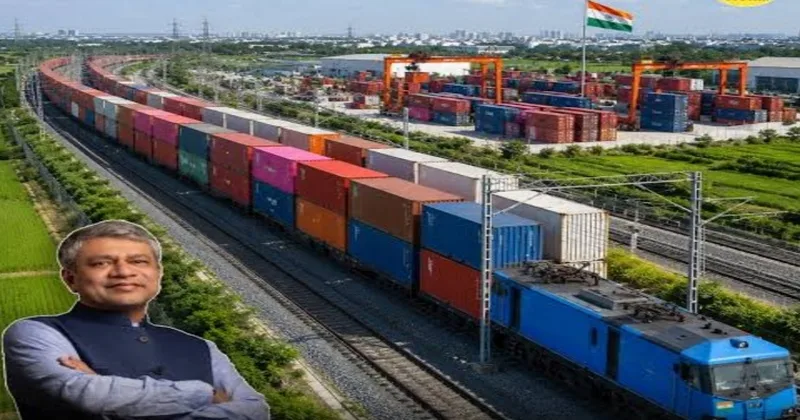
New Delhi: India has achieved a landmark milestone in railway transportation by becoming the first country in the world to successfully operate double-stack container trains powered by electric locomotives on a large scale. The achievement marks a significant advancement in freight transportation, combining high-capacity cargo movement with clean and energy-efficient operations.
🚆🇮🇳 A Global First by Indian Railways!
India has achieved a remarkable milestone by becoming the first and only country in the world to successfully operate double-stack container trains powered by electric locomotives. This breakthrough represents a major leap in freight… pic.twitter.com/20qHF0ECrs
— Miran🇮🇳 (@Miran7g) June 11, 2026
The breakthrough has been made possible through the development of dedicated high-clearance railway infrastructure and the electrification of freight corridors, enabling Indian Railways to run double-stack container trains under overhead electric lines. While countries such as the United States, Canada, China, and Australia operate double-stack container trains, most rely heavily on diesel-powered locomotives due to the challenges associated with running taller trains beneath electrified networks. India has overcome these engineering constraints through innovative design and infrastructure planning.
Engineering Innovation Behind the Achievement
One of the key challenges in operating double-stack container trains under electric traction is maintaining sufficient vertical clearance between stacked containers and overhead electric wires. To address this, Indian Railways, through the Dedicated Freight Corridor (DFC) project, designed a high-rise overhead equipment (OHE) system with increased wire height.
The Western Dedicated Freight Corridor, stretching across key industrial and port regions, has been specifically engineered to accommodate double-stack container movement. The corridor allows electric locomotives to haul two layers of containers safely and efficiently while maintaining operational reliability and safety standards.
This engineering accomplishment represents a major technological breakthrough, demonstrating India’s capability to solve complex infrastructure challenges through indigenous innovation and strategic planning.
Boosting Freight Capacity and Efficiency
Double-stack container operations significantly increase the volume of cargo that can be transported in a single train journey. By carrying two layers of containers instead of one, freight capacity rises substantially without requiring additional train paths.
This leads to several advantages
* Higher cargo-carrying capacity per train.
* Reduced transportation costs for industries and exporters.
* Better utilisation of railway infrastructure.
* Lower congestion on rail networks and highways.
* Faster movement of goods across long distances.
The enhanced efficiency is expected to strengthen India’s logistics ecosystem and improve supply chain competitiveness, benefiting sectors such as manufacturing, agriculture, e-commerce, and exports.
The transition from diesel-powered freight operations to electric traction delivers substantial environmental benefits. Electric locomotives produce significantly lower carbon emissions and are more energy-efficient than conventional diesel engines.
By combining electrification with high-capacity double-stack freight movement, Indian Railways has created a transportation model that reduces fuel consumption while moving larger volumes of cargo. This contributes directly to India’s climate commitments and efforts to develop greener transportation systems.
Role of Dedicated Freight Corridors
The success of electric double-stack operations is closely linked to the development of Dedicated Freight Corridors, one of India’s largest infrastructure projects.
These corridors are designed exclusively for freight movement, separating cargo traffic from passenger trains and enabling
* Higher train speeds.
* Greater reliability.
* Increased freight volumes.
* Reduced transit times.
* Improved network efficiency.
The Western Dedicated Freight Corridor has emerged as a crucial logistics artery connecting ports, industrial hubs, and consumption centres. Its specialised infrastructure has allowed India to pioneer a freight transportation model that few countries have been able to implement.
Logistics costs in India have historically been higher than those in many developed economies. The ability to transport larger cargo volumes using electrified double-stack trains is expected to help lower these costs significantly.
Reduced logistics expenses can improve the competitiveness of Indian businesses in global markets by making exports more cost-effective and supply chains more efficient. Industries dependent on bulk transportation stand to benefit from faster delivery schedules and lower freight charges.
The development also supports the government’s broader initiatives, such as Make in India, PM Gati Shakti, National Logistics Policy, and efforts to enhance multimodal connectivity across the country.
Setting a Global Benchmark
India’s achievement is particularly noteworthy because it combines two elements that have traditionally been difficult to integrate: double-stack freight operations and widespread railway electrification.
Countries with extensive double-stack rail networks often rely on diesel traction, while many electrified railway systems lack the infrastructure clearances needed for double-stack movement. By successfully overcoming these limitations, India has established a unique model that offers both high freight efficiency and environmental sustainability. The accomplishment positions India as a global leader in innovative railway freight solutions and showcases the country’s growing expertise in large-scale infrastructure development.
The successful operation of double-stack container trains powered by electric locomotives reflects India’s broader transformation in transportation and infrastructure. It demonstrates how strategic investments, engineering innovation, and long-term planning can create world-class logistics systems capable of supporting rapid economic growth.
As India advances towards the vision of Viksit Bharat, such achievements highlight the country’s ability to develop cutting-edge infrastructure that is efficient, sustainable, and globally competitive. The milestone not only strengthens Indian Railways’ role in national development but also sets a new international benchmark for freight transportation in the 21st century.