4,500 years ago, on the coast of Gujarat, the artisans of Lothal built the world’s earliest known dockyard: a brick-lined basin engineered to manage tidal flow, linked to warehouses, standardised weights and a settlement built around the business of moving goods efficiently. Long before the word “logistics” existed, the Indus Valley’s traders had already grasped its central problem: goods are only as valuable as a civilisation’s ability to track, store and move them without loss. That problem did not disappear with the millennia; it simply changed scale. This month, the Ministry of Commerce and Industry announced that the Logistics Data Bank, India’s digital tracking backbone for export-import containers, had tracked its ten-crore container since launch in 2016, a modern answer to the same ancient question, delivered not in brick and tide, but in RFID tags and cloud servers.
Union Minister of Commerce and Industry Piyush Goyal called the milestone “an important milestone in Indian logistics journey,” noting that technology is helping make logistics simpler, faster and more efficient while strengthening the competitiveness of Indian industry. Efficient logistics, he said, would be central to expanding India’s manufacturing base and global market presence, in line with the Prime Minister’s vision of a Viksit Bharat.
What exactly is the Logistics Data Bank? At its core, LDB is a technology platform that provides visibility into the movement of EXIM containers the shipping boxes carrying India’s exports and imports as they travel across the country’s ports, railways, roads and industrial hubs. It does this through Radio Frequency Identification tags fitted to containers, read automatically by scanners positioned across the logistics chain, and stitched together using the Internet of Things, big data and cloud computing into a single, near real-time picture of where any tracked container actually is. Rather than a shipper or manufacturer calling a port, a railway yard and a trucking company separately to locate a consignment, LDB consolidates that information into one searchable system, accessible through a single-window platform at ldb.co.in.
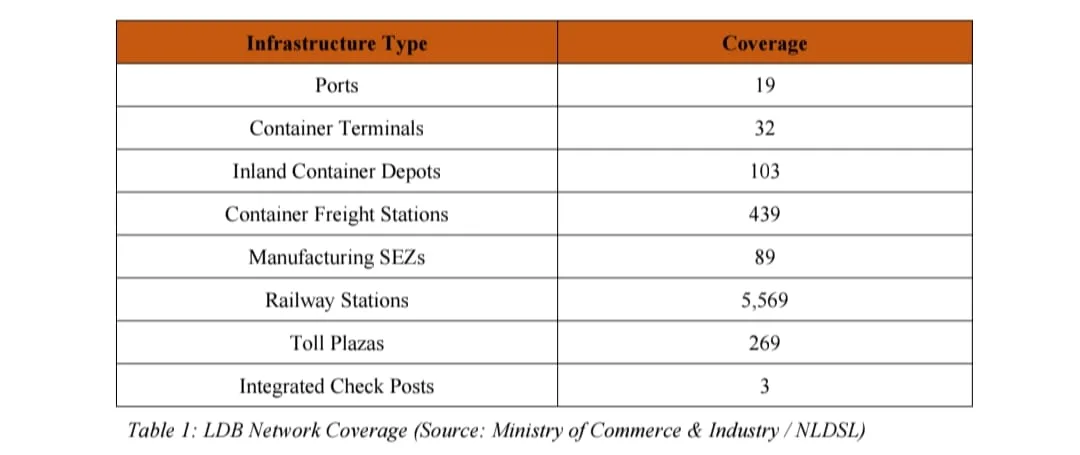
The scale of that system is what makes it distinctive. LDB now provides visibility of 100 per cent of India’s EXIM container movement, spanning 19 ports and 32 container terminals, and reaching deep into the country’s inland logistics network with 103 Inland Container Depots, 439 Container Freight Stations, empty yards, parking plazas and industrial zones, 89 manufacturing Special Economic Zones, 5,569 railway stations, 269 toll plazas and three Integrated Check Posts along India’s land borders.
That coverage did not happen by accident, and it began well before the platform’s 2016 launch. NICDC Logistics Data Services Limited, the company that built and runs LDB, was established on 30 December 2015 as a joint venture between the Government of India represented by the National Industrial Corridor Development and Implementation Trust and the Japanese IT major NEC Corporation. Its founding objective was narrow but ambitious: to harness information and communication technology to lift the efficiency of India’s logistics sector, at the time widely seen as one of the opaque and more fragmented parts of the country’s trade infrastructure. LDB was the company’s first major deliverable, built to solve a specific, longstanding complaint from exporters and importers that once a container left a factory gate, nobody, including the shipper, could reliably say where it was.
The platform has continued to expand well beyond that original mandate. LDB 2.0, launched by Piyush Goyal in September 2025, extended tracking beyond Indian shores for the first time, enabling high-seas tracking of India’s export containers once they leave port, alongside multimodal shipment visibility that follows a single consignment as it moves across ship, rail and road. NICDC Managing Director and NLDSL Chairman Rajat Kumar Saini, IAS, described reaching ten crore containers as “a proud moment in the journey of LDB,” noting that a platform which began with the narrow objective of tracking EXIM containers has become a central digital utility for India’s logistics sector, built through sustained cooperation with the Ministry of Ports, Shipping and Waterways, the Ministry of Road Transport and Highways, hundreds of ports, terminals and depots across the country.
The benefits of that scale show up less in the headline container count than in what the data enables once collected. LDB generates analytics on dwell time how long a container sits idle at a port or depot and transit time, allowing shippers, terminal operators and policymakers to identify exactly where a shipment is losing time and why. A terminal with unusually long dwell times, or a rail corridor with erratic transit windows, becomes visible in the data rather than buried in anecdote, giving both industry and government a shared, evidence-based starting point for fixing bottlenecks rather than debating them. That utility is reflected in usage; LDB now handles an average of over 1.5 crore container searches every month, drawn from exporters, importers, logistics companies and government agencies checking on shipments in near real time. Alongside the Unified Logistics Interface Platform, LDB’s sister initiative under NLDSL, it forms part of a broader digital public infrastructure approach to logistics, treating shipment visibility less as a private commercial service and more as a shared utility available to any stakeholder who needs it.
For the exporter community, and especially the smaller manufacturers who make up the bulk of India’s export base, this kind of visibility solves a problem that used to be simply absorbed as a cost of doing business. A mid-sized garment or engineering goods exporter without the leverage to demand real-time updates from a shipping line or a container freight station previously had little choice but to wait and hope; the same exporter can now check a consignment’s status on ldb.co.in without needing a relationship with anyone in the chain. That democratisation of information, putting the same visibility in the hands of a first-time exporter and a large conglomerate, is arguably a more consequential outcome than the ten-crore figure itself, because it changes who gets to plan with confidence rather than merely who gets to move the most cargo.
Where does this leave India’s standing globally? The World Bank’s Logistics Performance Index, which the press release notes has recognised LDB’s contribution, offers a useful yardstick. In its 2023 edition, the most recent full survey-based ranking, India stood 38th among 139 countries, up from 44th in 2018 and 54th in 2014, with a notably stronger 22nd-place finish in the “international shipments” category specifically. Indian ports recorded an average turnaround time of 0.9 days, faster than the United States, Germany, Australia and Canada. India has set itself the target of breaking into the LPI top 25 by 2030, alongside a broader goal of cutting logistics costs from the 13-14 per cent of GDP they have historically consumed toward single digits, closer to the levels seen in developed economies. India’s freight and logistics market itself is projected to grow at roughly 8.8 per cent a year, from about 317 billion dollars in 2024 to nearly 485 billion dollars by 2029 growth that a fragmented, low-visibility logistics chain would struggle to absorb without costs spiralling, and that a platform tracking every container by design helps keep in check. Platforms like LDB are not incidental to that ambition; tracking and tracing is one of the six parameters on which the LPI itself scores countries, and India’s improvement on that specific measure over the past decade tracks closely with LDB’s own expansion.
It is worth setting India’s approach against a global counterpoint. In 2018, Maersk and IBM launched TradeLens, a blockchain-based platform built with similar ambitions: a single, shared view of container movement across the world’s shipping networks, backed by two of the most powerful names in global trade and technology. By early 2023, it was gone. Maersk and IBM shut the platform down after failing to secure the industry-wide participation a genuinely global system required, an admission that even substantial private capital could not compel rival shipping lines, ports and customs authorities to share data on a common platform. LDB’s experience runs in the opposite direction precisely because it did not depend on voluntary industry consensus to build as public digital infrastructure with a government mandate behind it and RFID readers installed across state-owned and regulated infrastructure rather than negotiated port by port; it achieved the full national coverage that TradeLens could never assemble even with the entire globe as its canvas.
Nearly five millennia after Lothal engineers first tied a dockyard to standardised weights and a functioning administrative system, the underlying insight has not changed that trade moves only as fast as the information tracking it. What has changed is the instrument, with RFID tags and cloud dashboards in place of ledgers and tide gauges, but the same conviction that a trading civilisation’s strength lies as much in the visibility of its movement as in the volume of it. Ten crore containers tracked is a number, and what it represents is India quietly building the connective tissue port to rail to highway to border on which a Viksit Bharat trade ambition will have to run.