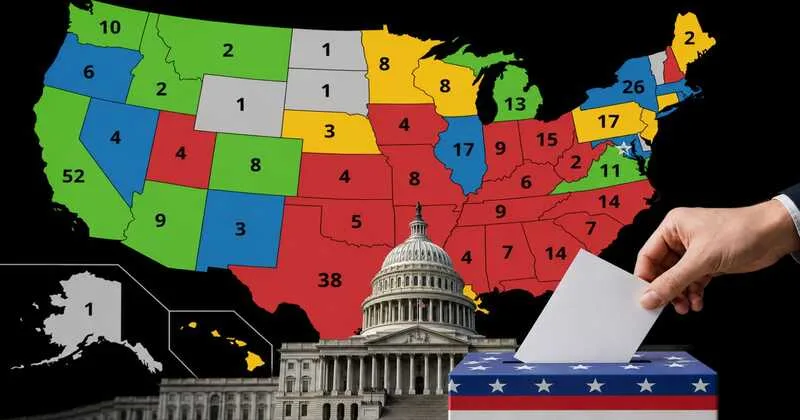
As the United States moves closer to the 2026 midterm elections, a wave of congressional redistricting across several states is reshaping the electoral map and altering the political calculations of both major parties. Redistricting, the process of redrawing electoral district boundaries, has intensified across the country following a series of court rulings, state-level decisions and political initiatives.
The developments come at a crucial time, with control of the US House of Representatives set to be one of the central contests of the 2026 elections. Democrats need to gain three seats to secure a majority in the House of Representatives, assuming vacant seats return to the parties that previously held them.
However, recent redistricting changes have altered the electoral terrain in multiple states. According to the reports of district-level data, Republican-led states have redrawn enough congressional districts to increase the national margin Democrats would need to win control of the House. Before the latest round of redistricting, Democrats would have needed to outperform former Vice President Kamala Harris’s 2024 national result by 3.1 percentage points to regain the majority. Following the redraws, that figure has increased to 4.9 percentage points.
The reports say that the new maps are worth nearly two additional points to Republicans in the national House vote margin. At the same time, polling aggregator FiftyPlusOne reported that Democrats held an almost six-point advantage over Republicans on the generic congressional ballot as of June 7.
Court rulings and state-level redistricting
The current redistricting cycle accelerated after several major political and legal developments. President Donald Trump encouraged Texas to undertake an early redraw of congressional districts, a move that later expanded into a broader national redistricting effort aimed at protecting Republican control of the House.
A significant turning point came with the US Supreme Court’s April ruling in Louisiana v. Callais. The decision strengthened the ability of states to defend district maps using partisan considerations when facing accusations that the maps weakened the voting power of Black voters. Following the ruling, several Southern states moved ahead with revised congressional maps.
Louisiana, Alabama and Tennessee all pursued changes affecting districts where Black voters had previously elected their preferred candidates. Florida had already undertaken redistricting efforts before the ruling.
Democrats sought to offset Republican gains through major redraws in California and Virginia. However, a key setback came when the Virginia Supreme Court overturned the results of an April referendum that had temporarily suspended the state’s independent redistricting commission. Democrats had hoped the Virginia changes would transform the state’s current 6-5 Democratic advantage in its House delegation into a 10-1 edge. The court ruling halted those plans.
🚨 HOLY CRAP! Republicans are now favored to WIN THE US HOUSE in the 2026 midterms by the latest Inside Elections forecast
They'd only need 7% — or ONE — of the 14 tossups to obtain a majority
🔴 Republican: 217 🔥
🔵 Democratic: 204
🟡 Tossup: 14Redistricting has been HUGE… pic.twitter.com/hbcnYCOqZn
— Eric Daugherty (@EricLDaugh) June 9, 2026
House Minority Leader Hakeem Jeffries said Democrats were exploring options to challenge the decision, while Democratic Congressional Campaign Committee Chair Suzan DelBene described the ruling as a setback.
The Virginia decision was widely viewed as one of the most consequential developments in the current redistricting cycle.
Electoral impact of the new maps
The redrawn districts have altered projections based on the 2024 presidential election results.
Kamala Harris carried 205 House districts before the latest redistricting changes. Under the new maps, she would have carried 200 districts.
Since 218 seats are required for a House majority, Democrats would need to gain additional districts beyond those won by Harris in 2024. Trump defeated Harris nationally by 1.5 percentage points in the 2024 presidential election. Analysts estimate Harris would have needed a national margin of approximately 3.4 points to carry a majority of congressional districts under the current maps.
Democrats will likely redistrict their states to eliminate all Republican representation after the Supreme Court rejects the VRA in redistricting.
California will have 52-0 Democrat seats, and Illinois will have 17-0 Democrat seats. pic.twitter.com/2DuZkRhcS7
— Justin (@JustinUSA) April 29, 2026
Across the ten states that undertook redistricting, Democrats held 80 seats in 2024 compared to Republicans’ 101 seats. According to the reports, Democrats would need to outperform Harris’s 2024 margin by 10.5 percentage points merely to maintain their existing position in those states. Harvard Law professor Nicholas Stephanopoulos said that while the current maps favour Republicans, the situation is “not remotely as bad” as the redistricting cycle that followed the 2010 census.
In 2012, Democrats needed about a 5.6-point national victory to gain House control. That year, the median congressional district voted for Republican presidential nominee Mitt Romney by 1.7 points even though Barack Obama won the national popular vote by 3.9 points.
Effects on incumbents and competitive districts
The new district boundaries are also affecting incumbent members of Congress. Four of the thirteen Democrats who won districts carried by Trump in 2024 now face constituencies that have become more Republican-leaning. They include North Carolina Representative Don Davis, Ohio Representative Marcy Kaptur and Texas Representatives Henry Cuellar and Vicente Gonzalez.
In California, two Democrats who previously represented Trump-supporting districts were shifted into more Democratic-leaning constituencies.
Lawmakers affected by redistricting have adopted different approaches.
Tennessee Representative Steve Cohen chose not to seek re-election under the new district configuration. Tennessee lawmakers reduced the Black share of voting-age residents in his Memphis-based district from 60.3 per cent to 31.7 per cent. Florida Representative Debbie Wasserman Schultz decided to run in a newly configured Black-plurality district. According to the analysis, only 2.1 per cent of the population in the new district overlaps with her previous constituency, representing the smallest incumbent overlap recorded.
Time: Democrats Set in Motion Plan to Redraw Congressional Maps in as Many as 13 States
Democrats are setting the stage to pursue redistricting efforts in as many as 13 states before 2028, redrawing congressional lines to secure potentially dozens of additional House seats,…
— Politics & Poll Tracker 📡 (@PollTracker2024) June 8, 2026
Louisiana Representative Cleo Fields, who won a newly created Black-majority district in 2024, plans to seek re-election despite facing a district that voted for Trump by 32 percentage points.
Observers have also noted that the revised maps could reduce the number of politically moderate districts in Congress by increasing the number of seats that strongly favour one party or the other.
Recent legal developments and the road to 2026
Legal challenges continue to shape the redistricting landscape. The US Supreme Court recently granted Alabama’s request to use a 2023 congressional map that a lower court had previously ruled intentionally discriminated against Black voters. In Florida, a judge declined to block the state’s revised congressional map, ruling that there was insufficient evidence to prove it had been drawn with partisan intent in violation of state law.
The series of court rulings has contributed to continuing changes in congressional boundaries across multiple states. Despite the redistricting shifts, political observers note that election outcomes will still depend on several factors beyond district maps, including candidate quality, voter turnout, campaign financing, political controversies and broader national sentiment. Democrats have pointed to recent special-election performances as a positive sign. In Michigan, a Democratic candidate won a state Senate special election by 19 points in a district that Harris had carried by less than one point in 2024.
Meanwhile, Virginia Democrats remain confident they can challenge Republican-held House seats despite the Supreme Court ruling that overturned the state’s proposed congressional map.
With less than a year and a half remaining before the 2026 midterm elections, redistricting continues to reshape the electoral landscape. Court decisions, state legislative actions and ongoing legal challenges are expected to remain central factors in determining how congressional districts are configured when voters head to the polls in November 2026.