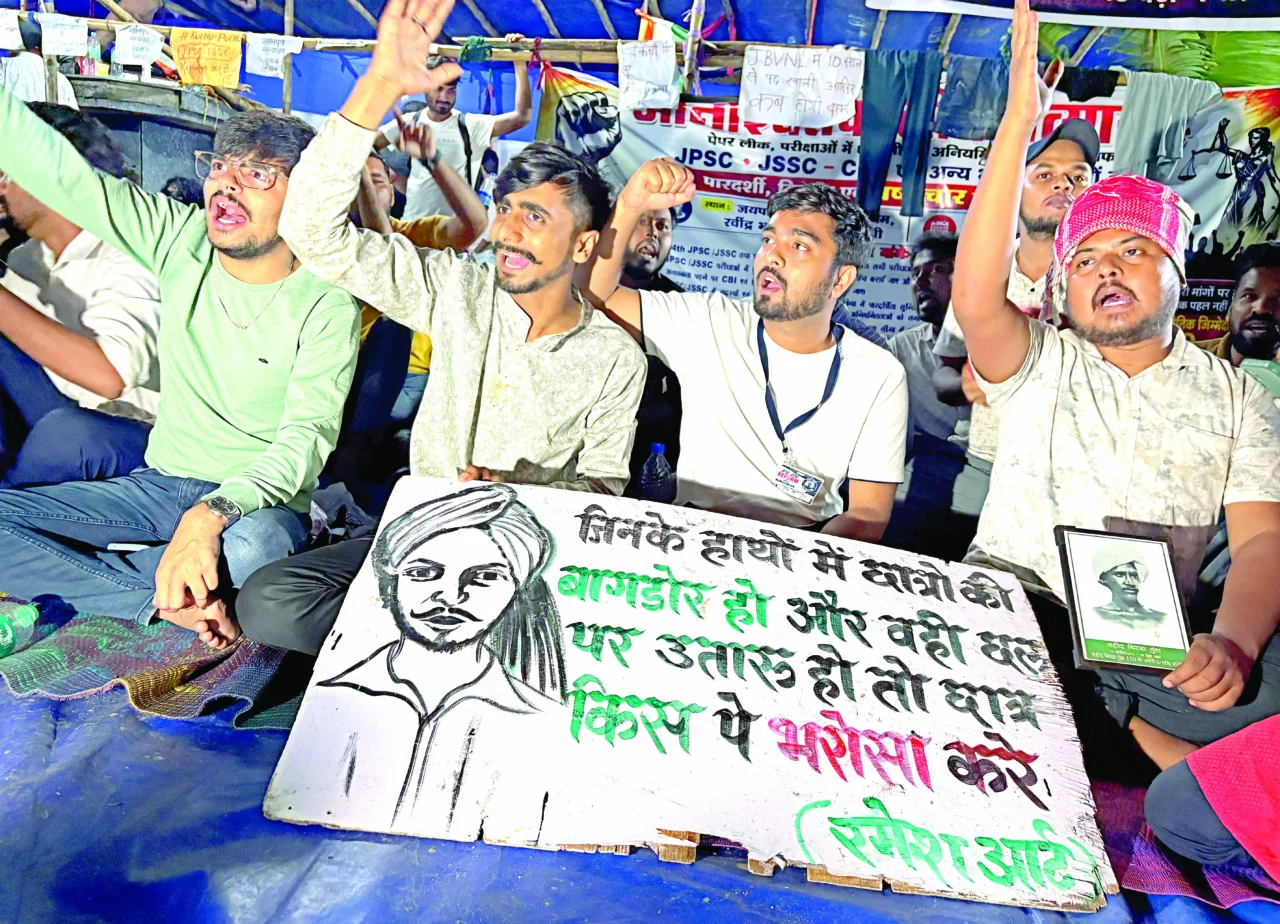
The first thing one notices at Jaipal Singh Munda Stadium in Ranchi is not the slogans. It is the books. A copy of Indian Polity lies open on one side. Beside it are handwritten current affairs notes, previous years’ question papers, and a half-finished cup of tea. Rainwater has seeped beneath the plastic sheets covering the protest site, forcing students to shift their bags repeatedly to keep their books dry. A few metres away, young men and women sit on an indefinite hunger strike. Volunteers move around with drinking water. Some students revise notes between speeches. Others stare silently at their admit cards and mark sheets.
For nearly two weeks, this has been home for hundreds of Jharkhand’s Government job aspirants. Many have not gone home. Many have stopped preparing for the next examination because they do not know when it will be held. Many have crossed the age at which they had imagined they would already be serving as civil servants. Yet every evening, after the speeches end and television cameras leave, the protest site quietly transforms back into a study circle. That image perhaps explains this movement better than anything else. This is not a protest of people who have abandoned hope. It is a protest by people desperately trying to hold on to it.
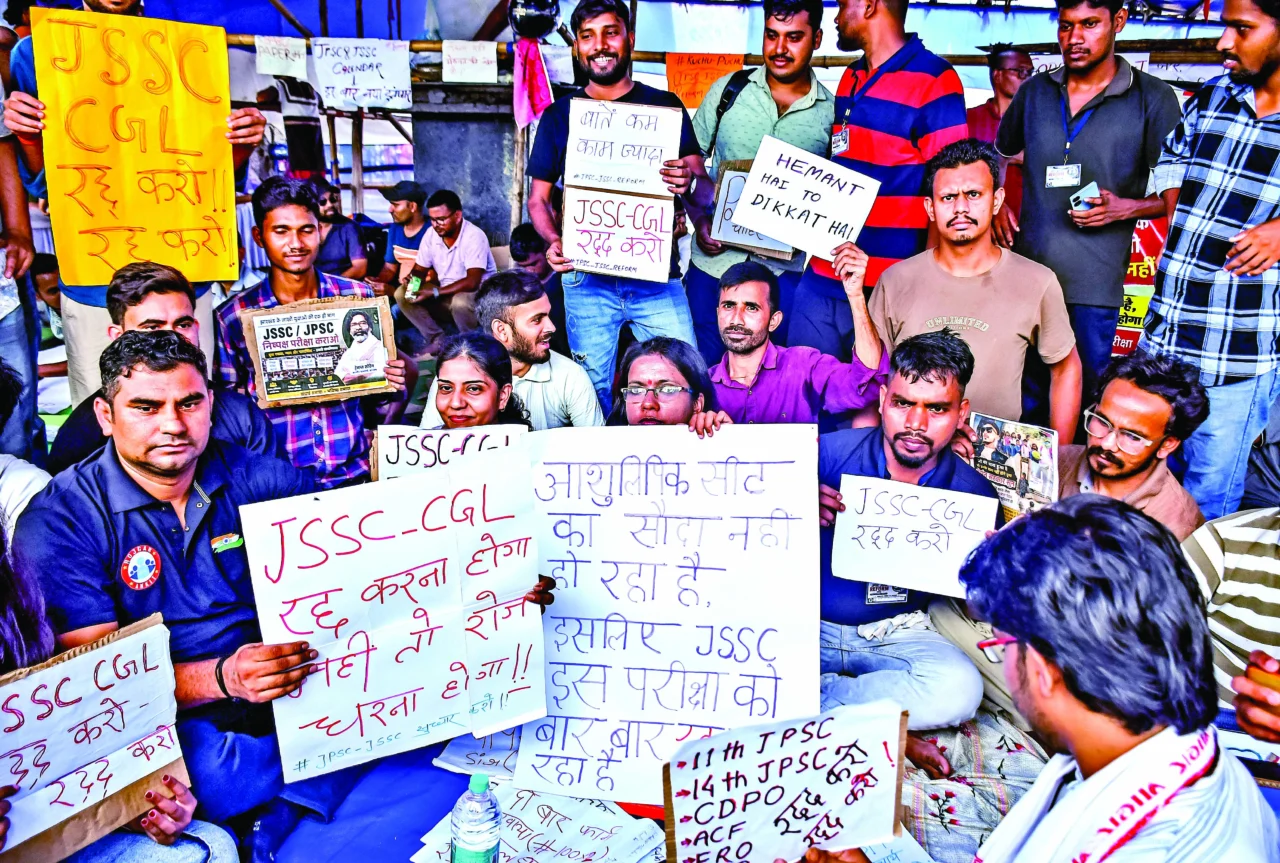
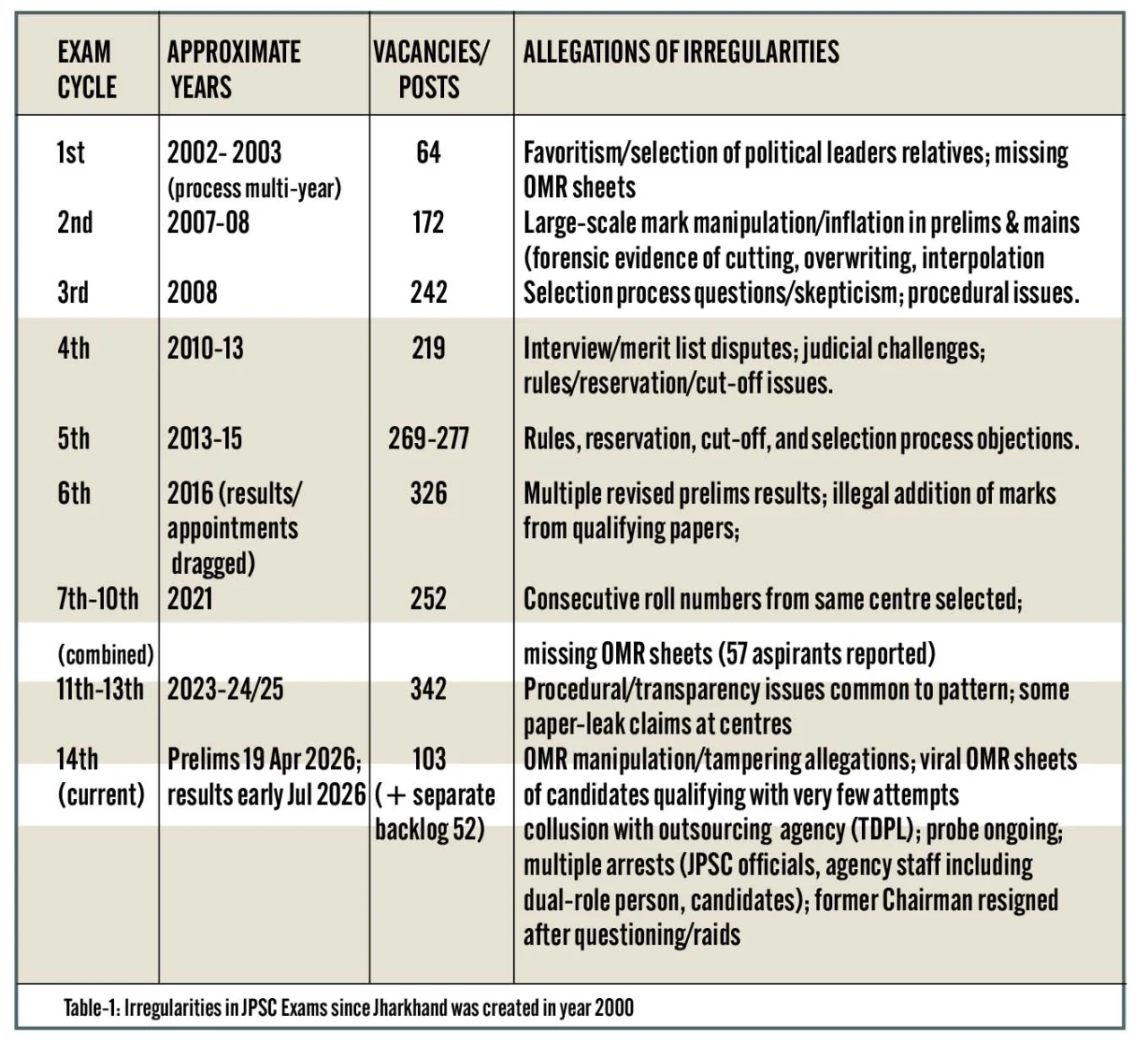
The immediate trigger for the agitation was the controversy surrounding the 14th Jharkhand Public Service Commission (JPSC) Combined Civil Services Examination. Soon after the preliminary results were declared, candidates began questioning the process. They demanded the publication of category-wise cut-off marks, raised objections over the merit list and pointed to alleged discrepancies in OMR sheets circulating on social media. As protests intensified, the State Government ordered a CID investigation. The probe led to arrests linked to the examination process, and the Commission eventually postponed the Civil Services Main examination scheduled for July 25–27. It later deferred nine recruitment examinations until further notice.
For many outside Jharkhand, this looked like yet another examination controversy. For the students sitting on damp mats in Ranchi, it was the moment when years of accumulated frustration finally spilled onto the streets. Almost every aspirant interviewed by Organiser began the conversation with the same sentence. “This is not about one examination.” It is about everything that came before.
A Generation That Kept Waiting
Jharkhand has struggled with irregular recruitment cycles almost since its formation. Civil services examinations have often been delayed, recruitment processes stretched over years, and several examinations have found themselves entangled in litigation or allegations of irregularities. Successive governments have promised faster and more transparent recruitment, yet many aspirants say uncertainty has become the only constant in their preparation.
That uncertainty has a human cost. It means engineering graduates working in clothing shops while waiting for results. It means students exhausting family savings on coaching. It means aspirants postponing marriages, careers and financial independence because they believe one more examination may finally change their lives.
For Kumar Lav from Hazaribagh, that hope has slowly turned into quiet despair. A Mechanical Engineer by training, he once prepared for the UPSC in Delhi before deciding to focus entirely on Jharkhand’s Civil Services. Today, between periods of preparation, he helps at his brother’s clothing shop.
Holding his marksheet carefully, he explains why he believes he should have found a place in the final selection list of an earlier JPSC recruitment. “I cleared the cut-off,” he says. “There were posts where height was not a requirement, yet I wasn’t selected. I kept asking myself where I had gone wrong.”
Then he pauses before speaking about something that has little to do with marks. “I was the topper of my Mechanical Engineering College. Friends who were not even among the better students are already working in MNCs. I don’t even know how to tell them that today I work in a clothing shop. Back home, people have started telling children not to study so much. They ask, ‘ What is the point? Look at him. Even after studying so much, he is still waiting.’”
His disappointment is not merely personal. It reflects something larger. When one generation begins questioning whether education still guarantees opportunity, the consequences travel far beyond one recruitment examination.
Among the many conversations at the protest site, one remained difficult to forget. Chandi Tiwari had travelled from Dhanbad. Like Kumar Lav, he is also a mechanical engineer. Unlike many others, however, he speaks with remarkable calm. His dream is simple. He wants to become a Deputy Superintendent of Police. For that dream, he left his job. Five years later, he is still preparing.
He says: “One recruitment cycle itself takes years. We are not getting older because we are lazy. We are getting older because the system moves slowly. We keep studying. We keep waiting. We keep believing that the next notification will finally change our lives.”
His words capture a reality that statistics cannot. Recruitment delays are often measured in months. Students measure them in birthdays.
Women Refusing to Go Home
One corner of the protest site is occupied by women participating in an indefinite hunger strike. Among them is Savita Kumari. She has been preparing for JSSC and JPSC examinations since 2019. She says that she had finally reached the stage where years of hard work would pay off. Instead, she is sleeping under plastic sheets in the middle of the monsoon.
“My family has seen my struggle,” she says. “They know how difficult it was for me to even continue my education. They know the fights I had to fight just to study. If after all these years we still don’t get justice, what purpose does my life have? How do I return home and look my parents in the eye?”
For Savita, the protest is not simply about employment. It is about dignity. It is about proving to parents that their sacrifices were not meaningless. She also speaks about the emotional burden borne by women aspirants. “There comes a point when relatives stop asking how your preparation is going. They start asking when you will stop preparing.”
Trust Is the Real Casualty
Many students at the protest spoke not only about the latest JPSC controversy but also about previous recruitment examinations. Krishna Lekh Kumar from Vishnugarh questioned the evaluation of the Khortha language paper, arguing that native speakers had received unexpectedly lower marks than some candidates from outside the state. Rupesh Kumar Pal recalled the controversy surrounding the JSSC Combined Graduate Level examination and alleged that discussions about “setting” and informal “rate cards” had become common among aspirants, though he clarified that nobody had approached him personally for money.
But something else became evident while speaking to students. The deepest crisis is no longer confined to one examination.
It is the erosion of trust itself.Students repeatedly used one word. “Vishwas.”
Faith. Faith that merit alone will decide success. Perhaps that is the true story unfolding in Ranchi. Not simply a protest over one examination. But a generation asking whether the institutions they have trusted for years still deserve that trust.
From Jantar Mantar to Ranchi – Two Student Protests, Two Different Languages of Dissent
Every protest leaves behind two legacies. One is the issue it raises. The other is the way people remember it. Sometimes the second becomes bigger than the first. That is perhaps what happened at Delhi’s Jantar Mantar.
The protest had begun around concerns over competitive examinations and the future of students. It had the potential to become a national conversation about transparency, accountability and the pressures faced by lakhs of young aspirants. Instead, as days passed, the focus steadily shifted.
Television debates were no longer discussing examination reforms. Social media was no longer debating recruitment policies. Instead, videos of abusive slogans, objectionable placards, heckling of journalists and political speeches dominated public discourse. Political leaders occupied the stage. Cameras turned towards confrontations. The original issue—the students—slowly disappeared behind the noise.
By the time the protest concluded, much of the country remembered not the demands of the aspirants, but the controversies surrounding the demonstration. It is against this backdrop that the Ranchi protest becomes significant. Not because every allegation raised by the students here is necessarily proven. Not because every demand must automatically be accepted. But because the students have consciously tried to ensure that their conduct does not overshadow their cause. That distinction emerged repeatedly during conversations at Morabadi Ground. Interestingly, it was the students, not political observers, who repeatedly brought up Jantar Mantar. “We saw what happened there,” one student remarked. “We didn’t want our movement to become that.”
“This Is Not Our Upbringing”
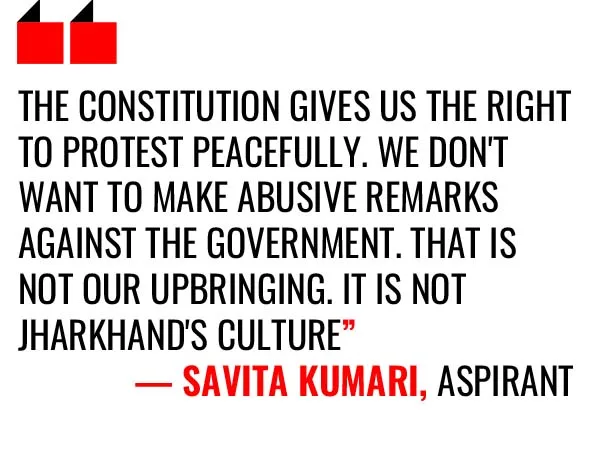
Among the strongest voices at the protest site was that of Savita Kumari. Her words perhaps explain the philosophy of the Ranchi movement better than any editorial observation.
This is an unusual statement to hear from someone sitting on an indefinite hunger strike. Most protest movements derive their energy from anger. This one repeatedly invokes restraint. Students say they have consciously instructed participants not to use abusive slogans, not to carry objectionable placards and not to indulge in vandalism. Throughout the days spent reporting from Ranchi, Organiser did not witness journalists being heckled or prevented from speaking to students. On the contrary, many aspirants actively approached reporters, carrying their mark sheets, admit cards and documents, eager to explain why they believed the recruitment process required greater transparency.Their effort was directed less towards attacking individuals and more towards convincing the public that their concerns deserved to be heard.
One of the most striking aspects of the Ranchi protest is what is absent. Political party flags. Large stages occupied by politicians. Competing ideological speeches. Students repeatedly insist that this is an aspirants’ movement. When asked about political support, Savita responds carefully. “If someone wants to support us morally, we welcome that. They can stand behind us like guardians stand behind their children. But this movement belongs to the students.”
That sentiment was echoed by several others. There was no attempt to deny that political accountability ultimately rests with the elected government. Indeed, many students openly criticised the state government’s handling of recruitment.
Some appealed directly to Rahul Gandhi, pointing out that he has often spoken about students’ issues across the country. Yet even while making those political appeals, they repeatedly rejected abusive language. “I want Rahul Gandhi to come here,” Savita says. “This is the government supported by your alliance. You should come and listen to our pain. Listen to what these students have gone through.” It is criticism. But it is criticism expressed without personal abuse.
The Tricolour and the Constitution
During one of the largest demonstrations, students marched carrying the national flag through Ranchi’s streets. The significance of the Tricolour, however, lay not merely in the flag itself but in the symbolism students attached to it.
Gaurav Prasad Gupta, another aspirant, explained why they had chosen this form of protest. “This Tiranga Yatra represents unity. We are demanding transparency. We are demanding regular examinations. We are not raising anti-national slogans. We are carrying the Tricolour because this is the identity of India. The Constitution teaches us unity. It does not teach us to divide the country.”
Throughout the march, slogans of “Vande Mataram”, “Bharat Mata Ki Jai” and “Chhatra Ekta Zindabad” echoed through the streets. Perhaps the most unexpected conversation at the protest site was with Anoop Minj. He was not preparing for JPSC. He was not writing JSSC examinations. He had simply come to support the students. Forty-five years old and employed in the private sector, he believes the issue extends far beyond one recruitment cycle.
“My age has passed,” he says. “I have a family now. But I don’t want my younger brothers or tomorrow, my own children to suffer like this. These students should be in libraries preparing to become BDOs, IAS officers and IPS officers. If they are forced to spend months sitting on protest sites, who will run the administration tomorrow?” His question broadens the debate. Recruitment controversies are often discussed in terms of vacancies. Rarely are they discussed in terms of the long-term impact on governance itself. Every delayed examination postpones the entry of a new generation into public administration. Every prolonged controversy discourages talented graduates from considering public service.
The Difference That Matters
There is a temptation to reduce the comparison between Jantar Mantar and Ranchi to a simple binary. That would be a mistake. The issue is not whether one protest was right and the other wrong. Investigations must proceed on evidence. Governments must respond according to law. Institutions must function through due process.
Yet there remains one important lesson. In democratic politics, how a protest is conducted often determines whether the country discusses its demands or merely its behaviour.
At Jantar Mantar, the conduct of the protest gradually overshadowed the issue. In Ranchi, the students appear determined not to allow that to happen. They have tried to ensure that the conversation returns repeatedly to recruitment, transparency, examinations and accountability.
Whether that strategy succeeds depends not only on the students. It also depends on whether governments respond before frustration hardens into permanent distrust. Late in the evening, the protest site slowly falls silent. The slogans stop. The speeches end. Television cameras begin packing up. Volunteers fold banners. Some students prepare for another night under leaking tarpaulin sheets. Then, almost instinctively, books begin to appear once again. Some revise polity. Others solve previous years’ question papers. Current affairs magazines pass from one group to another.
The protest quietly transforms back into what these young men and women always wanted it to be, a place where aspirants prepare for examinations.
Tomorrow’s examination may not have a date. The next recruitment notification may still be uncertain. The investigation may take weeks or months. Yet the students continue reading. That, perhaps, is the defining image of Ranchi. Not young people demanding shortcuts.