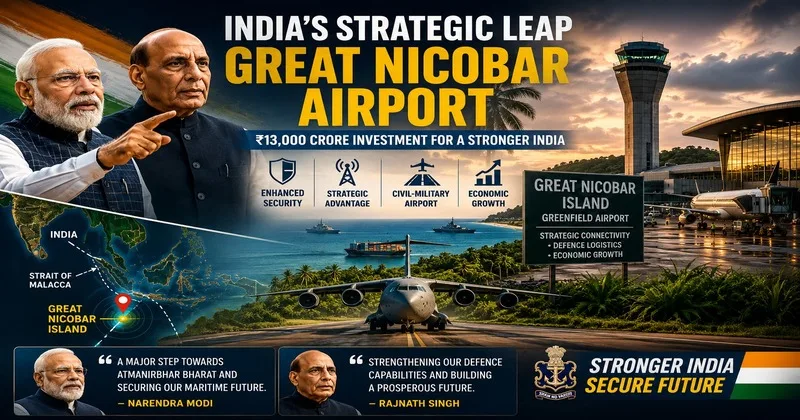
The Modi government at the Centre has taken a major and far-reaching decision to further strengthen its strategic edge in the Indian Ocean region. By approving a state-of-the-art greenfield civil-military airport on Great Nicobar Island, at a cost of approximately Rs 13,000 crore, the government has signaled clearly that India is ready to elevate its strategic presence in the Indo-Pacific region to new heights.
India’s New Strategic Hub Near the Strait of Malacca
This proposed dual-use airport will be constructed in the Chingen area near Galathea Bay, on the southeastern coast of Great Nicobar. Its most significant feature is its geographical location. The site lies in close proximity to the western entrance of the Strait of Malacca, considered one of the world’s busiest maritime routes connecting the Indian Ocean and the South China Sea.
A vast portion of global container trade and energy supplies passes through this maritime route. Consequently, a strong Indian presence here will not only facilitate the monitoring of maritime activities but also enhance the capability for rapid response to any strategic challenge or emergency. Experts believe this airport will serve as India’s “eyes and ears” in the Indian Ocean.
Excellent strategic move by PM @narendramodi ji, Great Nicobar Islands Project will significantly enhance India’s maritime strength, national security, and economic potential while protecting the environment and tribal communities. pic.twitter.com/YqVIdRCRSY
— Rohit (@Rohitsin298) June 9, 2026
A Convergence of Civil and Military Needs
The airport is being developed for dual use- serving both civil and military purposes. While its operations will remain under the control of the Indian Navy, civil aviation services will also be integrated. This arrangement will bolster India’s military reach and surveillance capabilities while simultaneously giving fresh impetus to connectivity, tourism and economic activities across the islands. Defense officials expect the project to be completed within the next five years, after which the strategic utility of the Andaman and Nicobar Islands will increase manifold.
Why a New Option Instead of Expanding INS Baaz?
It is noteworthy that plans to extend the runway at the Indian Navy’s INS Baaz air station in Campbell Bay had long been under consideration. The existing runway is approximately 4,500 feet long and there was a proposal to expand it to 10,000 feet. However, detailed technical studies revealed that expanding the runway would not be feasible due to terrain constraints, navigational challenges, and the need for extensive additional infrastructure.
Furthermore, there were concerns regarding the potential adverse impact on forests, wildlife habitats and local tribal areas. Consequently, the government decided to develop a new greenfield airport, a move experts consider more practical, sustainable and aligned with future requirements. The new site also offers ample scope for future expansion.
In this context, retired Lieutenant General Manik Kumar Das noted that this greenfield civil-military airport on Great Nicobar Island holds significance across three dimensions; economic, ecological and strategic. India already operates its only Tri-Service Command in the Andaman and Nicobar Islands, where the Army, Navy and Air Force function in an integrated manner. The new airport will further enhance these capabilities, making India’s role more impactful in maritime traffic surveillance, long-range military operations, disaster relief efforts and regional security cooperation.
He stated that, given China’s growing interference in the Indo-Pacific and Indian Ocean regions, it is essential for India to maintain a state of preparedness. Over the past few years, China’s increasing maritime activity and strategic projects in the Indian Ocean region have drawn the attention of many nations. In this light, the Great Nicobar project represents not merely infrastructure development for India, but a crucial strategic investment. Moreover, situated near the Strait of Malacca, this project will significantly strengthen India’s presence in the Indian Ocean region.
Just In : Under Great Nicobar Islands development projects, an International Airport will be built for use by Indian Armed Forces & Civilians
Timeline : 5 Yrs, Cost : Rs 13,000 cr to be shared by both Defence & Aviation Ministry says Defence Ministry source pic.twitter.com/zD9oZek7iE
— Vivek Singh (@VivekSi85847001) June 8, 2026
On the other hand, retired Lieutenant General Manik Kumar Das points out that we must also understand India’s shift towards ‘Integrated Theatre Commands’, a unified military structure that brings the Army, Air Force and Navy under a single commander rather than having them operate independently. The objective is to make warfare and security operations more effective and rapid by leveraging the combined resources of all three services. In this context, it becomes crucial to maintain a vigilant watch over distant areas, enabling us to execute military actions swiftly wherever necessary.
A Key Component of an Rs 81,000 Crore Mega Project
The greenfield airport is a crucial part of the comprehensive Great Nicobar development project, which entails an investment of approximately ₹81,000 crore. This ambitious plan comprises four major components:
- International Container Transshipment Terminal
- Greenfield Civil-Military Airport
- Energy and Power Infrastructure
- Modern Township and Urban Amenities
The government aims to develop Great Nicobar into a future global maritime, trade and logistics hub. If successful, this plan will significantly help India reduce its reliance on foreign transshipment centers like Singapore and Colombo.
A Boost for Employment, Investment and Tourism
The impact of the Great Nicobar project will extend beyond security considerations. Purnima Sharma, a manager at ILHTours (an international tourism company) and Mandeep Singh, a senior head at IHPL, stated that the construction of the airport and associated infrastructure would generate large-scale employment opportunities. Specifically, there is potential for thousands of direct and indirect jobs in the tourism, hospitality and service sectors within the region.
Purnima Sharma notes that improved air connectivity will make the region more accessible to tourists from across the country and the world. This will boost the tourism industry and inject new vitality into the local economy.
Government Focus on Environmental and Tribal Conservation
Concerns regarding the environment and questions concerning the interests of tribal communities have been raised in relation to this project. However, the government maintains that comprehensive measures are being taken to strike a balance between development and conservation. A long-term environmental conservation plan worth approximately ₹2,250 crore has been formulated and will remain in effect for the next 30 years.
Furthermore, about 82 percent of Great Nicobar’s land area is already protected as national parks, reserved forests and tribal conservation areas. The central government asserts that special safeguards will be implemented to protect sensitive zones and safeguard tribal interests during the project’s execution.
The Modi Government’s Long-Term Strategic Vision
Surendra Mishra, the Central and North Zone Organizing Secretary of the Akhil Bharatiya Poorva Sainik Seva Parishad, states, “Despite certain political and environmental groups, including the Leader of the Opposition in the Lok Sabha, Rahul Gandhi, raising questions about this project, the central government remains firm in its decision, as it is a crucial step linked to national interests.”
He adds, “In reality, this project is not merely about constructing an airport; it is part of India’s long-term strategic vision for the Indo-Pacific region. Strengthening maritime security, trade connectivity and regional influence has become a priority for India amidst the changing global geopolitical landscape; therefore, the proposed ₹13,000-crore greenfield airport in Great Nicobar is a move that will significantly bolster India’s strategic strength, economic potential and maritime security.”