The dynamics of contemporary warfare is being redefined. The texture of geopolitics is evolving with hard-nosed confrontations and increased transactionalism. The world is undergoing a once-in-a-century transformation. Nations across geopolitical theatre aim to extend their sphere of influence to fulfill hegemonic ambitions. Wars are emerging as a routine phenomenon across the geopolitical mosaic. The strategic calculations underlying global alliances are severely fractured and are witnessing fundamental shifts. Few loud battles and a lot more silent actions and atrocities, which is evidently brewing for a larger repercussion.
India is an emerging geopolitical and economic powerhouse, navigating these rapidly revolutionising geopolitical undercurrents that tend to rupture and rewrite the strategic fabric. In an era, when conventional warfares are described and decided with the aid of cutting-edge technologies, it is pivotal for India to articulate strategic deterrence with state-of-the-art weapon systems. Embedded with the principle of strategic realism coupled with responsible statecraft, India has to articulate a strategic edge against intruding threats to espouse national security & regional stability.
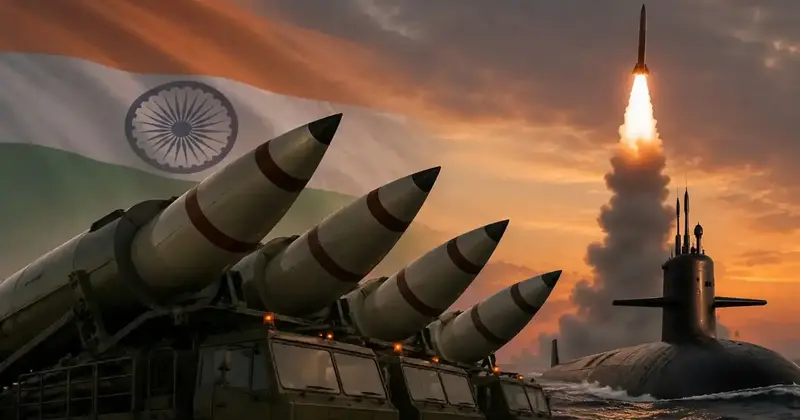
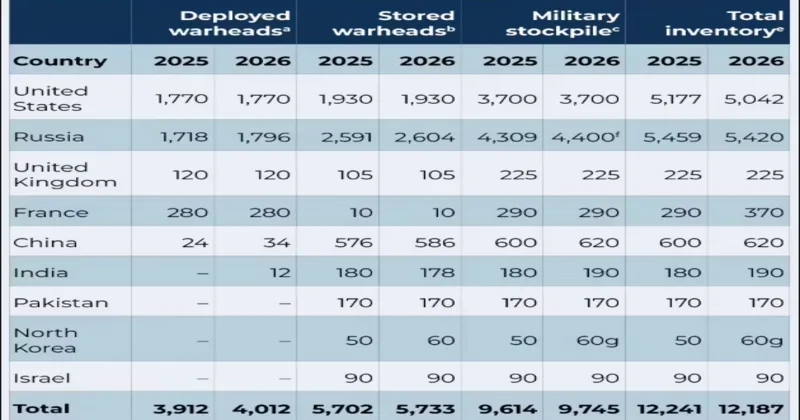
With these strategic underpinnings, India has deployed 12 nuclear warheads, thus heralding a doctrinal shift in its nuclear strategy. The latest assessment revealed by the Stockholm International Peace Research Institute(SIPRI), the global arms and ammunition watchdog, reiterates this fundamental repositioning in New Delhi’s nuclear policy. In its Yearbook of 2026, SIPRI reported that India now possesses a total nuclear arsenal of 190 warheads, compared to 180 warheads in the previous year. Of these 190 nuclear warheads, 12 are deployed and are in operational state. Thus, in a maiden move, India has decided to position its nuclear warheads in operational posture. Until the previous year, India’s nuclear arsenals were entirely stockpiled during peace time.
 SIPRI statement thus concludes that India’s latest nuclear posturing represents a departure from long-standing principle of storing nuclear warheads separately apart from delivering ballistic missiles. “It has been long assumed that India stores its nuclear warheads separate from its deployed launchers during peacetime. However, the country’s recent move towards placing missiles in canisters and conducting sea-based deterrence patrols suggests that India could be shifting in the direction of mating some of its warheads with their launchers in peacetime”, SIPRI observed.
India’s nuclear submarine strength: A shift from no-first use policy?
The SIPRI report further noted that as of January 2026, India has a total nuclear stockpile of 190 and among them 12 are deployed. The report further assesses that India may also have commenced deploying a small number of nuclear warheads on a single SSBN and conducting occasional deterrence patrols. SSBN stands for Ships, Submersible, Ballistic, Nuclear. It is the naval classification for nuclear-powered vessels, designed to deter nuclear attack from the adversaries.
This assessment by SIPRI comes amidst India’s swift military overhaul with respect to nuclear submarines. India has indeed operationalised two nuclear powered ballistic missile submarines INS Arighaat and INS Aridaman and have successfully conducted multiple deterrence patrols as well. They are capable of remaining underwater for prolonged hours without the necessity of repeated refuelling and can launch credible & precise strikes against nuclear threats. This operationalisation of nuclear submarines is part of India’s broader strategy to strengthen the maritime corridors & ensure national security by capitalising strong strategic deterrence. across oceans
The SIPRI report also states that India is rapidly accelerating its nuclear modernisation programme and is also believed to expand its nuclear arsenal strength. These nuclear efforts of India signals India’s strong push towards consolidating its offensive and defensive capabilities as against the historical “no first use” principle. Accordingly, when India became a nuclear state it scripted a self-imposed restriction as a part of responsible statecraft. New Delhi declared that until and unless the adversary launches, India is not going to escalate a nuclear attack at the first instance.
However, the latest shifts in India’s nuclear policy raises apprehensions that whether India decoupled from its “no first use” principle. The answer is a clear no. Despite erupting confrontations from the geopolitical fissures, New Delhi embraces responsible statecraft and will not escalate unmindful nuclear wars. In any global conflict, India advocates peace, dialogue, diplomacy and humanitarian well-being. However, the dynamics of warfare is rapidly oscillating with geopolitical actors emerging as increasingly transactional and contentious.
To sail through such an unpredictable and dangerous geopolitical mosaic and defend national security, it is pivotal for India to craft strategic deterrence. Deployment of nuclear submarines and 12 warheads as reported by SIPRI is clearly part of this deterrence calculation to secure the nation and its people from foreseeable and also unforeseen risks. A changed geopolitical latitude, an altered global approach to kinetic warfare needs a revamped domestic strategy as well. India’s nuclear shift is marked in this direction as a shield for national security against intruding aggressive adversaries, as a symbol of operational readiness.
Strategic deterrence against two-front threat from China and Pakistan
India’s renewed nuclear strategy indicates operational readiness and sealing strategic deterrence against anticipated two-front confrontation from China and Pakistan. Beijing and Islamabad are aggressively pushing their nuclear strength. The bonhomie between both the nations are also spiking with increased military assistance, weapon deals and military intelligence sharing. Thus, it is inevitable for India to fortify national security against these brewing two-front threat. As per SIPRI, India’s nuclear modernisation programme involves developing long-range systems capable of neutralising threats from China.
Also, as per SIPRI estimates China has 620 nuclear warheads and 34 among them are deployed. China’s deployed warheads increased from 24 to 34 from 2025 to 2026. As per the assessment, China is aggressively expanding its nuclear warheads than any other country. China showcased many of its nuclear arsenals during its 2025 military parade as a symbol of its military strength and a message to the globe regarding its capabilities. Beijing has also loaded 100s of missiles into its 3 major missile silo fields in Northern China along with relentlessly building additional silo complexes in its eastern frontier.
On the other hand, Pakistan is also a nuclear powered state with 170 warheads as per latest SIPRI report. It vows to further aggressively accelerate its nuclear capacity with considerable assistance from China. Islamabad’s increasing nexus with Beijing in terms of sharing military intelligence, surveillance satellites and other critical infrastructure poses a significant threat to India. Thus, spiralling China-Pakistan nexus is detrimental to the national security of India. Hence, a shift in nuclear policy and deployment of warheads is a strategic inevitability.
Infact, post Operation Sindoor, India sent a stern warning to Pakistan declaring that New Delhi will not heed to the nuclear blackmail or bluff of Islamabad. Pakistan cannot nourish terror activities against India under the veil of being a nuclear state & triggering illicit threat. New Delhi will defend its sovereignty against state-sponsored terrorism and nuclear cover cannot be an excuse for Pakistan to hide its terror deeds. This warning by New Delhi is indeed a message to Pakistan and the world beyond about India’s reinforced nuclear strategy.
Thus, the redesigning of India’s nuclear decisions is a strategic compulsion and geopolitical necessity as the backbone for national security architecture. As actors across geopolitical theatre espouse aggressive actions and imminent threat, India’s nuclear race is crucial to protect sovereignty, territorial integrity and transit the strong message of strategic deterrence. Nuclear warhead deployment is a resolve to configure regional security and balance of power amid steep geopolitical faultlines as two-front threat from China and Pakistan ferment evidently.
It is strategic prudence to script operational readiness & catalyse deterrence amid escalating geopolitical precariousness and impulsive war mongering, than waiting for the adversaries to reach the frontiers and knock the doors. India is explicitly in this direction and deployment of nuclear arsenals is one of the chapters in New Delhi’s geopolitical playbook to seal national security amidst spirlling great power competition.