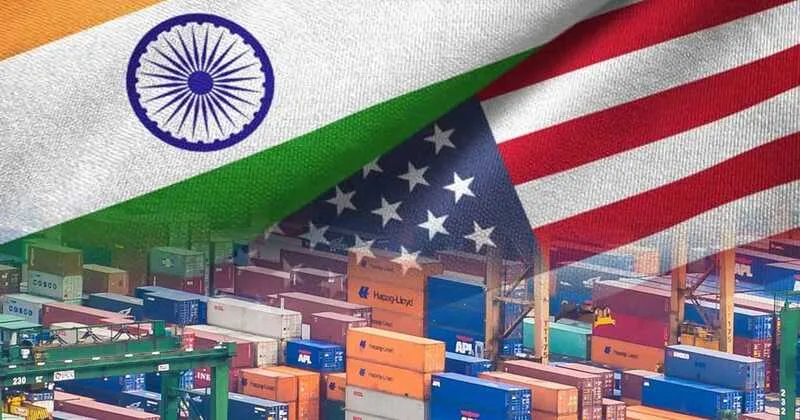
Washington: The revenue generated by tariffs imposed by US President Donald Trump on multiple countries this year has crossed $200 billion, equivalent to nearly Rs 18 lakh crore, providing a massive windfall to the US exchequer. This additional revenue is directly linked to Trump’s aggressive tariff announcements. However, the policy has landed the Trump administration in serious legal trouble, with court challenges now threatening the sustainability of these gains.
Two lower US courts have ruled that most of the tariffs imposed by Trump amount to an abuse of presidential authority and are illegal. These rulings have placed the administration under increasing pressure, with the legality of the tariffs now under scrutiny at the highest judicial level. Trump’s appeal against the lower court rulings is currently under consideration by the US Supreme Court. The apex court has earlier indicated that it harbours doubts about the legality of the tariff mechanisms employed by the administration. While final arguments are yet to be heard, indications suggest that procedural steps are nearing completion and a verdict could be announced soon.
If the Supreme Court upholds the lower court decisions, the Trump administration would be required to refund all tariff revenues collected so far to the affected companies. Such a ruling would represent a significant financial and political setback for the administration. In recent remarks, Trump warned that repealing the tariffs would undermine US national security. The administration has also argued that striking down the tariffs would cause international embarrassment for the United States. Trump went as far as to claim that without retaliatory trade measures, the US risked collapsing into a third-world country. Meanwhile, legal opposition to the tariffs continues to grow, with more American companies filing petitions against the measures. Recently, several seafood importers, including firms sourcing products from India, have approached the courts challenging the tariffs.
India waits and watches
India, meanwhile, appears to be adopting a calibrated wait-and-watch approach. Union Commerce Secretary Rajesh Agrawal has stated that trade agreement negotiations between India and the US have almost reached their final stages. However, he also made it clear that no immediate announcement should be expected. According to him, discussions will continue both in person and through virtual platforms, and India is not negotiating under any fixed deadline. There is growing assessment within trade circles that India is closely watching the outcome of the Supreme Court proceedings. If the verdict goes against the Trump administration, the 50 per cnet tariff imposed on Indian goods would automatically become invalid. Such an outcome would significantly strengthen India’s negotiating position in the ongoing trade agreement talks.
Trump recently reiterated his intention to impose additional tariffs on rice imports from India, including basmati rice. In response, the Indian negotiating team reportedly reminded US representatives that despite the steep 50 per cent tariff, the United States still depends on India for nearly 80 per cent of its rice imports. This dependency continues to give India substantial leverage. Notably, India’s export performance has remained resilient despite the tariffs. In November, Indian exports to the US rose 10.61 per cent, increasing to $6.98 billion from $6.31 billion in October. The data underscores the robustness of Indian exporters and the limited effectiveness of punitive tariffs against India.
The lower courts have ruled that Trump’s retaliatory tariffs imposed under the International Emergency Economic Powers Act (IEEPA) are illegal. If the Supreme Court upholds this view, all such tariffs would be nullified, and revenues already collected would have to be returned. While the Trump administration argues that other legal provisions allow the president to impose tariffs even without invoking the IEEPA, legal experts note that those statutes do not permit such steep tariffs to be sustained over long periods.
AI fears weigh on global markets
After a brief pause, selling pressure returned to US stock markets, particularly affecting companies with heavy investments in artificial intelligence (AI). In futures trading, the Dow Jones, S&P 500, and Nasdaq declined by up to 0.2%. Shares of major technology firms such as Oracle, Microsoft, ServiceNow, and Broadcom fell sharply, with losses extending up to 11.5 per cent. The weakness in US markets spilled over into Asia. Japan’s Nikkei dropped 1.45 per cent, Hong Kong’s Hang Seng fell 1.64 per cent, and China’s Shanghai Composite declined 1.18 per cent. In China, industrial production and retail sales data came in weaker than expected, further dampening investor sentiment. Despite global headwinds, India’s market indicators suggest resilience rather than panic. The GIFT Nifty was trading 34 points lower in early morning trade, pointing to a cautious but orderly start for domestic equities. This movement reflects global uncertainty rather than any India-specific weakness. Both the Sensex and Nifty had closed with marginal losses in the previous session, indicating stability amid volatile global cues.
Market participants are also awaiting the latest US employment data, which is expected to influence global risk sentiment. Meanwhile, institutional activity remained strong in India. BNP Paribas, which holds a 22.13 per cent stake in Geojit Financial Services, sold 4.1 crore shares worth Rs 278.8 crore at a price of Rs 68 per share. In corporate developments, shareholders approved the appointment of Tarun Garg as Managing Director and CEO of Hyundai Motor India. The State Bank of India appointed Ravi Ranjan as its new Managing Director. The Reserve Bank of India approved HDFC Bank’s acquisition of a 9.5 per cent stake in IndusInd Bank, a move seen as strengthening India’s banking sector.
Commodities and geopolitics
Geopolitical developments also influenced commodity markets. Ukrainian President Volodymyr Zelensky, under pressure from Russia and the United States, has largely agreed to a framework aimed at ending the war. This development triggered a sharp fall in crude oil prices, with WTI crude dropping to $56 per barrel and Brent crude falling to $60 per barrel.
In contrast, gold prices continued their historic surge. In India, the price of gold crossed Rs 99,000 per sovereign for the first time, touching Rs 99,280, just Rs 720 short of the Rs 1 lakh milestone. Internationally, gold is currently trading only $8 per ounce higher, suggesting limited upside in the immediate term. However, analysts note that if global prices rise further and the rupee weakens, gold in India could soon breach the Rs 1 lakh mark.