Kathmandu (Nepal): They had given him up for dead and begun the mourning and funerary rituals when suddenly it was learnt that Sherpa Hillary Dawa missing for 7 days after fall on Mount Everest had been found crawling down the icy slopes.
But what was once a happy discovery has been soured by the unprofessional behaviour of the BBC journalists, allege Nepali climbers and the survivor’s family.
The Nepal-based daily Tourism Times has reported in an article titled “Where is our right to privacy?” — BBC broadcasts ICU interview of Everest survivor Dawa Sherpa without permission” that Damu Sherpa, Dawa’s wife, said she was stunned when she saw the interview published by the BBC. “I am surprised to see this video interview of my husband, who is under critical medical intervention in the ICU,” she said. “Where is our right to privacy?”
The Nepal daily reported that the “BBC has broadcast a video interview of Dawa Sherpa, the Sherpa guide who survived seven days alone in Everest’s death zone, filmed inside the intensive care unit of HAMS Hospital in Kathmandu without the knowledge or consent of his family or hospital authorities, drawing sharp condemnation from his wife and raising serious questions about the broadcaster’s adherence to its own editorial standards.”
On social media, many have expressed how a similar incident in the ‘developed world’ would have resulted in legal suits and heads would have rolled.
The broadcast has drawn strong criticism from Dawa’s wife, Damu Sherpa, who said neither she nor other family members were approached for permission. She questioned how access was granted to the highly restricted ICU area, noting that even close relatives faced strict limitations due to the sensitivity of his condition. HAMS Hospital has also confirmed that it will investigate how the interview was conducted.
The incident has raised serious concerns about patient privacy, media ethics, and the treatment of vulnerable individuals. Dawa remains under intensive medical care for frostbite, dehydration, and injuries suffered during his survival ordeal after being left behind high on Everest and later found alive near Crampon Point while crawling toward base camp. Link in comment.
The Tragic fall and dramatic rescue
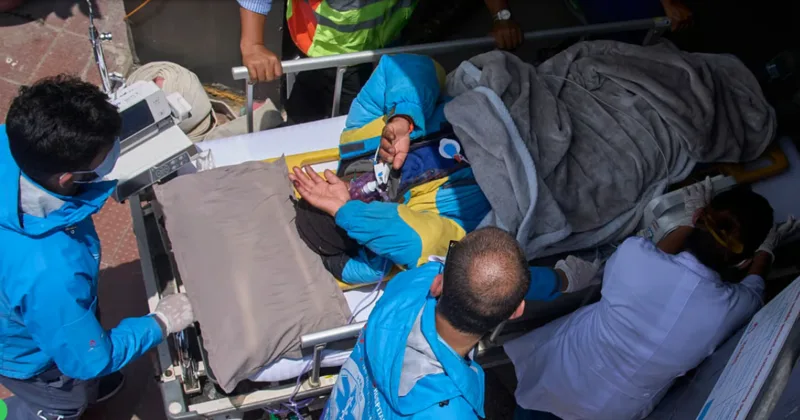
Dawa Sherpa, the Sherpa guide who survived seven days alone on Mount Everest without food or bottled oxygen, is in the intensive care unit at HAMS Hospital in Kathmandu, where doctors say his condition remains stable and his dehydration is showing significant improvement.
According to a press release issued by HAMS Hospital on Friday, Dawa arrived with severe dehydration, Grade II frostbite affecting both little fingers, Grade I frostbite on his right thumb and middle finger, and a right medial femoral condyle fracture with distal thigh intramuscular hematoma. In videos of him that BBC has published with such insensitivity, one can see his nose and several extremities (fingers and ears) blackened and looking rather worrisome.
The Nepalese daily reports that the survivor is now being administered intravenous Iloprost therapy for frostbite, supplemental oxygen, intravenous fluid resuscitation, and other supportive treatment. A multidisciplinary team is monitoring him closely. He is expected to remain in the ICU for several more days.
57-year-old Dawa had gone missing on May 29 near the Yellow Band above Camp III on Everest after being left behind by fellow climbers from Himalayan Traverse during descent. No search and rescue was conducted for seven days.
His family had already begun funeral rituals before he was found alive on June 4, crawling toward base camp at Crampon Point, rescued by a Sagarmatha Pollution Control Committee (SPCC) garbage management team.
He was airlifted from Gorakshep to Kathmandu by an Altitude Helicopter dispatched by 8K Expeditions. His wife, Damu Sherpa, has demanded stern action against Himalayan Traverse and criticised the government for its delayed response.
His survival – seven days without food or supplemental oxygen, crossing the Khumbu Icefall alone after expedition members removed all ladders – has been widely described as miraculous.
According to National Geographic, on the ranges near Mount Everest, the snow and ice on the mountain create deadly hazards like avalanches, and there is only a limited climbing season due to bad weather conditions.
The biggest danger is the altitude. Most climbers are not accustomed to the high altitude and low oxygen levels and rely on bottled oxygen they bring along. This is why the area above 8,000 meters (26,000 feet) elevation on Everest is called the “death zone.” Climbers who spend long periods in this region can develop altitude sickness and even brain swelling.
Dawa Sherpa’s ‘lost and found’ case has drawn international attention, reports Tourism Times. Most people are outraged over how little effort was put into trying to search and resuue the missing Nepali mountaineering guide. Norbu Tenzing Norgay, son of the legendary Tenzing Norgay Sherpa, said the incident has exposed the realities facing Everest’s mountain workers. “This story crystallises what Everest has become and the treatment of mountaineering workers,” he reportedly said.
The Nepal Mountaineering Association has separately called on the government to establish an independent investigation committee into the circumstances of Dawa’s abandonment, urging expedition operators to uphold their duty of care.