Media Bias and the Pahalgam Attack: A tale of selective outrage
June 4, 2026
  • Read Ecopy
  • Circulation
  • Advertise
  • Careers
  • About Us
  • Contact Us
Android AppiPhone AppArattai
Organiser
  • ‌
  • Bharat
    • Assam
    • Bihar
    • Chhattisgarh
    • Jharkhand
    • Maharashtra
    • View All States
  • World
    • Asia
    • Europe
    • North America
    • South America
    • Africa
    • Australia
  • Editorial
  • International
  • Opinion
  • RSS @ 100
  • More
    • Op Sindoor
    • Analysis
    • Sports
    • Defence
    • Politics
    • Business
    • Economy
    • Culture
    • Special Report
    • Sci & Tech
    • Entertainment
    • G20
    • Azadi Ka Amrit Mahotsav
    • Vocal4Local
    • Web Stories
    • Education
    • Employment
    • Books
    • Interviews
    • Travel
    • Law
    • Health
    • Obituary
  • Subscribe
    • Subscribe Print Edition
    • Subscribe Ecopy
    • Read Ecopy
  • ‌
  • Bharat
    • Assam
    • Bihar
    • Chhattisgarh
    • Jharkhand
    • Maharashtra
    • View All States
  • World
    • Asia
    • Europe
    • North America
    • South America
    • Africa
    • Australia
  • Editorial
  • International
  • Opinion
  • RSS @ 100
  • More
    • Op Sindoor
    • Analysis
    • Sports
    • Defence
    • Politics
    • Business
    • Economy
    • Culture
    • Special Report
    • Sci & Tech
    • Entertainment
    • G20
    • Azadi Ka Amrit Mahotsav
    • Vocal4Local
    • Web Stories
    • Education
    • Employment
    • Books
    • Interviews
    • Travel
    • Law
    • Health
    • Obituary
  • Subscribe
    • Subscribe Print Edition
    • Subscribe Ecopy
    • Read Ecopy
Organiser
  • Home
  • Bharat
  • World
  • Operation Sindoor
  • Editorial
  • Analysis
  • Opinion
  • Culture
  • Defence
  • International Edition
  • RSS @ 100
  • Magazine
  • Read Ecopy
Home Bharat

Media Bias and the Pahalgam Attack: A tale of selective outrage

On April 22, 2025, a brutal terrorist attack in Pahalgam, Kashmir, claimed the lives of at least 26 Hindu tourists, highlighting a disturbing disparity in how such tragedies are reported by both national and international media

Shuvabrata GaraiShuvabrata Garai
May 21, 2025, 07:30 pm IST
in Bharat, World, Opinion
Follow on Google News
FacebookTwitterWhatsAppTelegramEmail

On April 22, 2025, the serene valley of Pahalgam in Kashmir was shattered by the sound of gunfire. Four armed terrorists opened fire on a group of tourists and selectively identified and killed Hindu tourists that were men, leaving at least 26 dead and dozens more injured. What should have been a moment of national mourning and international outrage shed light on a grave problem: the selective coverage and silence from key sections of the media, both at the national and international levels.

Despite the gravity of the attack, much of the global media showed apathy and an ideological slant, covering the story with little urgency and an anti-reality, anti-humanitarian bias. The difference in how this was reported compared to similar attacks in Western countries was glaring writing on the wall and it was impossible to ignore.

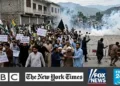
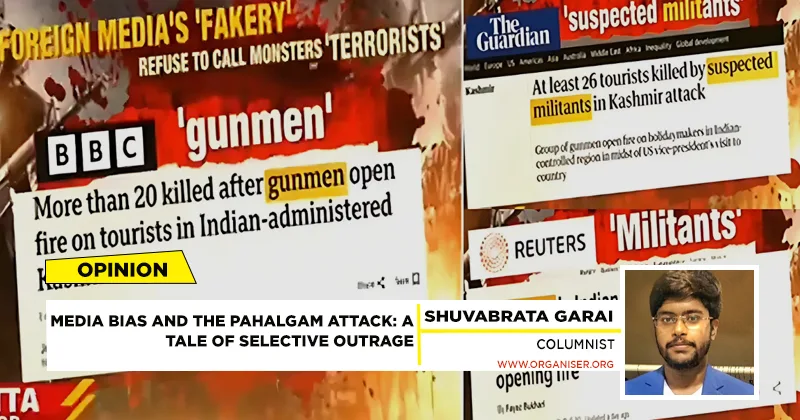
A striking example of such a response came from The New York Times (NYT). In its coverage titled “India Takes Aim at Pakistan After Slaughter of Civilians in Kashmir,” rather than clearly calling the attackers “terrorists,” the publication chose slanted terms like “militants” and “gunmen.”. This lessened the acute and grave violence of terrorism into something more palatable- a deeply regrettable choice of wording.

Read More: “Cops inactive, TMC leaders involved”: Major findings of High Court-appointed panel on Murshidabad Violence

Similarly, the BBC’s coverage did little to centre the grief of the victims. One headline read, “Pakistan suspends visas for Indians after deadly Kashmir attack on tourists,” removing all context and giving the impression that Pakistan was acting in justified response. This also shifted the focus from the human tragedy to geopolitical fallout. This sparked criticism from various quarters, including a diplomatic protest from the Indian government accusing the BBC of whitewashing terror.

The Indian government has long pointed out these outlets for their non-neutral and misleading writing. The misplaced emphasis, mitigating the crime and using slanted words dilutes the motives behind such heinous acts and contributes to a global narrative that often downplays violence in South Asia unless it fits a particular lens.

Indian media, however, was expected to rise above such neglect, and yet they also stumble. Many right-leaning channels focused heavily on the attackers’ identity, sometimes veering into communal narratives. On the other hand, several left-leaning platforms were equally egregious, offering limited attention to the victims and instead shifting the spotlight to political context or state failures.

Take The Wire, for example. Its article in the aftermath of the attack was more concerned with critiquing the government’s security lapses and recounting historical grievances than accurately identifying the real perpetrator of the crime- Pakistan and its state sponsored proxies of terrorism.

The Frontline headline “Is anger our mourning now?” takes an intellectual approach to public reactions to the Pahalgam attack. It questions whether anger has replaced mourning, suggesting that grief is being overshadowed by commodified outrage. While this perspective is thought-provoking, it risks distancing the public from the actual pain of the victims. In this case, the focus should be on the immediate human tragedy, rather than getting lost in abstract reflections. The victims’ suffering demands clear attention, not intellectual debates about the expression of grief.

By focusing more on politics than on people, Frontline’s coverage came across as cold and distant, leaving some to wonder: Where was the outrage for the innocent lives taken?

When attacks occur in Paris, London, or New York, they rightly draw widespread condemnation and blanket media coverage. Victims are named, mourned, and remembered. Hashtag trends, vigils are held, and world leaders react with urgency. Why, then, does a mass killing terror attack in Pahalgam specifically targeted Hindus by identity, not evoke the same level of national and international moral clarity and forceful response?

The uncomfortable truth is that selective outrage shows that some tragedies are seen as more important than others. In this hierarchy, some lives are mourned, while others are overlooked.

The global media, especially, has struggled to treat Hindu victims of terrorism with the same empathy and clarity it gives to victims in other parts of the world. The media is not just a recorder of events; it shapes and reflects public opinion. When it opts for silence, vague language, or political bias instead of honest reporting, it neglects its most important responsibility.

The Pahalgam attack should have been covered for what it was: a terrorist strike targeting innocent civilians with a religious intent aimed to strike fear and paralysis into Indian society. And yet, between muted headlines, ideological filters, and deflections, the story of 26 lost lives risks being forgotten. As citizens, readers, and storytellers, we owe it to the victims to demand better from our media, our institutions, and ourselves.


Topics: BBCGlobal MediaPahalgam Terrorist attack
ShareTweetSendShareSend
✮ Subscribe Organiser YouTube Channel. ✮
✮ Join Organiser's WhatsApp channel for Nationalist views beyond the news. ✮
Previous News

Swadeshi Strength: Securing India’s future through self-reliance

Next News

Operation Sindoor: India’s iron resolve crushes terror infrastructure

Related News

One Year of Operation Sindoor: The military campaign that reshaped India’s security outlook

Flags of India and Singapore

India and Singapore condemn Pahalgam attack, Red Fort blast; Reaffirm zero tolerance against terrorism at JWG meet

Hidayat Bhutto, UK and Europe Organiser of the World Sindhi Congress, issued a strongly worded statement condemning the violence and criticising Pakistan's alleged role in fostering cross-border terrorism

Pahalgam Terrorist Attack Anniversary: UK-based Sindhi leader blames Pakistan for fostering cross-border terror

CM Omar Abdullah inaugurates Asia’s largest Tulip Garden

J&K: CM Omar Abdullah inaugurates Asia’s largest Tulip Garden for visitors in Srinagar

Pahalgam Terror Probe Expands: NIA to Seek China’s Help on GoPro Camera Trail

Pahalgam Terror Attack Case: Court allows NIA to seek assistance from China via MEA into GoPro camera end user details

Ex-BBC ‘Editor’ Rifat Jawaid shared fake video (Image: CommuneMag)

Ex-BBC ‘Journalist’ Rifat Jawaid misleads public with Bangladesh video as Indian, deletes post without clarification

Load More

Latest News

TCS Nashik Case: Former AIMIM MP Imtiaz Jaleel Mentioned in 1,500-Page Chargesheet; Admits Meeting Nida Khan’s Family

TCS Corporate Jihad Case: Imtiaz Jaleel met Nida Khan’s family while she was absconding, says 1,500-page chargesheet

PM Modi to Overtake Nehru as India's Longest-Serving Elected Prime Minister on June 10

PM Modi set to surpass Nehru’s record, become India’s longest-serving elected Prime Minister

A representative image

West Bengal Joins Ayushman Bharat: CM Suvendu Adhikari announces coverage for 1.36 crore families

Representatives of the Hindu Janajagruti Samiti, advocates associated with the case, and the complainant address a press conference in Pune regarding allegations of religious conversion pressure and workplace harassment at Wipro Technologies.

After TCS, another Corporate Jihad: Hindu employee alleges Shahina pressured to convert, HR Zeeshan forced resignation

(Left) Nivedita Menon (Right) Arfa Khanum

Podcast Storm: Nivedita Menon & Arfa Khanum slammed for remarks on ‘Love Jihad’ and Hindu women

Operation Delta Hunt: Gujarat Police arrests 362 illegal Bangladeshis, investigates wider network

Operation Delta Hunt: Gujarat Police arrest 362 illegal Bangladeshi nationals during thes crackdown 72-hour

Bangladesh’s reported JF-17 push has triggered fresh scrutiny after India’s Ops Sindoor exposed the vulnerabilities of Pakistani-Chinese defence systems and precision strike capabilities

Shadows of Operation Sindoor: Questions loom over Bangladesh’s JF-17 ambitions amid Sino-Pakistani tech vulnerabilities

B. Nagendra, Congress MLA and former minister in Karnataka

Karnataka: CBI files chargesheets against Nagendra, Congress leader, ex-minister, 29 others in Valmiki Corporation scam

Representative Image (This is an AI generated image)

From Class 10 to Ayurvedic Doctor: Central Sanskrit University unveils new pathway to BAMS

Heera Group founder Nowhera Shaik (File Photo)

Telangana: ED arrests Nowhera Shaik’s aide in Heera Group Sharia-compliant Rs 3000 Cr investment scam

Load More
  • Privacy
  • Terms
  • Cookie Policy
  • Refund and Cancellation
  • Delivery and Shipping

© Bharat Prakashan (Delhi) Limited.
Tech-enabled by Ananthapuri Technologies

  • Home
  • Search Organiser
  • Bharat
    • Assam
    • Bihar
    • Chhattisgarh
    • Jharkhand
    • Maharashtra
    • View All States
  • World
    • Asia
    • Africa
    • North America
    • South America
    • Europe
    • Australia
  • Editorial
  • Operation Sindoor
  • Opinion
  • Analysis
  • Defence
  • Culture
  • Sports
  • Business
  • RSS @ 100
  • Entertainment
  • More ..
    • Sci & Tech
    • Vocal4Local
    • Special Report
    • Education
    • Employment
    • Books
    • Interviews
    • Travel
    • Health
    • Politics
    • Law
    • Economy
    • Obituary
  • Subscribe Magazine
  • Read Ecopy
  • Advertise
  • Circulation
  • Careers
  • About Us
  • Contact Us
  • Policies & Terms
    • Privacy Policy
    • Cookie Policy
    • Refund and Cancellation
    • Terms of Use

© Bharat Prakashan (Delhi) Limited.
Tech-enabled by Ananthapuri Technologies