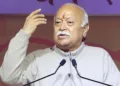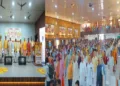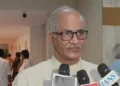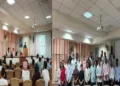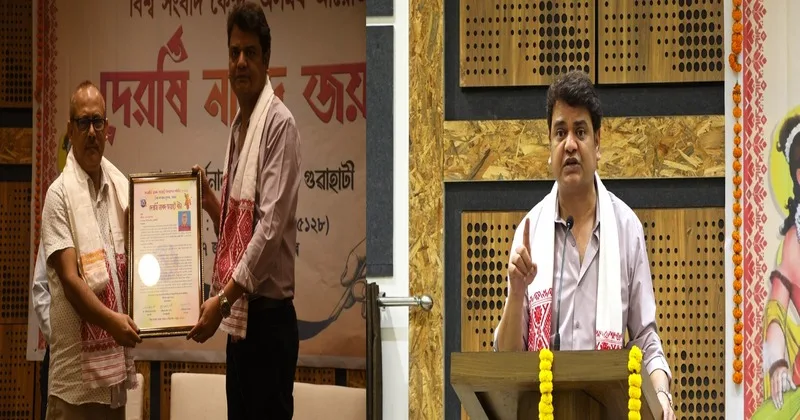
GUWAHATI: “Half-truths are far more dangerous in journalism than outright lies — and that the media must guard against them carefully”, Prakhar Shrivastava, Senior Consulting Editor and Anchor at Delhi Doordarshan Kendra, made this pointed observation while delivering the keynote address at a Narada Jayanti programme in Guwahati on June 7.
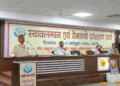
The event was organised by the Vishwa Samvad Kendra, Assam, at Sudarshanalaya in Guwahati. The highlight of the evening was the conferral of the prestigious Devarshi Narada Award to senior journalist Nava Thakuria, editor of Ishan Darpan. Three young journalists — Lakshyajyoti Gohain of NK TV, Ranjita Rabha of Pratham Khabar, and Mridul Haloi of Dainik Asam — were also specially felicitated.
RSS, partition, and a historical letter
Shrivastava spoke at length about the Rashtriya Swayamsevak Sangh, which is currently marking its centenary year. He pointed out that the media’s attitude toward the organisation has changed dramatically over the decades.
“While the media maintains a positive outlook toward the Sangh in today’s altered political landscape, such an attitude was rare in the past. When the media paid scant attention to the Sangh, founded in 1925, the nation was on the brink of partition. At that time, senior Congress leaders from Pakistan’s Sindh province migrated to India with their belongings. During that tumultuous period, RSS swayamsevaks risked their lives to rescue Hindus, Sikhs, and others targeted by fundamentalist attacks in Sindh,” he said.
He also referred to a letter written by then Defence Minister Baldev Singh to Home Minister Vallabhbhai Patel shortly after independence. According to Shrivastava, Sardar Patel had suggested placing the letter before the Cabinet — a letter that urged the government to support the Sangh’s rescue efforts for those stranded in Pakistan after Partition.
Nehru’s ban on RSS
Shrivastava offered a sharp and somewhat contrarian view on why Prime Minister Nehru banned the RSS after independence.
“Regrettably, these developments fueled resentment in Prime Minister Nehru’s mind. Nehru imposed a ban on the RSS not primarily due to the allegations surrounding Gandhi’s assassination, but rather out of displeasure over the rescue operations conducted by the Sangh in Pakistan during partition,” he remarked.
First victims of mob lynching
One of the most striking claims of the evening came when Shrivastava spoke about the violence that broke out following Mahatma Gandhi’s assassination.
“The first incident of mass lynching in independent India occurred in the wake of Gandhi’s assassination. This mass violence was perpetrated by a section of self-proclaimed Gandhians, and its first casualties were Dr Narayan Savarkar including the family of Veer Savarkar, who became the first in the country to pay the price of mass lynching,” he said.
Shrivastava also touched upon immigration patterns in Assam, tracing them back to the era of Sir Syed Muhammad Sadullah, and discussed the roles played by Moinul Hoque Choudhury and Fakhruddin Ali Ahmed in the demographic changes that followed.
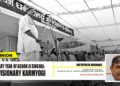
Accepting the award — which carried a cash prize of ₹50,000, a seleng sador, a citation, a portrait of Bharat Mata, and a bundle of books — Nava Thakuria said the figure of Narada holds deep relevance for journalists today.
He said that Narada, who created engagement through incisive questioning and well-meaning counsel, remains a guiding light for journalism. He also raised concern about how western models of journalism, focused on institutions and individuals, have gradually eroded India’s culturally rooted and nature-centric approach to news.
Kishore Shivam, Secretary of Vishwa Samvad Kendra, opened the programme with a brief overview of Devarshi Narada — describing him as a seeker of knowledge and an eradicator of flaws. He suggested that a closer study of Narada’s 84 Bhakti Sutras could enrich the goals of modern journalism.
The programme also featured the release of a souvenir and a rendition of Saraswati Vandana by Tribeni Bujarbaruah. Dr Gouranga Sarma, President of Vishwa Samvad Kendra, also addressed the gathering. The event was anchored by Nava Bujarbaruah and concluded with a vote of thanks by Guru Prasad Medhi. Over three hundred people from various walks of life attended the event.