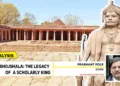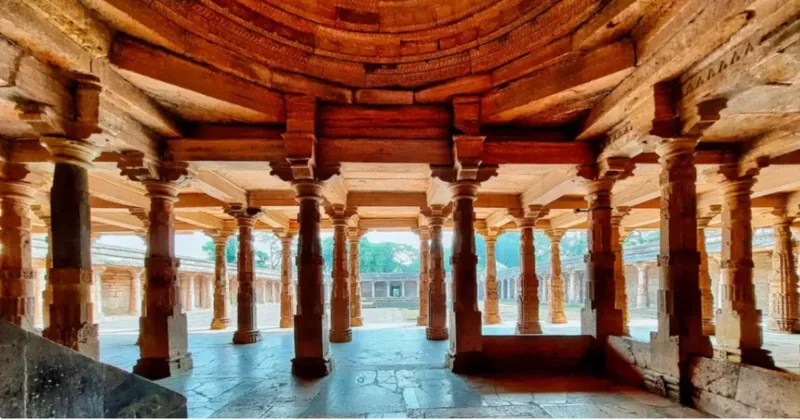
History is not merely an account of past events; it is the living soul of any nation and culture. Located in the southwestern part of the Dhar district in Madhya Pradesh, the historic ‘Bhojshala’ and the murti of ‘Vagdevi’ (Saraswati) that was once enshrined there bear witness to this glorious past and the archaeological grandeur of King Bhoj during the Paramara period. The great poet Madan, in his immortal work ‘Parijata-Manjari’, referred to this place as ‘Bharati-Bhavan’. It was not just a temple, but a radiant center of India’s intellectual and educational tradition. Having endured the cruel blows of time and foreign invasions, it is now moving forward to reclaim its pristine glory.
The School of Wisdom: Where Pillars Taught Grammar
During the reign of King Bhoj, the city of Dhara shone splendidly with its eighty-four intersections and crossroads, rivaling the abodes of the gods. The land, which had been vibrant with sweet poetic verses since the time of Vagpatiraj Munjadev, became a sanctuary for poets under the royal patronage of Bhoj.
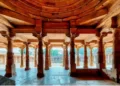
Currently, the inscriptions carved on two distinct grey limestone pillars supporting the dome of the prayer hall near the tomb of the Kamal Maula Mosque are no ordinary carvings. These inscriptions are of immense educational interest, reflecting the public’s deep-rooted interest in learning and teaching Sanskrit grammar.
The notes of historian K.K. Lele fascinatingly corroborate this fact. In his words:
“These must have been definitely prepared by some talented teacher and permanently engraved on the pillars, just like charts in modern schools… They confirm the tradition that this monument occupied by invaders (on whose pillars these are engraved) was merely a modified form of the Sanskrit school (shala) established by King Bhoj and managed by his successors. The old foundations tell the same story. Therefore, there is no doubt that the current monument was not only constructed from the demolished materials of the old shala but stands exactly where the old school once stood.”
This assembly hall (Sabhamandapa) featured a magnificent dome adorned with beautiful celestial nymphs (Apsaras). On either side, two pillars bore the ‘Nagabandha’ (serpentine loops) designs, which introduced students to the alphabet, inflections, and suffixes. Students practicing Sanskrit and Prakrit studied here. Ample space was left in the center of the temple assembly hall, and today’s ruins indicate that this assembly hall must have originally been a hundred-pillared structure (Shatastambhi). The architecture of this temple was distinct from other temples because deity worship was not the sole primary activity here; rather, it was a regular venue for education and assemblies of scholars.
King Bhoj himself, while classifying buildings in his monumental treatise on architecture, ‘Samarangana-Sutradhara’, described various types of assembly halls such as ‘Nanda, Jaya, Purna, Bhavita, Pravara, and Vikata’, stating that the structure should be square with chambers appropriately named. According to its architectural design:
- The east-facing entrance chamber is named Nanda
- The southeast is Bhavita
- The south is Bhadra
- The southwest is Daksha
- The west section is Jaya
- The northwest is Pravara
- The north is Purna
- The northeast is Vikara (Vikata)
Given the dimensions of Bhojshala—175 feet long and 160 feet wide—it appears highly probable that the idol of the Goddess was consecrated in this ‘Jaya’ chamber.
The Cruelty of History and the Scars of Invaders
This grand complex suffered severe damage historically, primarily inflicted by Mahmud Ghaznavi in 1305 CE and other subsequent invaders. Today, only the rectangular base remains intact; the rest of what is visible is reconstruction following the destruction. Only the upper dome section of the assembly hall was spared to keep the structure standing, but all the Apsaras on that dome were brutally destroyed.
According to references in historical chronicles, tablets inscribed with Dhanapala’s poetry were fixed onto the walls of the ‘Saraswatikanthabharana-Prasada’. The ‘Prabhavaka-Charitra’, specifically in the ‘Suracharya Charit’, also mentions that this was a school where the grammar formulated by King Bhoj was studied. Today, the reality is that hundreds of these original inscriptions lie scattered across the floor of the main chamber. While the general public calls this palace ‘Bhojshala’, the Prabhavaka-Charitra refers to it as the ‘Pathshala’, ‘Vagdevi-Kula Sadan’, or ‘Bhoj-Sabha’, and its presiding deity is addressed as ‘Vagdevi’ or ‘Bharati’.
The Captive Vagdevi in the British Museum Awaits an Early Return
Roughly 100 years ago, a British officer discovered an idol among the rear ruins of Bhojshala and took it back to England. There, the complete collection went to an individual named ‘Hindu Stuart’, who later donated it to the Queens Museum. This museum eventually transformed into the British Museum. No other specific information regarding its acquisition is available in the records of the British Museum.
Dr VS Wakankar of Ujjain, who visited the British Museum in August 1961 and examined the inscription on this idol, presented a paper on it during the ‘Bhoj Seminar’ organized in Ujjain in 1970. He had personally visited the British Museum on August 28, 1961, took photographs, and brought back a pencil rubbing of the inscription etched on the pedestal.
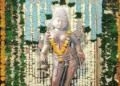
According to iconographic texts, the idol does not possess three eyes (Trinetra). Makrana marble was chosen for its construction specifically due to its pure white complexion. The inscription on the pedestal of the idol refers to it as ‘Vindhyadhari’ and the ‘Vagdevi Pratima’.
Marvel of Craftsmanship: Mathematical and Iconographic Measurements of the Vagdevi Idol
To preserve the historical authenticity intact, the precise scientific and iconographic measurements of this timeless idol are provided below verbatim, serving as irrefutable evidence of its historical grandeur:
The Slab and Pedestal: The idol is sculpted from Makrana marble. The inscription at the lower pedestal is etched on a base measuring 12” × 4”.
Grooves of the Inscription: There are two grooves on either side of the inscription. In the second groove on the left, an image of a woman is carved in the Apabhramsha style, with the word ‘Sote’ inscribed above it.
Core Measurements:
- Height of the idol: 4” (Note: As per the reference text)
- Thickness of the idol: 9”
- Inscription tablet: 12” × 4”
- Second tablet: 2 ⅓” × 4”
- Third tablet: 2 ¼” × 4”
- Height of Bhojraj: 14 ½”
- Height of Mahakumar: 8 ½”
- Height of the Lion: 6 ½”
- Child seated on the Lion: 14”
- Crown (Mukut): 4 ½”
- Face: 5” × 4 ½”
- Neck (Griva): 1 ½”
- From neck to mid-breast: 3”
- Distance between breasts: 4 ½”
- Nipple measurements: 3 ½” × 3 ½” and 3 ½” × 3 ½”
- Width of shoulders: 10 ½”
- Mid-arm: 5”
- Armlet (Bhujabandh): 2 ½”
- Forearm: 6”
- From mid-breast to navel: 6”
- From navel to pelvic region: 7”
- Narrow part of the waist: 6” (Diameter: 19”)
- Hip portion: 8 ½” (Diameter: 30”)
- Feet: 1” × 9”
Ornamentation and Form
Crown and Ears: The Kirit crown is adorned with 4 rows of beads and three rows of precious gems, with a string of pearls at the lower section, designed in a conical shape. Behind the idol, on the right side, the hair is tied (Keshabandha), and the upper part of the right ear is broken. The left ear features an ornament at the top connected by two beaded bands and dangling pearls, while both ears feature ear-rings (Karnakundal) at the bottom.
Necklace and Girdle: There is no traditional neck-collar (Graiveyaka). Instead, an ornament combining three strings of pearls hangs down the upper chest from the neck, which splits into two pearl strings and a dangling pendant between the breasts. Below, there are three rows of waist girdles (Katibandha Mekhala), and from the lowest girdle, four bell-shaped segments of a Kanchipatnam hang in a semi-circular fashion. Pearl strings hang down the center to below the knees, beneath which lie the folds of the drapery.
Hands and Legs: The legs are draped in a Sakachha garment, adorned with four anklets and a pair of Manjeeras (tinkling anklets). Similar ornaments are present on the figures of Bhoj, the Mahakumar, the child riding the lion, and the garland-bearing Gandharvas (the Gandharva on the left side of the idol has been destroyed). The idol is in a standing posture, exhibiting the Tribhanga (triple-bend) pose. It possesses four arms, out of which the lower two are broken. The upper right hand holds a writing case or inkstand (this is definitely not a Veena, but rather a long pen-case or an ankush), while the object in the left hand is broken.
Traces of Colour: Deep red and golden colors were applied to the forehead of the idol, traces of which are still visible today. The eyes were painted black, and light black paint can still be seen on the eyebrows and the contours of the eyes.
Attendant Figures: The bearded Ayudhapurusha (personified weapon) standing to the right of Saraswati is presumably holding a Veena, whose staff is still partially visible, and a portion of the circular base of the gourd resonator can be seen 2 to 3 inches near the head. This figure appears to be King Bhoj himself, as he wears a Kirit crown and possesses a beard. All Paramara-era donor statues recovered from this period (from Un, Dhar, Ujjain, Dharampuri, etc.) feature similar beards. The boy standing in front of him resembles theatrical Ayudhapurushas and holds a coconut (Shriphal) in his hand, representing the Mahakumar.
Ultimately, following continuous efforts and judicial investigations, it has been confirmed that this monument was an unparalleled center of education—a school built by King Bhoj for the followers of Hinduism during the Paramara period. Through judicial evidence, this monument has been officially declared to be a Sanskrit school of Hinduism and a temple dedicated to Vagdevi.
In fact, across the entire length and breadth of India, there are numerous such inscriptions and monuments that were vandalized by invaders. May their exploration continue systematically, so that the true history and archaeology of India stand as an inspiring example for generations to come.