In a landmark judgment delivered on May 15 2026, the Indore Bench of the Madhya Pradesh High Court recognized Bhojshala as a temple dedicated to Goddess Vagdevi (Saraswati). The court set aside the long-standing administrative arrangement that had permitted Friday namaz at the adjoining Kamal Maula structure and directed the central government and the Archaeological Survey of India (ASI) to manage the monument accordingly. The ruling followed the ASI’s scientific survey, which reported evidence of an earlier temple structure and inscriptions associated with Sanskrit learning.
Bhojshala: A contested yet clear History
K.m munshi in his book, Glory That Was Gurjaradesa wrote “During Bhoja rule civilization of Malwa had risen to a magnificent pitch. Our appreciation for Bhoja for having portrayed a faithful picture of the most glorious period of medieval history is heightened when we take into consideration that he worked and stood for all that was glorious in Hindu culture.”
Raja Bhoja is traditionally believed to have established the Bhojshala at Dhar–then known as Dhāranagari–in 1034 CE. This institution is referred to in historical and literary sources as Saraswati Kanthabharana and, in some traditions, as Sharada Sadan, both names reflecting its association with Goddess Saraswati and the cultivation of learning. According to Bhagwatilal Rajpurohit in his book Bhojraj, Raja Bhoja founded three such centres of learning in Malwa: the first at Ujjain, the second at Dhar, and the third at Mandu.
In Ujjain, the original Bhojshala identifies with the site now known as the “Bina Neev ki Masjid,” located about one kilometre from the Mahakaleshwar Jyotirlinga. The popular name “Bina Neev” (“without foundation”) is interpreted in this account to suggest that the later structure stood upon the remains of an earlier educational and sacred complex.
The third Bhojshala is associated with Mandu. At one end of the Shahi complex stands the tomb of Dilawar Khan, built in 1405. The Vikram Smriti Granth, in a chapter titled “Ancient Remains of Mandav,” notes that when the southern wall of the tomb collapsed, several black-stone inscription fragments were found, along with numerous sculptural remains, including images of Nataraja Shiva and various goddesses. A broken image of Saraswati was reportedly discovered at the same site. These findings have been cited as evidence that the structure incorporated materials from an earlier temple and centre of learning. Supporting this view, Major C. E. Luard, in his 1912 work Dhar and Mandu, observed that the construction materials used in Dilawar Khan’s tomb strongly suggested the presence of a pre-existing Hindu temple at the site.
In 1269 AD, a Muslim fakir named Kamal Moulana reached Malwa and initiated the Islamic onslaught. He spent 36 years gathering comprehensive information about the Malwa region, which he later provided to Alauddin Khilji. In 1305 AD, Alauddin Khilji attacked and sacked Malwa, including Bhojshala, where thousands of teachers and students were reportedly killed.
In 1514 AD, Mehmud Shah attacked Bhojshala and attempted to convert it into a dargah. He encroached upon the land outside the Saraswati Temple and built the Kamal Moulana Makbara, 204 years after the death of Kamal Moulana. It is on this basis that a claim was later advanced to portray Bhojshala as a dargah.
In 1703 AD, Malwa was captured by the Marathas, ending the long and unjust rule of the Muslim rulers. In 1826 AD, however, the East India Company conquered Malwa. During an excavation in 1875, the Vagdevi idol was discovered by British officer Major General William Kincaid and was taken to England between 1886 and 1891.
In 1934, the princely state of Dhar, following repeated requests to offer namaz at Bhojshala due to limited space outside the Kamal Maula Dargah, sought permission from the ruler to use the Bhojshala complex on Fridays for prayers. The ruler granted this permission. This marked the beginning of Friday namaz at the complex and later became a major source of contention between Hindus and Muslims. In 1952, Hindus began efforts to regain full access to Bhojshala.
In 2003, following an order by the Archaeological Survey of India, the Hindu community was granted permission to worship every Tuesday and on Vasant Panchami, while Muslims were permitted to offer namaz every Friday. This arrangement continued until the latest High Court order, in which the court granted full access to Hindus and recognized the complex as a Hindu structure.
Patthar Gawāhī Denge
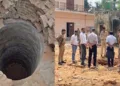
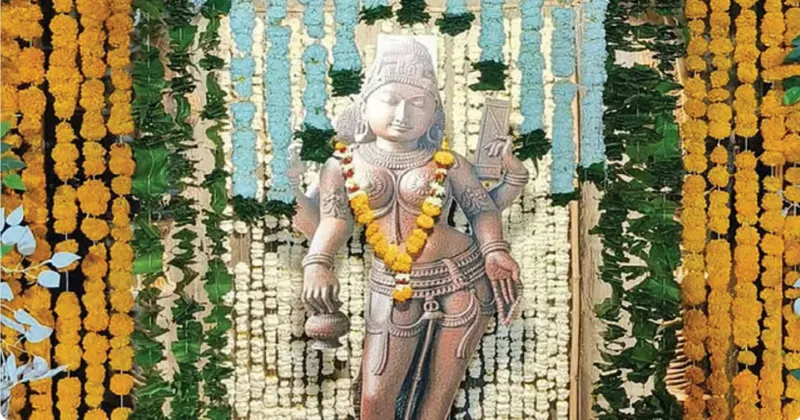
The 2024 survey conducted by the Archaeological Survey of India (ASI) at the Bhojshala complex became a major basis for the recent court judgment, which held that the Bhojshala of Dhar was a Hindu complex. The excavation uncovered 94 intact sculptures, including depictions of Bhagwan Vishnu Vishnu, Bhagwan Ganesha, Bhagwan Shiv, Parvati maa, and Nataraja. In addition, around 1,700 relics were reportedly discovered during the survey, including a damaged image of Vagdevi (Goddess Saraswati).
The survey further found that many of the pillars were richly ornamented with detailed carvings depicting armed deities, as well as human and sacred animal figures. Decorative murals portraying lions and other human and animal motifs were identified across different sections of the complex. Although some of these artistic elements had suffered damage over time, a substantial number remained preserved, offering important evidence of the site’s artistic and cultural legacy.
The survey also documented inscriptions such as “Om Namah Shivaya” and “Om Saraswatyai Namah” carved into the architecture in Pali and Sanskrit. In addition, some inscriptions in Brahmi script were found, indicating that Dhāranagari had long been a centre of learning in central India. The ASI also discovered a Kaal Sarpa Yantra, suggesting that the study of astronomy was practiced at the site. On the basis of this archaeological, epigraphic, and sculptural evidence, the ASI concluded that Bhojshala was originally a Hindu complex.
Continuity of Tradition
Coloniality often persists through what may be called “managed multiculturalism,” wherein indigenous claims are diluted into state-regulated arrangements that reduce sacred knowledge traditions and civilizational spaces to mere museum artifacts or shared utility zones. The case of Bhojshala reflected precisely this condition. However, the recent High Court judgment granting exclusive access to Hindus has the potential to strengthen those centres where knowledge traditions have endured for thousands of years.
With the restoration of Bhojshala, attention must now turn to other sites that once served as major centres of vidyā and Sanatani culture. As noted above, Raja Bhoja is believed to have established two other Bhojshalas in Mandu and Ujjain. Similarly, sites such as the Bijamandal Temple in Vidisha and other ancient centres of learning deserve renewed scholarly and cultural focus. Reviving these institutions is essential to healing the epistemic and cultural genocide that has unfolded on the land of Bharat over the past millennium.