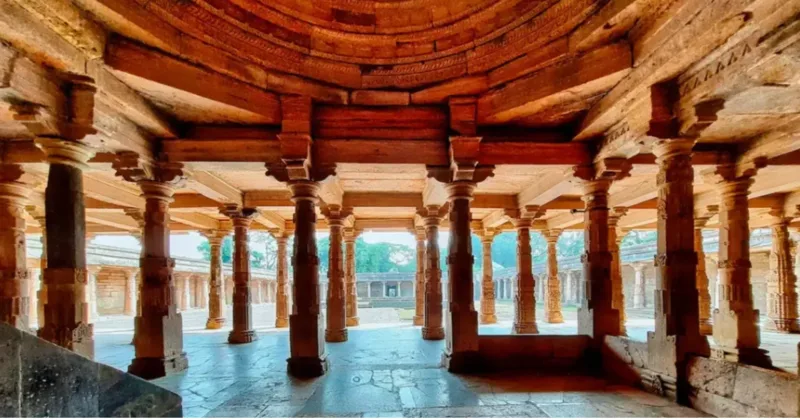
The recent developments surrounding the Bhojshala complex in Dhar have reignited a national conversation about history, heritage, and civilisational memory in India. For many Indians, Bhojshala is not merely an archaeological site or a disputed structure. It represents a deep cultural connection with India’s intellectual and spiritual traditions, especially the legacy of Raja Bhoj, one of medieval India’s most celebrated rulers. The verdict and the discussions emerging around it are being viewed by many as part of a larger process through which India is reclaiming its cultural prestige and rediscovering neglected chapters of its own past.
Bhojshala has long been associated with learning, Sanskrit scholarship, and the worship of Saraswati Maa. Historical accounts and local traditions describe it as a renowned centre of education established during the Paramara period under Raja Bhoj. Over centuries, the structure underwent political and architectural changes, eventually becoming a site of contestation between communities. Yet despite historical disruptions, the memory of Bhojshala as a sacred and scholarly space survived among local devotees and cultural historians. This persistence of memory is significant because it reflects the resilience of Indian civilisation even after repeated invasions, destruction, and political transformations.
The Bhojshala issue also highlights the growing importance of archaeology and historical evidence in public discourse. In recent years, India has witnessed increasing interest in the historical origins of several sacred sites. Archaeological surveys, inscriptions, architectural motifs, and textual records have become central to understanding the layered histories of these places. In the case of Bhojshala, supporters of the temple claim have consistently argued that the site bears unmistakable signs of a pre-existing Hindu structure connected to Saraswati worship and classical learning traditions.
For decades, discussions surrounding such sites remained confined to academic circles or local activism. However, the changing cultural atmosphere in India has brought these debates into mainstream national consciousness. Many Indians now seek a more confident engagement with history, one that acknowledges both the achievements and the wounds of the past. The Bhojshala verdict is therefore being interpreted not simply as a legal development, but as a symbolic moment in the broader journey of cultural recovery.
The significance of Bhojshala extends beyond religion alone. It speaks to the restoration of intellectual heritage and cultural continuity. Raja Bhoj occupies a special place in Indian history because he symbolised the fusion of governance, scholarship, architecture, and artistic patronage. His reign is remembered for promoting Sanskrit literature, philosophy, astronomy, medicine, and temple architecture. The revival of interest in Bhojshala consequently reflects a renewed appreciation for India’s indigenous knowledge systems and educational traditions. In an era when nations across the world are seeking to reconnect with their civilisational roots, India too appears determined to preserve and celebrate its historical inheritance.
Critics often argue that revisiting historical disputes risks creating social tensions. While social harmony remains essential, it is equally important to recognise that genuine reconciliation cannot emerge from the denial of historical experiences. Across the world, societies have attempted to confront painful histories through preservation, acknowledgment, and restoration. India’s engagement with sites like Bhojshala should therefore be viewed through the lens of cultural introspection rather than hostility. For many citizens, acknowledging the historical transformation of sacred spaces is part of a larger effort to reclaim dignity and historical truth.
The Bhojshala discourse also reveals a shift in India’s intellectual confidence. Earlier, many discussions concerning temple destruction, cultural displacement, or civilisational trauma were dismissed as politically inconvenient or academically unfashionable. Today, however, there is a visible willingness to examine historical evidence more openly. This shift does not necessarily imply hostility toward any community. Instead, it reflects the aspiration of a society that wishes to understand its own history honestly and without inherited colonial frameworks.
India’s civilisational identity has always been deeply connected to its sacred geography. Temples, pilgrimage centres, monasteries, rivers, and learning institutions have historically shaped social life and collective consciousness. When these spaces were damaged, transformed, or erased, communities often carried the memory of loss across generations. The endurance of such memory demonstrates the extraordinary continuity of Indian civilisation. Despite centuries of political upheaval, the cultural imagination of the country remained intact through rituals, stories, festivals, and local traditions.
The renewed focus on Bhojshala also coincides with India’s broader cultural resurgence on the global stage. In recent years, the country has increasingly projected its civilisational heritage through initiatives promoting yoga, Ayurveda, Sanskrit studies, traditional arts, and heritage conservation. International interest in India’s ancient knowledge systems has expanded significantly. Simultaneously, there has been growing domestic interest in preserving temples, manuscripts, monuments, and forgotten historical narratives. The Bhojshala verdict fits naturally into this larger atmosphere of cultural revival.
Importantly, cultural restoration should not be misunderstood as an attempt to rewrite history selectively. Rather, it should encourage a fuller understanding of India’s past in all its complexity. A mature civilisation does not fear historical inquiry. It embraces evidence, encourages debate, and preserves memory while remaining committed to democratic values and peaceful coexistence. India’s strength has always rested in its ability to absorb diversity while retaining civilisational continuity. That continuity is precisely what many people see reflected in the Bhojshala issue.
For younger generations, the Bhojshala debate offers an opportunity to engage more deeply with India’s historical consciousness. It encourages students, researchers, and writers to explore neglected archives, regional histories, temple architecture, and indigenous scholarship traditions. Such engagement is essential because nations derive confidence not merely from economic growth or military power, but also from cultural self-awareness. Civilisations that lose touch with their historical roots often struggle to sustain intellectual confidence in the modern world.
Ultimately, the Bhojshala verdict represents more than a dispute over land or architecture. It symbolises the persistence of memory, the revival of historical inquiry, and the desire of a civilisation to reconnect with its own foundations. For many Indians, it marks another step in reclaiming cultural prestige after centuries of disruption and erasure. The conversation surrounding Bhojshala reflects a nation attempting to reconcile history with modernity while preserving the continuity of its ancient identity. In that sense, Bhojshala stands not only as a monument of the past, but also as a reminder that civilisations survive through memory, resilience, and the courage to rediscover themselves.
The broader public response to Bhojshala also demonstrates how heritage has become central to contemporary Indian identity. Young Indians increasingly seek stories that inspire pride in the country’s philosophical depth, artistic achievements, and civilisational endurance. The rediscovery of sites linked to ancient learning and worship fulfils that emotional and intellectual aspiration. It reminds citizens that India was not merely a geographical entity but a flourishing cultural civilisation that contributed significantly to mathematics, philosophy, linguistics, architecture, spirituality, and governance. In this context, Bhojshala has emerged as a powerful symbol of continuity between India’s past and present. The growing demand for preserving such spaces reflects an evolving national consciousness that values cultural confidence alongside economic and technological progress. By protecting heritage and acknowledging historical realities with sensitivity, India can continue building a future rooted in memory, dignity, and civilisational self-respect.
Such conversations ultimately strengthen democratic engagement with history because they encourage research, debate, preservation, and public participation in safeguarding monuments that embody India’s enduring cultural and intellectual inheritance.